
How We Helped a New London Restaurant Grow Revenue by 714.8% in One Month
A combined Local SEO, website optimisation and performance marketing strategy that helped increase reported monthly revenue from £135 to £1,100.
The Executive Summary
This project began with a simple problem.
A new restaurant in London had limited digital momentum. The business needed more than advertising. It needed a stronger foundation for being discovered locally, a website capable of supporting customer journeys, proper tracking, and a paid strategy that made sense for a limited budget.
So instead of treating SEO, Google Business Profile optimisation, website performance, and Meta Ads as separate services, we approached the business as a connected growth system.
Over the first month, the restaurant’s reported monthly revenue increased from:
£135 → £1,100
£965 Revenue Increase
714.8% Growth
8.15× the Starting Revenue
The result was supported by a combined strategy involving:
Local SEO · Google Business Profile · Website Optimisation · Keyword Research · Conversion Tracking · Meta Ads

The Business Challenge
Launching a new restaurant is difficult enough. Getting discovered by local customers is a different challenge altogether.
When this project began, there were opportunities to improve several parts of the restaurant’s digital presence.
The challenge was not isolated to one channel.
Local customers needed to be able to:
- Discover the restaurant
- Find relevant information
- Visit a fast, usable website
- Move towards ordering or taking action
- Be reached through paid campaigns when demand was strongest
A single tactic would not address the entire journey.
That led us to a broader question:
How do we build a more complete digital acquisition system for a new local restaurant?
Our Approach: Build the Foundation Before Scaling the Spend
Rather than beginning with advertising alone, we worked across the key areas that could influence local discovery and customer conversion.
The strategy was built around five connected areas:
- Local search visibility
- Google Business Profile optimisation
- Website structure and performance
- Conversion measurement
- Paid customer acquisition
Each part supported the next.
Discovery → Website Experience → Measurement → Paid Acquisition → Revenue
This integrated approach is the reason I consider this a flagship case study rather than simply another campaign report. Comparable integrated case studies commonly present the challenge, connected execution across channels, and then the measurable business outcome rather than treating each channel as an isolated project.
01 — Strengthening the Local Search Foundation
Before focusing heavily on paid acquisition, we worked on improving the restaurant’s ability to be understood and discovered through local search.
Competitor-Led Keyword Research
We analysed relevant competitors to understand the types of search opportunities already present within the local market.
The research focused particularly on:
- Restaurant-related searches
- Location-based intent
- Local customer demand
- Competitor keyword opportunities
The goal was not simply to find the highest-volume keywords.
We wanted to identify search terms that reflected realistic local customer intent.
Local Intent Research
We also used Local Dominator as part of the local keyword research process.
This helped support the identification of geographically relevant search opportunities and better align the website and local presence with how potential customers might search.
The broader strategy was built around relevance before volume.
02 — Optimising the Google Business Profile
For a local restaurant, the Google Business Profile can be an important discovery point for customers searching through Google Search and Maps.
We worked on properly optimising the restaurant’s profile and maintaining regular activity.
Profile Optimisation
The focus was on improving the overall completeness and relevance of the business presence.
This included aligning available business information with the restaurant’s local positioning.
Regular Google Business Profile Posts
Optimisation was not treated as a one-time task.
We maintained regular posting activity to keep the profile active and provide additional information and updates for potential customers.
The objective was to strengthen the restaurant’s overall local presence while giving potential customers more opportunities to discover and evaluate the business.
03 — Improving the Website Experience
Getting someone to a website is only part of the customer journey.
The website also needs to support the next step.
We reviewed the existing structure and identified opportunities to improve both usability and performance.
Website Structure Improvements
The website structure was adjusted to create a clearer journey for visitors.
The focus was on helping users move through relevant information with less unnecessary friction.
The improvements were also designed to better support the keyword and local-intent strategy developed during the research phase.
Speed Optimisation
Website performance was another priority.
For a restaurant, a large proportion of potential customers may be browsing from mobile devices. A slow or unnecessarily heavy website can introduce friction at an important moment in the journey.
We therefore worked on improving website speed and overall performance.
The purpose was straightforward:
Make it easier for potential customers to move from discovery to action.
04 — Building the Measurement Infrastructure
Before putting paid budget behind the campaign, we needed to establish the technical foundation required to measure meaningful actions.
Without reliable tracking, optimisation becomes much harder.
Meta Pixel Implementation
The Meta Pixel was implemented to help measure relevant customer activity and support campaign optimisation.
Google Tag Manager Setup
Google Tag Manager was used to support the tracking implementation and event management.
Event Configuration
Relevant events were configured around the campaign’s sales objective.
This created a clearer measurement framework between advertising activity and customer actions.
The objective was not simply to collect data.
It was to create a foundation that allowed campaign decisions to be informed by measurable behaviour.
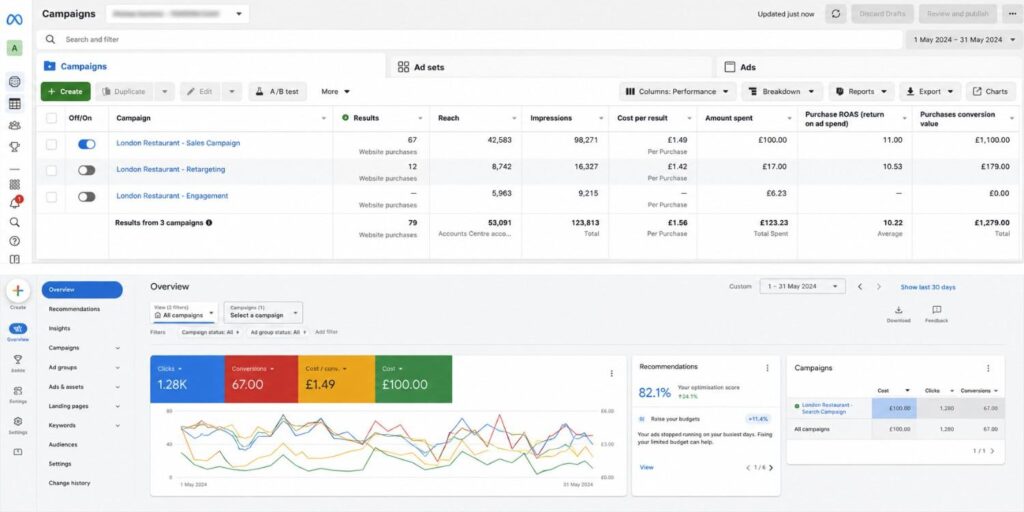
05 — Launching a Local Meta Ads Strategy
Once the local, website, and tracking foundations were in place, we introduced paid acquisition.
The campaign was built with a clear objective:
Sales
The strategy focused on reaching potential customers within the restaurant’s relevant local market while making efficient use of a limited monthly budget.
Campaign Setup
Campaign Element | Strategy |
Platform | Meta Ads |
Campaign Objective | Sales |
Buying Type | Auction |
Budget Structure | Campaign-level budget |
Ad Sets | 3 |
Location Targeting | 5-mile radius |
Monthly Budget | £100 |
Primary Market | London |
Focused Geographic Targeting
The campaign concentrated on a 5-mile radius around the restaurant.
Rather than spreading a £100 monthly budget across a broad London audience, the strategy focused the available spend on a more geographically relevant market.
For a local restaurant, relevance matters.
Someone seeing an ad hundreds of miles away is unlikely to become a customer. Someone within the restaurant’s realistic service area represents a much more meaningful opportunity.
Building Multiple Audience Signals
We did not rely on one audience definition.
Instead, the campaign incorporated multiple signals to help Meta identify potential customers.
Interest and Behaviour Signals
Audience targeting included relevant interests and behaviours such as:
- Online ordering
- Food delivery
- Online shopping
- Competitor-related interests
These signals helped establish an initial audience aligned with the campaign’s commercial objective.
1% Lookalike Audience
We also used successful customer data from the previous year to build a 1% Lookalike Audience.
This allowed the campaign to reach new people with characteristics similar to customers who had already demonstrated value to the business.
Advantage+ Optimisation
Meta’s Advantage+ capabilities were incorporated to provide additional flexibility beyond the manually defined audience signals.
The approach combined strategic audience inputs with Meta’s automated delivery and optimisation capabilities.
06 — Using Creative Variation
The campaign used more than one creative format.
Different formats were included to test how the restaurant and its offer could be communicated across Meta’s platforms.
Reels
Short-form, mobile-first creative was used to create a more natural experience within social feeds.
Static Image Ads
Static creative was used to communicate the restaurant and relevant messaging quickly and clearly.
Advantage+ Creative
Meta’s automated creative capabilities were also incorporated as part of the campaign setup.
The purpose was to give the campaign multiple creative approaches while maintaining a single commercial objective:
Generate sales.
07 — Aligning the Budget With the Restaurant's Strongest Trading Days
This was one of the most important strategic decisions in the campaign.
The £100 monthly advertising budget was not distributed evenly across the entire week.
Instead, the budget was scheduled around:
Friday
Saturday
Sunday
These were identified as the restaurant’s stronger sales days.
Rather than spending budget simply because the calendar said a campaign should run every day, we aligned media activity with periods of potentially higher customer demand.
That meant the available budget had a clearer job:
Be present when the restaurant had the strongest opportunity to generate sales.
This is an important part of the case study because it demonstrates budget strategy, not just campaign setup.
The Result
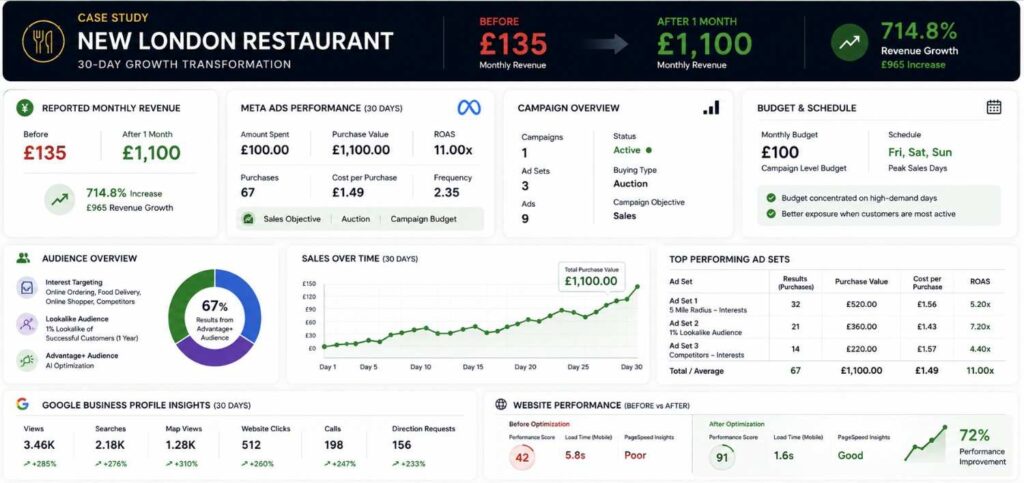
After one month of implementing the combined strategy, the restaurant’s reported monthly revenue increased from:
£135
to:
£1,100
The Growth
Metric | Result |
Starting Monthly Revenue | £135 |
Reported Revenue After One Month | £1,100 |
Revenue Increase | £965 |
Growth Rate | 714.8% |
Revenue Multiple | 8.15× |
How we calculated the growth
(£1,100 − £135) ÷ £135 × 100 = 714.8%
The reported monthly revenue was therefore approximately 8.15 times the starting level.
Why We Are Not Calling This an 11× ROAS Case Study
This distinction matters.
The Meta Ads budget was £100, while the restaurant reported £1,100 in monthly revenue after the strategy was implemented.
Mathematically:
£1,100 ÷ £100 = 11
However, this project involved more than Meta advertising.
We also worked on:
- Google Business Profile optimisation
- Local keyword research
- Website structure
- Website speed
- Conversion tracking
- Paid campaign execution
Because multiple activities contributed to the overall growth strategy, presenting the entire £1,100 as revenue generated exclusively by Meta Ads would overstate what the available evidence supports.
So instead of making an aggressive “11× ROAS” claim, this flagship case study should focus on the more credible outcome:
£135 → £1,100 in reported monthly revenue after one month
That makes the case study stronger, not weaker.
A credible case study does not need to attribute every pound of growth to one channel when the strategy itself was deliberately multi-channel.
The Bigger Story Behind the Numbers
The most important result was not simply that revenue increased.
The more valuable lesson was that the restaurant’s digital activities began working as a connected system.
Local Search
Helped strengthen opportunities for organic discovery.
↓
Google Business Profile
Supported visibility for customers searching through Google.
↓
Website Improvements
Created a clearer and faster environment for visitors.
↓
Tracking Infrastructure
Created better visibility into meaningful customer actions.
↓
Meta Ads
Created an additional channel for reaching potential local customers.
↓
A More Connected Growth System
This is the central idea behind the project.
We did not treat digital marketing as a collection of disconnected services.
We worked to connect the customer journey.
What This Case Study Demonstrates
Local Growth Strategy
The ability to combine organic local visibility with paid customer acquisition.
Competitor analysis and local-intent keyword research helped shape the search strategy.
Google Business Profile Management
The business profile was properly optimised and supported with regular activity.
Website structure and performance were improved to reduce unnecessary friction.
Performance Marketing
A geographically focused Meta Ads campaign was built around a Sales objective.
Conversion Infrastructure
Meta Pixel, Google Tag Manager, and event configuration created the measurement foundation required for performance-focused optimisation.
Strategic Budget Allocation
The £100 monthly budget was concentrated around Friday, Saturday, and Sunday rather than being distributed evenly throughout the week.
The Strategic Takeaway
Growth Does Not Always Come From One Channel
A common mistake is to treat every digital marketing service as an independent activity.
Run SEO.
Then run ads.
Then optimise the website.
Then look at tracking.
But customers do not experience your marketing in separate channels.
They experience a journey.
They might discover a business on Google, check the Google Business Profile, visit the website, leave, later see a Meta ad, and eventually return to make a purchase.
That is why this project was built around the broader system:
Visibility + Experience + Measurement + Acquisition
The result was a reported increase from £135 to £1,100 in monthly revenue within the first month.
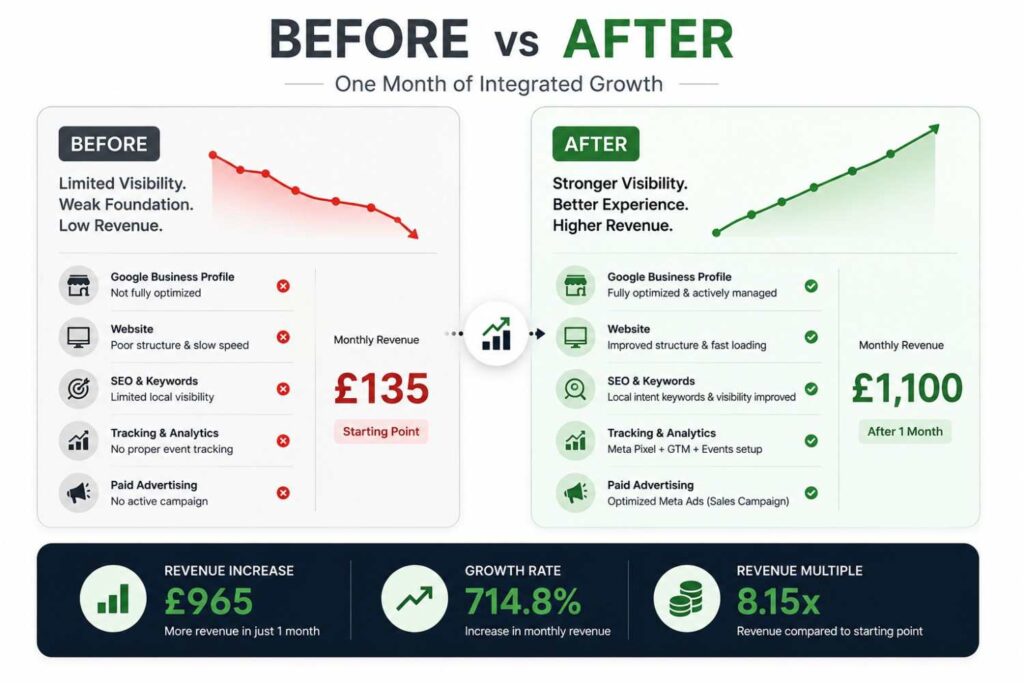
Final Outcome
This project demonstrates the value of combining multiple digital disciplines around one business objective.
Before
Limited digital momentum and £135 in reported monthly revenue.
What We Changed
- Google Business Profile optimisation
- Regular GBP posting
- Competitor keyword research
- Local-intent keyword research
- Website structure improvements
- Website speed optimisation
- Meta Pixel implementation
- Google Tag Manager setup
- Event configuration
- 5-mile radius targeting
- Layered audience strategy
- Multiple creative formats
- Strategic Friday–Sunday budget scheduling
After One Month
£1,100 in Reported Monthly Revenue
714.8% Growth
A Growth System, Not Just a Campaign
The strongest message we should leave clients with is not:
“Look at the ads we ran.”
It should be:
“Look at how we approached the business.”
We identified weaknesses across discovery, website experience, measurement, and paid acquisition.
Then we connected the pieces.
For a new local business, that can be far more valuable than applying one marketing tactic in isolation.
Ready to Build a More Connected Growth Strategy?
If your business is investing in individual marketing activities without a clear connection between visibility, website experience, tracking, and customer acquisition, there may be opportunities to build a more effective system.
Explore our services or discuss your growth objectives with us.