
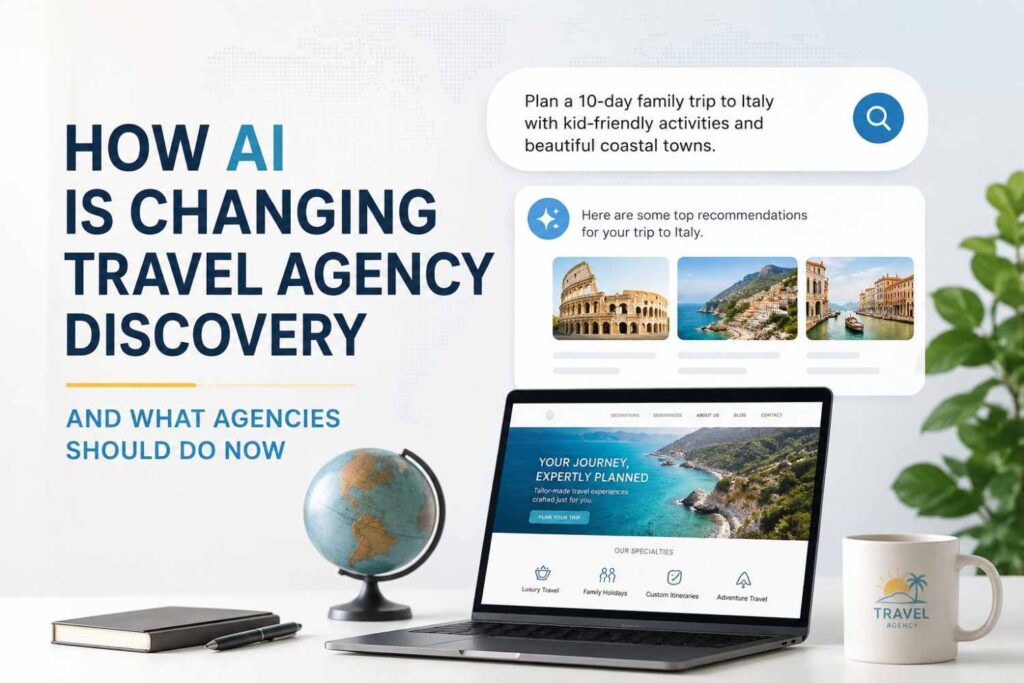
For years, travel agencies understood the basic mechanics of online discovery. A traveler searched for a destination or a travel service, opened several websites, compared itineraries and prices, checked reviews, and eventually decided whether to book independently or speak with an agency. That process has not disappeared, but another layer is beginning to shape how people research trips: conversational, AI-powered search.
Consider someone planning a two-week trip to Italy. Instead of running separate searches for family-friendly destinations, private tours, hotel recommendations, transportation options and travel advisors, they can now ask an AI-powered search tool to help them work through the entire problem. They might start with a broad question and then refine it based on the answer they receive.
For travel agencies, this creates a different kind of visibility challenge. Ranking for a traditional search term is still valuable, but it doesn’t necessarily tell you whether your business will be considered when a traveler asks a much broader question about what to book, where to go, or which company to trust.
Google’s AI search experiences are designed to handle more complex questions and can use related searches across different subtopics to build a broader response. At the same time, Google continues to emphasize that the fundamentals of SEO remain important for these experiences.
The opportunity for travel agencies, then, isn’t to abandon search as they know it. It is to understand how AI travel search is changing the discovery journey and make sure their expertise is visible throughout it.
The Travel Search Journey Is Becoming More Conversational
Travel is particularly well suited to conversational search because planning a trip rarely comes down to one simple question.
A traveler may need to think about the destination, time of year, budget, transportation, accommodation, activities, family requirements and the amount of planning they are willing to handle themselves. A search such as “best places to visit in Italy” might be useful at the beginning, but it doesn’t get someone very far when they are actually trying to build a realistic itinerary.
That is where conversational search becomes interesting.
A traveler could ask something closer to: I’m traveling to Italy with my parents for 12 days. We want to see Rome and Florence, spend some time on the Amalfi Coast, and avoid changing hotels every other night. What would you recommend?
The question contains much more than a destination keyword. It includes traveler type, duration, preferences, pace and practical constraints. The follow-up might ask about private transportation, suitable hotels or whether a particular route is realistic.
Google describes this broader research process through features such as AI Mode and query fan-out, where a complex question can lead to related searches across multiple subtopics before information is brought together into a response.
That matters because a travel agency’s opportunity may no longer begin with a traveler searching specifically for an agency. It can begin with the problem the agency is particularly good at solving.
From Search Results to Recommendations
Traditional search and AI-powered search approach discovery differently.
A conventional search gives the user a collection of pages to investigate. The user decides which results deserve attention and does much of the comparison themselves. An AI-powered experience can potentially do more of that interpretation before presenting the user with an answer.
For a travel agency, that distinction is significant.
Imagine an agency that simply describes itself as a full-service travel company offering flights, hotels, vacations and tours. Now compare it with an agency that clearly specializes in customized family travel from New York, has extensive experience planning European itineraries, works with private guides, and regularly handles complex multi-city trips.
Both may provide excellent service. But the second business has given customers—and the systems helping them research—a much clearer understanding of who it serves, what it knows and where its expertise is relevant.
This is why AI search visibility shouldn’t be reduced to the question of whether an agency can somehow “rank in ChatGPT.” The more useful question is whether the agency has built a digital presence that consistently communicates its expertise across the subjects and decisions that matter to its customers.
The Competition Is Getting Wider
Travel agencies have always competed with other agencies, tour operators and online travel agencies. AI-assisted discovery broadens that competitive environment because the information influencing a traveler’s decision can come from many different types of sources.
Depending on the question, a traveler might encounter information from an OTA, a hotel, an airline, a destination authority, a travel publication, a specialist tour operator, a review platform, a blogger or an experienced travel advisor.
This creates an important challenge for independent agencies. Having deep knowledge of a destination is valuable, but knowledge that exists only inside the business has limited marketing value. If that expertise isn’t reflected on the website, in useful content, in reviews, in professional profiles or through credible external sources, there is much less for customers and search systems to connect to the agency.
That makes digital representation of expertise increasingly important.
An agency that wants to be recognized for African safaris, luxury European travel or destination weddings should make those associations unmistakably clear throughout its digital presence rather than expecting a generic “travel agency” page to establish them.
What AI Needs to Understand About Your Travel Agency
Travel agencies do not need to build a separate “AI website” or fill their pages with special GEO terminology.
Google’s current documentation says there are no additional technical requirements or special AI markup required for eligibility in AI Overviews or AI Mode. Its guidance continues to emphasize the fundamentals of Search, including crawlability, useful content, internal linking, page experience and accurate structured data.
What does deserve attention is the clarity of the information already available about the business.
A potential customer should be able to understand from your digital presence what kind of travel you specialize in, which destinations you know particularly well, who you typically serve, where you operate, what services you provide and why your experience is worth trusting.
That information should not be scattered across an outdated About page, a few old blog posts and a third-party profile. It should form a consistent picture across your website and the wider web.
For a travel agency, that could mean making relationships such as these much clearer:
New York → Luxury Travel → Italy → Custom Itineraries → Family Travel → Private Experiences
Or:
California → Adventure Travel → East Africa → Safari Planning → Small Groups → Expert-Led Experiences
The specific combination will depend on the business. The principle is the same: make the agency’s expertise clear enough that both people and search systems can understand where it belongs.
Your Website Still Has a Critical Role to Play
It would be a mistake to think that AI discovery makes the agency website less important. In many cases, it makes the website more important because the website becomes the place where a recommendation is evaluated.
A traveler may encounter an agency while researching a destination through an AI-powered search experience. The next step could be a visit to the agency’s website, where the traveler wants to see evidence that the recommendation makes sense.
Is the agency actually experienced with this type of trip? Does it understand the destination? Are there examples of similar itineraries? What do previous clients say? Is the process clear? What happens after submitting an inquiry?
A website that answers those questions well can turn an initial mention into genuine consideration. One that looks generic, provides little evidence of expertise, or makes it difficult to understand the service can lose the customer even after successful discovery.
This is why AI search should be viewed as part of a broader customer journey rather than an isolated SEO problem. Discovery only creates value when the experience that follows gives the customer a reason to continue.
Travel Content Needs to Demonstrate Expertise
This is an area where many travel agencies have an opportunity to improve.
A typical agency blog can quickly become a collection of destination summaries: the best things to do in Rome, the best time to visit Paris, ten attractions in Barcelona, and so on. Those subjects can attract search traffic, but they are also covered extensively by tourism boards, publishers, OTAs and countless other websites.
The agency’s advantage is not that it can write another list of attractions. Its advantage is that it has experience making travel decisions for real people.
That experience can produce much more distinctive content.
Instead of another generic article about visiting Italy, an agency could explain how it would approach a ten-day Italian itinerary for a family with young children. Instead of simply listing hotels in Paris, it could explain which neighborhoods work best for different types of travelers and why. Instead of describing safari destinations from a tourism brochure, an experienced specialist could explain the practical differences between routes, seasons, lodges and types of safari.
Google’s guidance for content appearing in AI search emphasizes useful, original, people-first information and warns against creating large amounts of low-value content simply to manipulate search visibility.
For travel businesses, that makes first-hand experience particularly valuable. The more an article reflects what the agency actually knows, the harder it is to reduce that content to another generic travel page.
First-Hand Knowledge Can Become a Competitive Asset
Travel agencies often possess information that is difficult for larger platforms to replicate.
A travel advisor who has personally inspected hotels, worked with local guides, planned complicated itineraries and dealt with unexpected travel problems has accumulated practical knowledge that isn’t captured by a destination’s official tourism page.
That knowledge can become part of the agency’s digital authority.
Explain which hotels work well for families and which ones don’t. Discuss the practical difference between two routes that look similar on a map. Explain when a private transfer is worth the additional cost. Share the mistakes you repeatedly see travelers make. Describe how you would modify an itinerary for older travelers, young children or someone with limited mobility.
Those details are useful because they come from experience rather than compilation.
They also give prospective customers a much better reason to choose an advisor instead of booking everything themselves.
SEO Still Matters
The rise of AI search has produced plenty of predictions that traditional SEO is finished. For travel agencies, acting on that assumption would be premature.
Google’s current documentation says its AI search experiences are built on its core Search systems and that established SEO practices continue to apply. Pages still need to be accessible and indexable, while internal linking, useful content, page experience and accurate structured data remain relevant.
The practical implication is straightforward: don’t stop doing the things that make your website useful and discoverable simply because AI search has appeared.
Technical SEO, destination pages, service pages, local search, internal linking, reviews, useful content and conversion optimization still have an important role.
The difference is that these assets now need to support a broader discovery environment.
Start Building Visibility Around the Whole Travel Decision
One of the biggest mistakes an agency can make is focusing its entire content strategy on searches that contain the words “travel agency.”
Those searches matter, but they happen relatively late in the decision process.
Someone considering a trip to Japan may spend weeks researching before they ever decide whether they need a travel advisor. They may search for destinations, seasons, itineraries, transportation, hotels, experiences and practical advice before the question of who should plan this trip? ever appears.
That earlier research represents an opportunity.
A travel agency specializing in Japan could create useful resources around itinerary planning, regional differences, rail travel, family travel, seasonal considerations and the practical decisions that travelers struggle with. Over time, that content can establish familiarity with the agency before the traveler reaches the provider-selection stage.
The objective isn’t to turn every informational article into a sales pitch. It is to be useful early enough that the agency becomes familiar before the customer is ready to buy.
A Better Travel Content Structure
A strong content strategy should follow the customer’s decision process rather than simply producing articles around whatever destination keyword has the highest search volume.
Destination Discovery
Help travelers decide where and when to go.
Examples include choosing between destinations, understanding seasonal differences, or finding places suited to particular types of travelers.
Trip Planning
Help them work out how the trip could actually work.
This is where itinerary planning, transportation, accommodation and timing become important.
Decision Support
Help travelers compare meaningful alternatives.
For example, a family might be deciding between two destinations, a private tour and a group experience, or independent booking and using a travel advisor.
Provider Selection
Finally, help them understand when professional assistance is valuable and what to look for when choosing an agency.
This structure gives a travel agency something much more valuable than a large collection of disconnected blog posts: a body of useful knowledge that reflects the way customers actually make decisions.
Local Visibility Still Matters
For agencies serving a particular city or region, AI search doesn’t eliminate local search. In many cases, the two can complement each other.
A New York agency, for example, can build relevance around combinations of location, service, destination and specialization:
Luxury travel agency in New York
New York travel advisor specializing in Italy
Family travel planner in NYC
New York safari travel specialist
These aren’t merely keyword combinations. They describe different relationships between the agency and its market.
Google also recommends keeping business information such as Business Profile details current as part of maintaining a strong presence across its search experiences.
For agencies with a strong local customer base, local SEO, reputation management, useful content and AI-search visibility should therefore be considered parts of the same broader discovery strategy.
Reputation Becomes More Important as the Purchase Becomes More Complex
Travel is a high-trust purchase. Someone may happily experiment with an unfamiliar restaurant after seeing a recommendation, but they are likely to be much more careful before handing an unfamiliar company responsibility for a family vacation, honeymoon or $15,000 international itinerary.
That makes reputation an important part of the discovery ecosystem.
Reviews matter, but they are not the only signal. Customer stories, published expertise, professional memberships, media coverage, partnerships and relevant third-party references can all help establish credibility.
The goal shouldn’t be to manufacture hundreds of mentions simply because someone says they are useful for “AI citations.” A much stronger strategy is to build genuine evidence that the business has expertise worth recognizing.
For a travel agency, that might mean being quoted in a travel publication, contributing expert commentary, developing partnerships with relevant organizations, publishing original research, or simply building a substantial body of customer experiences that demonstrates the quality of the service.
Measuring AI Search Visibility
Traditional rank tracking tells you where a page appears for a particular query. It doesn’t necessarily tell you whether an AI-powered search experience is considering your agency when a customer asks a broader question.
Travel agencies can begin investigating this without turning it into a complicated technical project.
Build a set of realistic questions based on the decisions your customers actually make. If you specialize in luxury family travel from New York, for example, test questions around that specific combination of audience, location, destination and service.
Then look at how different AI search experiences represent the market. Which businesses appear? How are they described? What sources are being referenced? Does your agency appear in the right context? Are competitors consistently associated with expertise that you also possess?
This establishes a useful baseline.
Google has also begun rolling out dedicated Search Console reporting for generative AI features, including AI Overviews and AI Mode, giving eligible sites additional information about visibility in these experiences.
The broader lesson is that AI search should be treated as something to observe and measure, rather than something to speculate about.
What Travel Agencies Should Do Now
There is no need to rebuild an entire digital strategy simply because AI search is growing. The better approach is to strengthen the foundation and make sure it reflects what the agency is genuinely good at.
Start by clarifying the business’s positioning. Make it easy to understand who you serve, which destinations or experiences you specialize in, where you operate and what makes your service different.
Then look at the website itself. Important destination and service information should be easy to find, clearly organized and supported by evidence. Content should demonstrate genuine expertise rather than simply repeating information available elsewhere.
From there, build authority around the business through legitimate third-party relationships, reviews, professional contributions and other credible references. Maintain a strong local presence where relevant, and make sure the information about the agency is consistent across important platforms.
Finally, begin monitoring AI search scenarios that reflect real customer questions. You don’t need a complicated dashboard on day one. You need a baseline that tells you where the agency is visible, where competitors are stronger and which areas deserve attention.
These activities work best as one connected strategy rather than as separate “SEO,” “GEO,” “content” and “reputation” projects.
The Opportunity Is Bigger Than AI
It is tempting to look at AI search as another marketing channel that agencies need to optimize for. But the more useful way to think about it is as a change in how customers discover and evaluate expertise.
A traveler may begin with a broad destination question, use AI to narrow down the options, read an agency’s website, look at reviews, compare itineraries and eventually submit an inquiry.
The agency that becomes visible only at the final step is competing for a customer who has already formed most of their opinion.
The agency that provides useful information throughout the journey has more opportunities to become familiar, credible and relevant before the booking decision arrives.
That is a much bigger opportunity than simply trying to appear in an AI-generated answer.
The Travel Agencies That Prepare Early Will Have an Advantage
Nobody can say exactly how AI-powered travel discovery will develop over the next few years. The technology is moving quickly, and different platforms are experimenting with different approaches to research, recommendations and booking.
What is already clear is that travelers are experimenting with AI as part of the planning process. Google has reported strong growth in searches related to AI travel assistants and AI concierge tools, while its own search products are becoming more capable of handling complex, conversational research.
Travel agencies shouldn’t respond by abandoning traditional search or chasing every new AI tactic that appears.
The stronger response is to make the business easier to understand, easier to discover and easier to trust.
That means a technically sound website, useful content, clear specialization, credible authority, strong local presence where appropriate, and a customer experience that lives up to the promise made during discovery.
AI may change how the traveler finds you.
It doesn’t change why they choose you.
Frequently Asked Questions
What is AI travel search?
AI travel search refers to using AI-powered search and conversational tools to research destinations, compare travel options, plan itineraries and discover travel businesses. Instead of relying solely on traditional search results, travelers can ask more detailed questions and refine their research through follow-up conversations.
How are travelers using AI to plan trips?
Travelers are increasingly experimenting with AI for destination research, itinerary planning, recommendations and other parts of the travel decision process. Google’s 2026 travel trends research reported significant growth in searches related to AI travel assistants and AI concierge tools.
Will AI replace travel agencies?
AI can make travel research faster, but it doesn’t remove the value of professional judgment, personalization, destination knowledge and human support. For complex or high-value trips, those factors can remain important. The bigger challenge for agencies is making that expertise visible while customers are researching their options.
How can travel agencies appear in AI search?
There is no guaranteed shortcut for appearing in AI-generated results. Google recommends continuing to follow established SEO practices, including maintaining accessible websites, useful content, strong internal linking and accurate structured data.
Does SEO still matter for travel agencies?
Yes. Google’s documentation states that its AI search experiences continue to rely on core Search systems and that existing SEO best practices remain relevant. AI search expands the discovery environment; it does not eliminate the foundations of search visibility.
Final Takeaway
Travel discovery is becoming more conversational, but the underlying competition hasn’t changed as much as the interface has.
Travelers still want good recommendations. They still compare options. They still look for evidence of expertise. And when the purchase is important, they still want to know that the business they choose can deliver what it promises.
What is changing is where those decisions begin.
AI-powered search can introduce travelers to destinations, experiences and businesses before they ever perform a traditional agency search. That gives travel companies a reason to think more broadly about visibility—not just rankings, but the information, expertise and reputation that surround the brand.
The agencies best positioned for this shift won’t necessarily be the ones chasing every new AI feature. They will be the ones that have already invested in becoming genuinely useful and clearly understood across the digital journey.
For a travel agency, that means turning destination knowledge into valuable content, making specialization obvious, building credible authority, maintaining strong search fundamentals and paying attention to how the brand is represented in emerging AI search experiences.
The goal isn’t simply to appear in the answer.
It’s to become one of the businesses a traveler has a reason to consider.
Is Your Travel Agency Ready for the New Discovery Journey?
Gadget Majesty helps travel businesses strengthen their digital visibility across SEO, Local SEO, AI Search, GEO, content and digital experience—with the goal of turning discovery into qualified inquiries and direct business.