
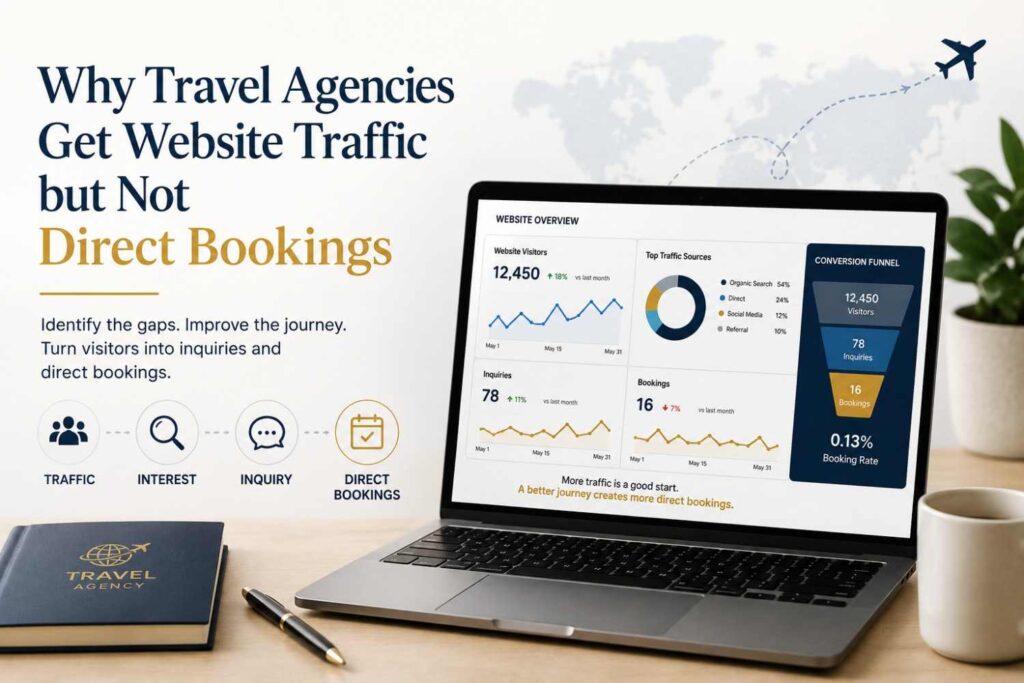
Getting people to visit your travel agency website feels like progress.
And it is.
You may see organic traffic increasing in Google Analytics. Search Console may show thousands of impressions. Your destination pages might be appearing for searches you didn’t even expect. Perhaps your social media posts are bringing visitors too.
But then you look at the number that actually matters to the business: inquiries, consultation requests and direct bookings.
The numbers don’t always move together.
A travel agency can have a growing website audience and still struggle to turn that attention into business. That can be frustrating, particularly when you’ve already invested in SEO, paid advertising, content or a new website.
The problem is often not that people aren’t interested in what you offer. It is that the journey between discovering your agency and deciding to contact you isn’t giving them enough reason to take the next step.
For travel businesses, that gap can be especially significant. Someone researching a vacation may visit several destinations, compare dozens of options and spend days or weeks planning before they are ready to speak with an advisor.
So the real question isn’t simply whether your website gets traffic.
It is:
Does the traffic you’re attracting have a clear reason to become a customer?
Traffic and Bookings Are Two Different Problems
One of the easiest mistakes in digital marketing is treating website traffic as a proxy for business growth.
More visitors can certainly create more opportunities. But traffic alone doesn’t tell you whether you’re reaching the right people, whether they understand your offer, or whether your website makes the next step easy.
Imagine a travel agency that specializes in luxury European vacations.
Its website might attract visitors searching for:
- Things to do in Paris
- Best time to visit Italy
- Rome travel guide
- Places to visit in Europe
- Italy itinerary
- Best beaches in Greece
Those searches can generate substantial traffic, but many of those visitors are still in the research stage.
They aren’t necessarily looking for a travel advisor.
Compare that with someone searching:
Luxury travel advisor for Italy
or:
New York travel agency specializing in private Italy trips
The second group is much closer to a commercial decision.
This is why a travel agency shouldn’t simply ask, “How much traffic are we getting?”
It should ask:
Where is that traffic coming from? What were those people trying to accomplish? And what happens after they arrive?
Your Traffic May Not Be the Problem
Before changing your website or increasing your advertising budget, look at the quality of the visitors you’re already attracting.
A travel agency can rank well for broad destination searches while remaining almost invisible for searches related to its actual commercial strengths.
For example, suppose your agency specializes in custom African safari itineraries.
A page ranking for:
Best things to do in Kenya
may bring considerably more visitors than a page ranking for:
Luxury Kenya safari travel advisor
But the second search may be much more valuable.
This creates an important distinction between traffic volume and traffic value.
If your website attracts thousands of people who are simply collecting travel ideas, a low inquiry rate may be perfectly understandable. The problem may be your targeting rather than your conversion rate.
That’s why SEO for travel agencies shouldn’t be built entirely around high-volume destination keywords.
You need content and landing pages that cover different stages of the travel decision, from initial inspiration through to provider selection.
The Traveler May Not Understand Why They Need You
This is one of the biggest conversion problems on travel websites.
An agency may say:
“We create unforgettable travel experiences.”
It sounds pleasant, but it doesn’t tell the customer much.
Why should they use your agency instead of booking everything themselves?
What do you actually handle?
What kind of traveler benefits most from your service?
What makes your expertise different from what they could find through an OTA, a destination website or a few hours of research?
The stronger travel agencies tend to answer those questions clearly.
For example:
We plan customized Italy itineraries for families who want to experience multiple cities without spending their vacation constantly changing hotels and transportation.
That communicates far more than:
We create unforgettable memories.
The first statement gives the customer a reason to recognize themselves in the service.
And recognition is an important step toward conversion.
Your Website May Be Attracting Researchers Instead of Buyers
Not every visitor is supposed to book immediately.
Someone reading an article about the best time to visit Japan may be six months away from making a decision. Someone comparing private and group tours may still be trying to understand what they want.
That doesn’t make those visitors worthless.
It means the website needs to accommodate different levels of intent.
A useful travel website should give visitors somewhere to go depending on where they are in the journey.
A person still exploring destinations might be directed toward a detailed destination guide.
Someone planning a trip might see itinerary examples.
Someone comparing options might see your expertise, testimonials and service approach.
Someone ready to talk should be able to request an itinerary or consultation without having to hunt for a contact form.
The mistake is expecting every visitor to behave like someone who has already decided to buy.
The Page They Land On Matters
A common problem with travel SEO is sending every searcher to the same generic page.
Someone searches for a specific destination and lands on a homepage.
Someone searches for luxury travel and lands on a generic “Tours” page.
Someone searches for family travel and lands on a page that speaks to everyone.
That creates unnecessary friction.
The landing page should make the connection between the search and the agency’s offering immediately obvious.
If someone searches for:
Luxury Italy travel advisor
the page they reach should clearly communicate:
Luxury travel → Italy → advisor expertise → relevant experiences → proof → next step.
The visitor shouldn’t have to reconstruct that connection themselves.
Your Website Needs to Sell the Expertise Behind the Service
Travel agencies have something that many online booking platforms cannot easily replicate:
human expertise.
But many websites barely demonstrate it.
An About page saying that the company has “years of experience” isn’t enough.
Show what that experience means.
Have you personally visited the destinations?
Have you inspected the hotels you recommend?
Do you work with particular guides or local partners?
Have you handled complicated multi-country itineraries?
Do you specialize in families, luxury travelers, corporate groups or destination weddings?
Do you understand the practical problems that travelers encounter?
These details help transform an agency from another travel website into a business with a reason to trust it.
And that distinction becomes increasingly important as travelers have access to more information than ever.
Generic Content Can Bring Traffic Without Creating Demand
Travel agencies have a natural temptation to publish as much destination content as possible.
The thinking is understandable:
More articles → more keywords → more traffic → more customers.
But the middle of that equation is not guaranteed.
A generic article about “10 Things to Do in Rome” may attract visitors who have no relationship with your agency. They might read the article, find the information useful, and leave.
That doesn’t mean the content failed.
It means the content wasn’t necessarily designed to move that reader toward a commercial relationship.
A stronger approach is to connect informational content with the agency’s actual expertise.
Instead of simply publishing:
10 Things to Do in Rome
consider content such as:
How We’d Plan a 7-Day Rome Trip for a First-Time Family
or:
Rome in Three Days vs Five: Which Itinerary Makes More Sense for Families?
Now the agency is demonstrating judgment.
The content becomes a way to show potential customers how you think, not simply what you know.
Your Calls to Action May Be Asking for Too Much
Another reason travel websites struggle to convert traffic is that the only visible action is something like:
BOOK NOW
That can work for a hotel or an airline.
It isn’t always the best first step for a travel advisor.
A traveler considering a complicated itinerary may not be ready to “book.” They may want to ask a question first.
Consider alternatives such as:
Request a Custom Itinerary
Speak With a Travel Advisor
Plan My Trip
Request a Consultation
Tell Us About Your Trip
The wording should match the service you actually provide.
If your agency’s value lies in planning and expertise, the CTA should invite the customer into that process.
Trust Has to Appear Before the Inquiry Form
Imagine a traveler has spent twenty minutes researching a destination and eventually reaches your contact page.
What do they know about you?
If the page simply says:
Contact us for more information
you are asking for personal information before you’ve given the visitor much reason to trust you.
A better journey builds confidence before the form.
That could include:
- Relevant customer testimonials
- Specific travel expertise
- Example itineraries
- Destinations you specialize in
- Advisor profiles
- Professional credentials
- Media mentions
- Reviews
- Photos from actual trips
- Clear information about your planning process
The goal isn’t to cover the page with trust badges.
It’s to answer the question quietly sitting behind the inquiry:
“Why should I trust this company with my trip?”
Your Booking Process May Be Creating Friction
Sometimes the problem isn’t marketing at all.
It’s what happens when someone decides they are interested.
A traveler clicks Contact and encounters a form with fifteen required fields.
Or they have to create an account.
Or they aren’t sure how long it will take to receive a response.
Or there is no clear explanation of what happens after submitting the inquiry.
Small uncertainties can become reasons to postpone the decision.
The inquiry process should make the next step feel straightforward.
Tell people what they can expect.
For example:
Tell us where you’re going, when you’d like to travel and what kind of experience you’re looking for. A travel advisor will review your request and contact you to discuss the trip.
That is much more reassuring than a generic contact form.
Don’t Send Every Visitor to the Homepage
Your homepage has an important job, but it shouldn’t have to carry every conversion.
If someone arrives from a page about luxury African safaris, give them a clear path toward your safari expertise.
If someone arrives from an article about family travel in Italy, connect them to your relevant family itinerary service.
This is where content architecture and conversion architecture should work together.
Your blog attracts the visitor.
The destination or service page builds relevance.
Social proof establishes trust.
And the inquiry process creates the conversion.
That is a much stronger system than hoping every article visitor eventually finds the Contact page.
Paid Traffic Makes the Same Problem More Expensive
The problem becomes particularly painful when the website is supported by Google Ads or Meta Ads.
You’re paying to bring someone to your website.
If the landing experience doesn’t match the promise of the advertisement, you’re paying for the opportunity to lose the visitor.
For example, an advertisement might say:
Private Italy Itineraries Designed Around Your Family
but send the user to a generic homepage.
The visitor has to figure out where the promised service is.
A better experience continues the same message from advertisement to landing page:
Ad → Relevant landing page → Evidence → Offer → Inquiry
The closer those pieces are aligned, the less work the customer has to do.
Measure the Journey, Not Just the Traffic
If a travel agency wants to understand why its website isn’t producing enough direct business, Google Analytics and Search Console can provide a useful starting point.
Look beyond total sessions.
Ask:
Which pages attract the most visitors?
Which search queries bring them in?
Which pages generate inquiries?
Which pages have high traffic but almost no engagement?
Which landing pages generate phone calls or form submissions?
Are visitors from organic search behaving differently from paid visitors?
Which destinations or services attract commercially relevant searches?
This can reveal something important.
You may discover that your most visited article produces very few inquiries, while a much smaller service page consistently generates leads.
That doesn’t mean the article is useless.
It means the two pages are doing different jobs.
The objective is to understand those jobs and connect them properly.
What a Stronger Travel Agency Funnel Looks Like
A travel agency doesn’t need to turn every visitor into a customer immediately.
A more realistic journey looks like this:
Discovery
A traveler searches for a destination, problem or travel idea.
↓
Useful information
They find genuinely helpful content from your agency.
↓
Relevance
They discover that your agency specializes in the kind of trip they’re considering.
↓
Trust
They see evidence of expertise, experience and successful customer outcomes.
↓
Consideration
They explore itineraries, services and the planning process.
↓
Inquiry
They request an itinerary, consultation or conversation.
↓
Booking
The advisor takes over the relationship and helps turn the plan into a real trip.
The website doesn’t need to force that entire journey into one page.
It needs to connect the stages.
So, Why Are You Getting Traffic but Not Direct Bookings?
There isn’t one universal answer.
For one travel agency, the problem may be poor keyword targeting. For another, it may be a generic website that doesn’t communicate specialization. Another may have excellent traffic and positioning but a frustrating inquiry process.
In many cases, several problems exist at the same time.
The most useful diagnostic questions are:
Are we attracting people who are actually relevant to our service?
Does the landing page match what they were searching for?
Can they immediately understand why they should choose us?
Have we demonstrated enough expertise to earn their trust?
Is there a clear next step that fits their buying stage?
Is the inquiry process easy?
Are we measuring inquiries and qualified leads—not just sessions?
Once those questions are answered, the solution becomes much clearer.
The Goal Isn’t More Traffic. It’s More Valuable Traffic.
Travel agencies should absolutely continue investing in organic visibility.
But the ultimate objective isn’t to build a website that receives impressive traffic reports.
It is to build a digital presence that attracts the right travelers, helps them make decisions, demonstrates why your agency is worth trusting, and gives them a straightforward path to start a conversation.
That requires the pieces to work together.
Your SEO needs to reach the right searches.
Website content needs to help rather than simply attract clicks.
Your website needs to communicate your specialization.
User generated proof needs to reduce uncertainty.
And your conversion process needs to make the next step easy.
When those elements are aligned, traffic becomes much more valuable.
Final Takeaway
If your travel agency is getting website traffic but very few direct bookings, don’t immediately assume that you need more traffic.
First, understand what is happening between discovery and decision.
You may be attracting travelers too early in their research. Your pages may not match their intent. Your specialization may not be clear enough. Your website may not demonstrate enough expertise. Or your inquiry process may be creating friction at exactly the moment someone is ready to talk.
The solution isn’t always another SEO campaign or a larger advertising budget.
Sometimes the bigger opportunity is to make better use of the attention you’re already earning.
Get the right traveler to the right page, give them a reason to trust you, and make the next step obvious.
That is how a travel agency turns search visibility into a pipeline of direct opportunities.
Travel Agency Direct Bookings FAQ
Why do travel agencies get website traffic but no bookings?
Traffic does not necessarily mean purchase intent. A travel agency may attract visitors who are researching destinations rather than looking for an advisor. Other common issues include weak positioning, poor landing-page relevance, insufficient trust signals and a difficult inquiry process.
How can travel agencies turn website traffic into more inquiries?
Start by matching landing pages to search intent, making your specialization clear, demonstrating relevant expertise and using calls to action such as Request a Custom Itinerary or Speak With a Travel Advisor. Tracking inquiries by landing page can also reveal where the strongest opportunities are.
What type of SEO traffic is most valuable for travel agencies?
Commercially relevant searches are generally more valuable than broad informational traffic. Searches that combine a destination, travel need, traveler type or service—for example, a specific type of travel advisor—can indicate stronger intent than a broad destination query.
Should travel agencies focus on SEO or conversion optimization?
They need both. SEO can create visibility, but conversion optimization determines what happens after the visitor arrives. Increasing traffic to a website that doesn’t communicate its value or make inquiries easy can simply increase the number of visitors who leave without contacting the agency.
How important is the travel agency website for direct bookings?
Very important. Even when a customer discovers an agency through Google, social media, advertising or an AI-powered search experience, the website often becomes part of the evaluation process. It needs to communicate expertise, specialization, credibility and a clear next step.
Getting Traffic Is Only the First Step
Gadget Majesty helps travel businesses connect SEO, content, local search, AI search, paid acquisition and conversion-focused web experiences so digital visibility has a clearer path toward qualified inquiries and direct business.