
Search no longer always ends with a page of links.
A customer researching software, choosing an agency, planning a trip or comparing local businesses can now ask an AI-powered search experience a detailed question and receive a synthesized answer immediately. Google offers AI Overviews and AI Mode, while platforms such as ChatGPT and Perplexity can also search the web and use external sources when answering certain queries.
That change has created a new question for businesses:
How do you become one of the brands or sources that AI systems find useful enough to mention, reference or cite?
Generative engine optimization, usually shortened to GEO, attempts to answer that question.
At its best, GEO is not a collection of tricks for manipulating large language models. It is a broader approach to making a business and its information easier to find, understand, retrieve and trust when an AI system constructs an answer.
That distinction matters because much of what currently gets marketed as GEO is simply conventional SEO with a new label.
The more useful approach starts by understanding how AI-assisted discovery actually works.
What Is Generative Engine Optimization?
Generative engine optimization is the practice of improving the visibility of a brand, website or source within answers produced by generative search and AI systems.
Instead of focusing only on whether a page ranks first, fifth or tenth in a traditional search result, GEO also considers questions such as:
- Does an AI system recognize the business correctly?
- Does it retrieve the company’s content when researching a relevant question?
- Does the brand appear in recommendations or comparisons?
- Does the answer cite or reference the website?
- Are the products, services, expertise and relationships between them understood accurately?
The term itself has an academic origin.
Researchers introduced Generative Engine Optimization in work first published on arXiv in 2023 and later presented at ACM SIGKDD in 2024. Their research described generative engines as systems that gather information from multiple sources and synthesize it into an answer rather than simply returning a ranked list of pages. Their experiments also showed that changes to content could affect visibility inside generated responses, although results varied significantly by domain. arXiv
Since then, GEO has expanded into a much broader marketing discipline covering AI search visibility, brand entities, content retrieval, citations, authority and measurement.
That broader definition is useful, but businesses should be careful not to treat every emerging GEO recommendation as a proven ranking factor.
Why GEO Has Become Important
Traditional search usually gives the user choices.
A person searches for something, reviews several results and decides which website to visit.
Generative search can compress several stages of that process into one interaction.
Someone might ask:
Which CRM is best for a small consulting company that needs email automation but does not need enterprise reporting?
Instead of searching for “best CRM,” opening several articles, comparing features and then refining the search, an AI system may perform much of that research on the user’s behalf.
Google explains that AI Mode and AI Overviews can use query fan-out, where the system performs multiple related searches across subtopics and data sources before generating a response. Its newer guidance also describes retrieval-augmented generation, or RAG, as part of the way current search systems ground AI responses in relevant and recent web information. Google for Developers
For businesses, this changes where competition takes place.
You still want pages to rank.
However, you increasingly also want your company, expertise or content to become part of the information an AI system retrieves while forming an answer.
That creates another layer of search visibility rather than replacing the old one.
GEO vs SEO: What Actually Changes?
SEO and GEO overlap heavily, but they do not measure success in exactly the same way.
Traditional SEO often revolves around relationships such as:
Query → Search Result → Website → Conversion
Generative discovery may look more like:
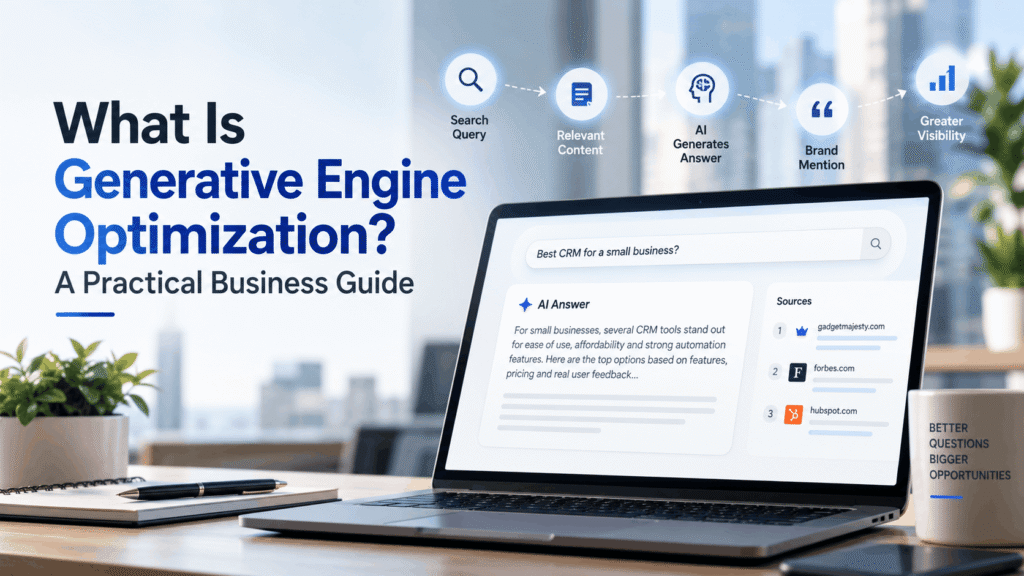
Prompt → Retrieval → AI Answer → Brand Mention or Citation → Website or Later Brand Search → Conversion
The website still matters in both journeys.
What changes is the role the page can play.
In conventional search, a page often competes to become the destination. Within an AI-generated response, the same page may function as a supporting source that helps the system form an answer.
This creates several practical differences.
SEO usually emphasizes ranking positions
Organic rankings, impressions, clicks and conversions remain important.
GEO adds answer visibility
You may also care whether your business appears in relevant AI answers, which sources receive citations and whether the system describes your brand accurately.
SEO often begins with individual queries
GEO needs to consider broader topics and relationships because conversational searches often involve follow-up questions and several connected intents.
GEO does not remove SEO
This is perhaps the most important point.
Google explicitly says its existing SEO best practices remain relevant to generative AI features. Pages must still be crawlable, indexable and eligible to appear in Search. Google also states that websites do not need special AI files, special schema or additional technical requirements to appear in AI Overviews or AI Mode. Google for Developers
For Google Search at least, the idea that GEO requires an entirely separate technical discipline is difficult to support.
A better interpretation is that SEO creates much of the retrieval foundation, while GEO expands the visibility strategy around entities, sources, authority and generated answers.
How Generative Search Finds Information
There is no single architecture behind every AI search platform.
That makes universal GEO checklists risky.
Still, a useful simplified model has four stages:
1. Understanding the question
The system interprets what the user wants.
A complex prompt may contain several intents at once. It may also lead the system to generate additional searches or subquestions.
2. Retrieving relevant information
Search-enabled systems can retrieve pages or other sources related to those questions.
This stage deserves far more attention than many GEO discussions give it.
Recent research published in October 2026 analyzed hundreds of thousands of citations across commercial queries and found that retrieval explained substantially more citation variation than many individual page characteristics within the studied systems. Semantic alignment between page content and the queries generated by the AI system also mattered. The research is recent and should not be treated as a universal ranking model, but it reinforces an important principle: a page cannot become a useful citation if the system never retrieves it in the first place. arXiv
3. Synthesizing the answer
The model combines retrieved information with its reasoning and existing knowledge to construct a response.
Several sources may contribute even when only a few receive visible citations.
4. Presenting sources or brands
Depending on the platform and query, the final response may include citations, links, company names, products or recommendations.
This is why GEO cannot be reduced to “write content that sounds good to an LLM.”
Visibility begins much earlier in the process.
The Role of Entities in Generative Engine Optimization
Keywords describe language.
Entities describe things.
A business is an entity. So is a product, person, location, service, organization or recognized concept.
Consider a real estate agency.
Search systems should ideally be able to understand relationships such as:
Agency → Agents → Service Areas → Property Types → Neighborhoods → Buyers → Sellers → Listings → Valuations
For a restaurant, the graph looks different:
Restaurant → Location → Cuisine → Menu → Dish → Dietary Options → Reservations → Reviews
This is why semantic SEO becomes particularly useful in AI-driven discovery.
A website that mentions “commercial property SEO” fifty times does not necessarily communicate more meaning than one that clearly explains relationships between property types, locations, agents, search behaviour, enquiries and services.
Strong entity clarity comes from consistent business information, sensible information architecture, descriptive content, contextual internal links, accurate structured data and corroborating information elsewhere on the web.
The objective is not to “feed entities to an LLM.”
It is to remove ambiguity about who you are, what you offer, what you know and how those concepts relate to one another.
What Actually Helps With GEO?
There is still no universally accepted list of GEO ranking factors.
A practical strategy should therefore separate durable search principles from speculative tactics.
Create information worth retrieving
Commodity content creates a major problem.
If fifty websites publish nearly identical explanations of the same subject, an AI system has little reason to depend on any particular one.
Google’s 2026 guidance makes a similar point. It advises publishers to create unique, non-commodity content and specifically warns against producing large numbers of pages around every possible query variation merely to influence search or generative responses. Google for Developers
Useful differentiation can come from:
original data, real experiments, case studies, expert analysis, proprietary frameworks, firsthand experience, unusual comparisons or information that answers a question more precisely than existing pages.
This matters for ordinary SEO as well.
AI search simply makes generic content easier to summarize without visiting the original publisher.
Answer specific questions clearly
Good writing does not need to become robotic just because AI systems may retrieve it.
Clear sections, descriptive headings and direct explanations make information easier for humans to navigate and can also make individual passages easier to retrieve.
A page about restaurant marketing, for example, might clearly answer:
How do restaurants know which marketing channel produced an order?
That is more useful than hiding the answer inside a broad section called “Improve Your Marketing Strategy.”
Clarity helps retrieval without sacrificing natural writing.
Build topical relationships
A single article rarely establishes expertise around a complex subject.
Suppose a company provides AI Search Optimization.
A useful supporting content structure might cover:
Generative Engine Optimization
→ AI Search Visibility
→ Entities and Brand Understanding
→ AI Citations
→ SEO vs GEO
→ Measurement
→ Content Retrieval
Each page should answer a genuinely different question.
That last condition matters. Publishing twenty slightly altered definitions of GEO does not create meaningful topical authority.
Google’s current guidance specifically warns against generating separate pages for every query variation. Google for Developers
Make the website technically accessible
No amount of semantic sophistication compensates for content that search systems cannot access properly.
For Google’s AI features, normal technical SEO requirements still apply. Important pages should be crawlable, indexable and internally discoverable, while significant information should remain available in text. Google also recommends sound page experience, sensible JavaScript implementation and structured data that matches what users can actually see on the page. Google for Developers
There is no special GEO schema required for Google.
That claim is worth repeating because it cuts through a considerable amount of marketing noise.
Strengthen authority beyond your own website
Your website tells search systems what you say about yourself.
The wider web can help establish whether others recognize the same expertise.
Relevant editorial mentions, credible citations, industry publications, review platforms, directories, customer discussions and other independent sources can contribute to a more complete picture of a brand.
That does not mean chasing mentions everywhere.
The useful question is:
Where would someone researching this subject reasonably expect this business to appear?
For a specialist SaaS company, that could include technical publications, software review platforms and industry communities.
For a restaurant, local publications, review platforms, Google Business Profile information and food-related sources may matter more.
GEO therefore intersects with digital PR, reputation management, local search and brand building much more than traditional on-page optimization alone.
Do Structured Data and Schema Improve GEO?
Structured data still has value, but claims around it need precision.
Google uses structured data to help understand page content and support eligible search features. At the same time, the company explicitly says that websites do not need a new type of structured data or special schema to appear in AI Overviews or AI Mode. Google for Developers
The practical rule is straightforward:
Use appropriate schema where it accurately represents visible information.
For example, a business may legitimately use markup for its organization, local business, product, article or other supported content where relevant.
Do not add invented attributes simply because someone claims they are “GEO signals.”
Machine-readable information should reinforce reality, not create a parallel version of it.
GEO Is Not About Writing for Robots
One of the least useful responses to AI search is making content sound increasingly artificial.
Some pages now start every section with a rigid definition, add excessive FAQs, force entities into awkward sentences and break natural ideas into fragments because the publisher believes an LLM will prefer them.
That can damage readability without providing a proven visibility benefit.
Google’s recommendations remain centred on helpful, reliable and people-first information. Its generative AI guidance also says publishers should focus on accuracy, quality and relevance regardless of whether AI assists with content creation. Google for Developers
Structure matters.
Clarity matters.
Originality matters.
None of those require writing as though the reader were a database.
The strongest approach is still to write for a knowledgeable human while making the information easy to understand and retrieve.
How Should a Business Start With GEO?
A sensible GEO strategy begins with the business rather than the AI platform.
First, identify the subjects for which the company genuinely deserves visibility.
A specialist travel agency might focus on destinations, itineraries, travel logistics and direct booking. A software company could build around its category, use cases, integrations, comparisons and customer problems.
Next, examine whether the website explains those areas clearly.
Look for missing relationships rather than simply missing keywords.
If a real estate agency talks extensively about listings but barely explains the neighborhoods, property types, buyer concerns or valuation process, the problem goes beyond keyword targeting. The site’s information model remains incomplete.
Then strengthen the evidence behind the content.
Original examples, customer experience, data, demonstrations and detailed case studies give both people and search systems more meaningful information than another generic summary.
Finally, evaluate how the brand appears outside its own website.
GEO cannot live entirely inside a CMS.
How Do You Measure Generative Engine Optimization?
Measurement remains one of the biggest differences between mature SEO and emerging GEO practices.
Traditional search gives us established metrics such as:
rankings, impressions, clicks, CTR, organic sessions and conversions.
AI visibility introduces additional questions:
Does the brand appear?
Which prompts trigger it?
Which competitors appear instead?
Which sources receive citations?
How accurately does the answer describe the business?
Do AI referrals convert?
For Google specifically, measurement improved considerably in 2026.
Search Console now provides dedicated Generative AI performance reports for visibility in experiences such as AI Overviews and AI Mode. Google completed the worldwide rollout on August 31, 2026. Google for Developers
For other platforms, reporting remains less standardized.
A practical measurement framework can combine recurring prompt monitoring, citation analysis, brand-mention tracking, referral traffic and conversion data.
The important thing is not to invent a single “GEO score” and assume it represents business value.
A brand appearing in 500 informational answers may generate less commercial value than appearing consistently in ten high-intent comparisons.
What GEO Cannot Guarantee
No agency, platform or consultant can guarantee that a specific AI system will cite a particular page.
These systems change quickly. They may use different models, retrieval systems, indexes and answer-generation methods. Outputs can also vary across prompts, locations, sessions and model versions.
Google itself advises businesses to evaluate third-party GEO and AEO claims carefully and notes that external tools do not have access to its internal ranking data. Google for Developers
That does not make GEO meaningless.
It simply means businesses should evaluate it the same way they should evaluate good SEO: through evidence, controlled improvement and measurable outcomes rather than promises of guaranteed placement.
Where SEO, GEO and AEO Fit Together
The terminology can become unnecessarily confusing.
SEO focuses on making content discoverable and competitive within search systems.
AEO, or answer engine optimization, generally describes efforts to make information suitable for direct answers.
GEO focuses on visibility within responses produced by generative systems.
In practice, those disciplines overlap.
A clearly structured page can rank organically, support an AI Overview, provide information for a conversational answer and help users make a decision after they reach the website.
Businesses therefore do not need three disconnected strategies.
They need a search visibility strategy that accounts for how discovery is changing.
The Business Value of GEO
The most important shift is not from Google to ChatGPT or from links to answers.
It is from competing only for traffic to competing for influence during research.
A potential buyer may learn about a company through an AI answer without visiting the website immediately. They might encounter the brand again during a comparison, search for it directly later, or visit after the AI system cites a specific resource.
That makes visibility harder to attribute neatly.
It also makes strong brands, clear expertise and credible information more important.
SEO remains the foundation because search systems still need discoverable content.
Content strategy supplies the knowledge.
Digital PR and external authority reinforce credibility.
Entity clarity helps systems understand the business.
GEO connects those pieces around a new discovery environment.
Final Takeaway
Generative engine optimization is best understood as an extension of modern search strategy rather than a replacement for SEO.
The goal is not to manipulate an AI model into mentioning a business.
The goal is to make the business easy to discover, easy to understand, useful to retrieve and credible enough to reference when people ask questions related to its expertise.
Some tactics will change as search platforms evolve. The durable principles are less fashionable: strong technical foundations, original information, clear entities, meaningful topical coverage, credible external signals and accurate measurement.
Those foundations already make websites better for traditional search.
Now they also help businesses compete for visibility in the answers that increasingly sit between a customer’s question and their next decision.