
Restaurants rarely have a traffic problem in isolation.
More often, the problem is somewhere between being discovered and getting the customer to take action.
A restaurant might appear in Google Search and Maps but receive very few visits. Its website might attract visitors who leave without viewing the menu. The menu may be easy to find, yet the reservation or ordering process could still create unnecessary friction.
Increasing the advertising budget won’t automatically solve any of those problems.
Before spending more on Google Ads, Meta Ads, or other acquisition channels, it is worth understanding what happens when a potential customer searches for the restaurant. That is where a restaurant SEO audit becomes useful.
A good audit looks beyond rankings. It examines how the restaurant appears in local search, how clearly Google and customers can understand the business, what happens after someone reaches the website, and whether the journey from discovery to order or reservation makes sense.
The goal isn’t to find as many SEO issues as possible.
The goal is to find the issues that are most likely holding the business back.
What Is a Restaurant SEO Audit?
A restaurant SEO audit is an assessment of the search visibility, website, local presence, content, technical foundation and conversion journey of a restaurant.
For a restaurant, that usually means looking at several connected assets rather than treating SEO as a website-only activity.
The journey might look like this:
Google Search → Google Maps → Business Profile → Website → Menu → Reservation/Order → Customer
Every stage matters.
A restaurant may have excellent visibility but a poor website experience. Another may have a strong website but very little local visibility. A third may perform well organically but need paid advertising to generate more immediate demand.
The audit helps identify which situation you’re actually dealing with.
That distinction matters because the right solution depends on the problem. More traffic isn’t always the answer.
1. Start With How Customers Actually Find the Restaurant
The first step is to stop looking at the restaurant from the owner’s perspective and look at it from the customer’s.
A restaurant owner knows its name, cuisine, location and specialties. A new customer doesn’t necessarily search using any of those exact terms.
Someone might search for:
- Italian restaurant near me
- Indian restaurant in Manchester
- best sushi near [location]
- restaurants open now
- family restaurant near me
- halal restaurant in [area]
- restaurants for dinner near [location]
The exact searches depend on the restaurant, its location and the occasions it serves.
During an audit, examine both branded and non-branded visibility.
Branded searches tell you whether people can find the restaurant when they already know about it. Non-branded searches are more revealing when you’re trying to understand discovery.
For example, ranking for the restaurant’s own name is useful, but it doesn’t necessarily demonstrate strong local search visibility. Showing up when someone searches for a relevant cuisine, dish, restaurant type or nearby dining option is a different level of visibility.
This is also where competitor research becomes valuable.
Look at the restaurants appearing for the searches that matter. Compare their Google profiles, websites, reviews, menus, content and overall search presence.
The objective isn’t to copy them.
It is to understand what Google and customers are being given to work with in that market.
2. Audit the Google Business Profile
For restaurants, the Google Business Profile is often one of the most important parts of the local customer journey.
Someone searching for a restaurant may never visit the website first. They may discover the business through Google Maps, look at photographs, check reviews, open the menu and then decide whether to visit or order.
That makes the profile more than a business listing.
It is part of the restaurant’s digital storefront.
Start with the fundamentals:
- Correct business name
- Appropriate primary category
- Relevant additional categories
- Accurate address
- Current opening hours
- Phone number
- Website
- Menu
- Ordering options
- Reservation options
- Photos
- Reviews
- Relevant business attributes
Then look at the quality of the information rather than simply checking whether each field is populated.
Does the profile communicate what the restaurant actually offers?
Are the photos current and representative?
Is the menu easy to access?
Can customers quickly understand where the restaurant is located?
Are ordering or reservation options available where appropriate?
A complete profile gives both customers and Google more useful information about the business. But completeness alone isn’t the objective. The information needs to accurately represent the real customer experience.
3. Examine the Menu as Part of the Search Experience
The menu deserves more attention than it usually gets in an SEO audit.
For a restaurant, the menu is often the point where a potential customer decides whether the business is relevant.
They may want to know whether you serve sushi, whether there are vegetarian options, how much a meal costs, whether you offer lunch, or whether a particular dish is available.
If the menu is hidden behind an image, difficult PDF, outdated page or third-party platform, that information becomes harder to discover and use.
A strong audit should examine how the menu is presented on both the website and Google Business Profile.
Look at:
- Menu accessibility
- Clear categories
- Dish names
- Descriptions
- Prices
- Dietary information where relevant
- Updated offerings
- Mobile usability
- Links from search and the Business Profile
This isn’t about turning every dish into a keyword target.
It is about making the restaurant’s offering clear and useful.
A well-structured menu can help a customer make a decision much faster than a generic paragraph describing the restaurant.
4. Assess Whether the Website Supports the Search Journey
Getting someone from Google to the website is only the beginning.
Once they arrive, the website needs to answer the questions that brought them there.
A restaurant website should make it easy to understand the essentials:
What do you serve?
Where are you located?
What does the menu look like?
How much does it cost?
Can I book a table?
Can I order online?
When are you open?
The answers don’t need to be buried under layers of navigation.
The homepage should establish the restaurant’s identity quickly, while dedicated pages can provide deeper information where it genuinely helps customers.
Depending on the business, useful pages might include the menu, reservations, ordering, private dining, catering, events or location-specific information.
The important distinction is usefulness over volume.
Creating dozens of thin pages such as slightly different versions of “best restaurant in [location]” rarely creates a meaningful customer experience. A smaller website with genuinely useful pages can be much stronger than a large website created primarily to capture variations of the same keyword.
5. Check the Restaurant’s Local SEO Signals
Local SEO extends beyond the Google Business Profile.
Google can use information from the business website, third-party sources and other signals when understanding a local business. That makes consistency across the wider web important.
Check whether the restaurant’s core information is consistent across relevant platforms and references.
Pay particular attention to:
- Business name
- Address
- Phone number
- Website
- Opening hours
- Cuisine
- Restaurant description
Then look beyond basic citations.
Does the restaurant have legitimate mentions from local publications?
Are there relevant food or hospitality websites referencing the business?
Are local organizations, event websites or community publications mentioning the restaurant where appropriate?
Are there authoritative websites linking to the restaurant?
These signals shouldn’t be approached as a directory-submission exercise.
The bigger question is whether the restaurant has developed a credible presence within its local market.
That is much closer to what local authority actually means.
6. Review Technical SEO Without Losing Sight of the Customer
Technical SEO matters, but it shouldn’t turn the audit into a collection of technical scores.
Start with the fundamentals:
- Mobile usability
- Page speed
- Indexability
- Crawlability
- HTTPS
- XML sitemap
- Canonical URLs
- Redirects
- Broken links
- Duplicate content
- Important page indexing
- Appropriate structured data
Then connect those findings to the customer experience.
A technically impressive website that takes too long to load isn’t helping much.
A perfectly structured page that hides the menu three clicks deep isn’t particularly useful either.
For restaurants, mobile experience deserves special attention because customers often search while they are already deciding where to eat. They may be standing nearby, travelling through an area or looking for somewhere to dine that evening.
The website needs to work in that moment.
Technical SEO should support usability, not exist separately from it.
7. From Search Visibility to an Actual Customer
Getting a customer to discover a restaurant through Google is only part of the job. Once someone reaches the https://support.google.com/business/answer/14189260?hl=en&utmBusiness Profile or website, the experience needs to make the next decision easy. They may want to check the menu, compare prices, look at photos, confirm the location or make a reservation, and every unnecessary step creates another opportunity for them to leave.
This is why a restaurant SEO audit should look beyond rankings and traffic. Follow the journey from the initial search through to the action that matters to the business, whether that is an online order, reservation, phone call or visit.
For example, a restaurant might have strong visibility in Google Maps and receive plenty of profile views, but if the menu is difficult to find or the ordering process doesn’t work smoothly on mobile, that visibility isn’t translating into enough customers. In that situation, creating more visibility isn’t necessarily the first priority. The bigger opportunity may be removing the friction between discovery and conversion.
The same principle applies to organic website traffic. A visitor who lands on a page that clearly explains the restaurant, presents the menu and provides an obvious route to booking or ordering is much closer to becoming a customer than someone who has to search through the site for basic information.
The audit should therefore evaluate not just whether people can find the restaurant, but what happens once they do.
8. Map the Restaurant’s Search Intent
Not every restaurant search means the same thing.
Someone searching for:
“restaurants near me”
is still exploring.
Someone searching for:
“Italian restaurant in Soho”
has narrowed the options.
Someone searching for:
“restaurant name menu”
already knows the business and wants information.
Someone searching for:
“restaurant name booking”
is much closer to taking action.
Your audit should therefore map important searches against the stage of the customer journey they represent.
A useful way to think about it is:
Discovery
The customer is looking for options.
Evaluation
They are comparing restaurants, menus, reviews, prices and locations.
Decision
They have a strong preference and need practical information.
Transaction
They are ready to order, reserve or contact the restaurant.
The restaurant’s search strategy should support these different moments where there is genuine value to provide.
This also prevents the common mistake of judging SEO success entirely by keyword rankings.
A ranking is useful because of what it enables the customer to do next.
9. Look at Reviews as a Search and Trust Signal
Reviews deserve their own place in a restaurant audit because they influence both discovery and decision-making.
A potential customer may compare several restaurants that appear in the same local search result. Reviews can immediately change how those options are perceived.
Look at more than the overall rating.
Review the:
- Number of reviews
- Recency
- Customer sentiment
- Recurring complaints
- Common positive themes
- Owner responses
- Mentions of food, service and experience
The recurring themes can also provide useful customer language.
If customers repeatedly mention a particular dish, dining experience or service quality, that language can help the business better understand how customers perceive it.
The objective isn’t to manufacture keywords inside review responses.
It is to understand what customers actually value about the restaurant.
10. Connect Search Data With Business Data
SEO data becomes far more useful when it is connected to what the restaurant is trying to achieve commercially.
Google Search Console can show which queries generate impressions and clicks, which pages receive search visibility and how those pages perform in search results. Analytics, ordering systems and reservation platforms can then add another layer by showing what visitors do after reaching the website.
Looking at these signals together can reveal where the real problem sits.
A page that receives plenty of impressions but very few clicks may have a relevance or search-result presentation issue. If people are clicking through but leaving quickly, the page may not be meeting the intent behind the search. When visitors engage with the website but rarely complete an order or reservation, the problem may be further down the conversion journey rather than with SEO itself.
This broader view prevents a common mistake: treating every business problem as a traffic problem.
A restaurant doesn’t necessarily need more visitors simply because its website has low sales. It may need more relevant visitors, a better landing experience, a clearer offer, or a smoother path to purchase. Search data helps identify the symptoms, while business data helps determine whether those symptoms are actually affecting revenue.
That is why an audit should finish with business priorities rather than a list of SEO metrics. The useful question is not simply “How are we ranking?” but “Where are we losing potential customers, and what change is most likely to improve the outcome?”
11. Decide What Should Be Fixed First
Not every SEO issue deserves the same priority.
A restaurant might have twenty technical recommendations and only two issues that are materially affecting customers.
Those two deserve attention first.
A practical prioritization model is to consider:
Business impact + customer impact + search impact + effort
For example, fixing an incorrect opening hour can be more immediately valuable than rewriting a page title.
Making the menu accessible on mobile may matter more than creating five new blog posts.
Fixing broken ordering functionality may be more important than chasing another low-volume keyword.
This is where a strategic audit differs from an automated SEO report.
The objective isn’t to produce the longest list of recommendations. It is to identify the most valuable actions.
Should You Fix SEO Before Spending More on Ads?
There isn’t a universal point at which a restaurant should stop advertising and focus entirely on SEO. Organic search and paid advertising serve different purposes, and a healthy acquisition strategy can use both.
The more important consideration is whether the current customer journey is strong enough to support additional traffic.
Suppose a restaurant has an incomplete Google Business Profile, an outdated menu, a slow mobile website and a difficult reservation process. Increasing the advertising budget may bring more people into that experience, but it doesn’t address the reasons they are dropping out. The business could end up paying more to generate traffic without getting a proportional increase in customers.
In another situation, the fundamentals may already be in good shape. The restaurant could have strong local visibility, a well-structured website, clear conversion paths and reliable tracking, but still need more demand to fill tables during specific periods. In that case, paid acquisition could be a sensible investment.
The decision should therefore start with the constraint, not the channel.
If the restaurant isn’t being discovered for relevant searches, improve its organic and local visibility. When people are finding it but not taking action, examine the website and conversion journey. Or if the foundation is working and the business simply needs more qualified demand, advertising may be the right next move.
SEO doesn’t need to be perfect before you run ads. It needs to be strong enough that additional traffic has somewhere productive to go.
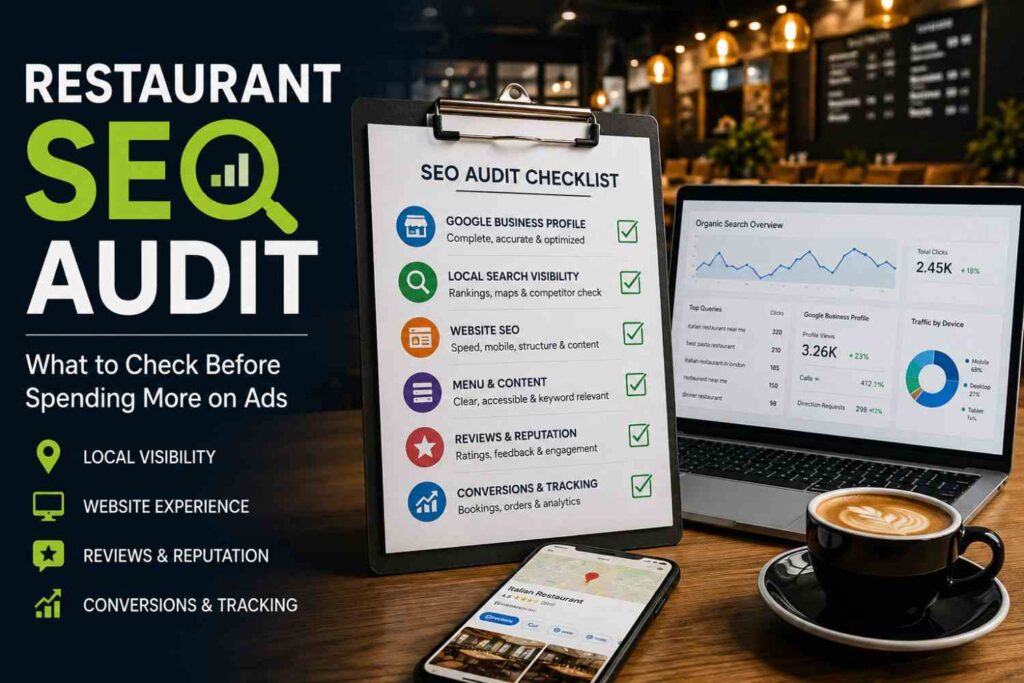
Restaurant SEO Audit Checklist
Before increasing your marketing budget, review the areas that influence the journey from search to customer.
| Audit Area | What to Review |
| Search Visibility | Branded and non-branded searches, rankings and competitors |
| Google Maps | Local visibility and competing restaurants |
| Business Profile | Categories, information, photos and customer actions |
| Menu | Accessibility, structure, pricing and mobile experience |
| Website | Content, navigation, UX and conversion paths |
| Local Signals | Business information, mentions and relevant authority |
| Technical SEO | Indexing, crawlability, speed and site health |
| Search Intent | Discovery, evaluation, decision and transaction |
| Reviews | Volume, recency, sentiment and customer feedback |
| Conversions | Orders, reservations, calls and other meaningful actions |
| Tracking | Search, website and conversion data |
| Paid Traffic | Landing pages and post-click experience |
The purpose of this checklist isn’t to achieve a perfect score.
It is to answer a more useful question:
What should the restaurant fix first?
The Real Value of a Restaurant SEO Audit
A restaurant SEO audit is most useful when it changes the conversation from “What SEO tasks should we do?” to “What is preventing more potential customers from choosing us?”
That shift matters because restaurant growth rarely depends on one isolated SEO factor. Visibility, reputation, website experience, menu information, location signals, search intent and conversion paths all influence different parts of the customer journey.
An audit brings those pieces together so the business can see where the strongest opportunity actually lies.
For one restaurant, the priority might be improving its presence in local search. For another, it could be fixing the website experience or making the menu and ordering process easier to use. A third restaurant may already have a solid organic foundation and simply need a more effective paid acquisition strategy.
The value, therefore, isn’t in producing the longest audit or identifying the largest number of technical issues. It’s in separating the important problems from the noise and turning those findings into clear business priorities.
Before increasing your marketing budget, understand how effectively your existing digital presence is moving people from search to consideration, and from consideration to customer.
That is what makes a restaurant SEO audit more than an SEO checklist. It gives you a clearer basis for deciding where the next investment should go and why.