
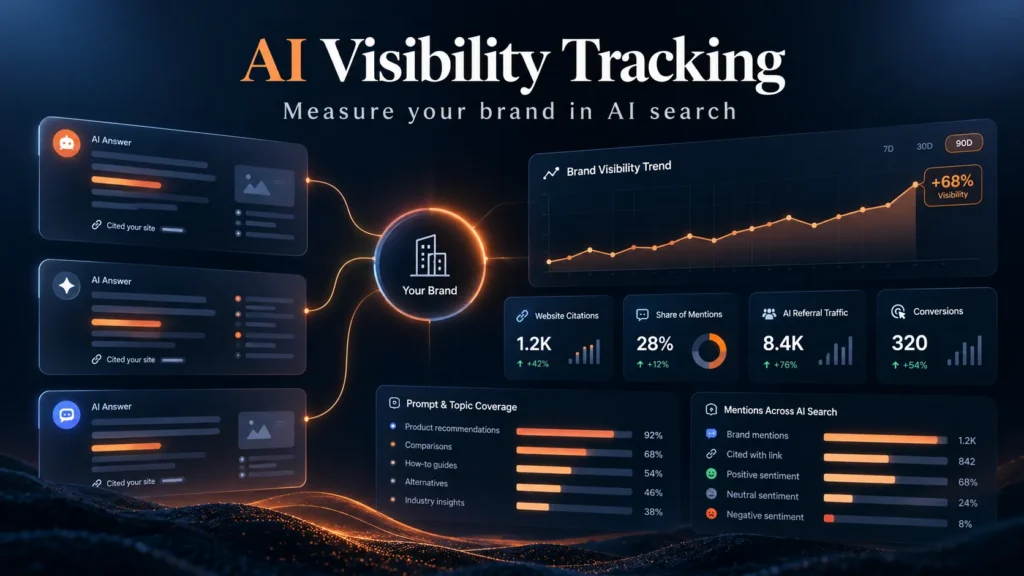
AI Visibility Tracking: Measure Your Brand in AI Search
Search visibility used to be relatively easy to recognize.
A page ranked. It earned impressions and clicks. Visitors reached the website, and analytics showed what happened next.
AI search adds a less visible layer to that journey.
A potential customer can ask ChatGPT, Google AI Mode, an AI Overview, or another answer engine about your market and receive a useful response without moving through a traditional results page. Your company might be recommended, cited as a source, compared with competitors, mentioned inaccurately—or left out entirely.
That is why AI visibility tracking cannot be reduced to another rank report.
What matters is whether your brand appears around the questions your customers ask, what those systems say about you, which sources they rely on, and whether that visibility eventually contributes to business.
What Is AI Visibility Tracking?
AI visibility tracking measures how a brand, website, product, or service appears across AI-generated search and answer experiences.
It looks at more than a single position.
A useful tracking system can show whether the brand is mentioned, whether the website is cited, which topics produce visibility, how accurately the business is represented, which competitors appear alongside it, and whether AI-driven visits lead to meaningful actions.
Traditional SEO still matters underneath all of this. Search engines and AI systems need information they can discover, understand, and trust.
But measuring AI visibility requires a wider lens.
Start With a Baseline, Not a Visibility Score
It is tempting to reduce AI visibility to one percentage.
That can be useful for reporting, but the number means very little until you know what sits behind it.
Start with a controlled set of prompts connected to the business.
A local service company might track questions about its core services, customer problems, locations, comparisons, recommendations, and brand name. A software company would probably need a different mix built around use cases, alternatives, integrations, and buying criteria.
The set does not need to be enormous.
A smaller group of commercially meaningful prompts, reviewed consistently, tells you more than hundreds of random questions generated for the sake of producing a dashboard.
Once that baseline exists, several measurements become useful.
1. Brand Presence
The first signal is simple: does the brand appear?
You can calculate a basic presence rate:
Brand Presence Rate = Prompts With a Brand Mention ÷ Total Prompts Tracked × 100
If a business appears in 12 of 40 tracked prompts, its presence rate is 30%.
On its own, that figure says very little about quality. The value comes from using the same methodology over time.
A rise from 30% to 45% across an unchanged set of relevant prompts is meaningful. A rise caused by replacing difficult prompts with easier ones is not.
Consistency matters more than creating an impressive score.
2. Citation Visibility
A brand mention and a website citation should be tracked separately.
An AI response may recommend your company without linking to the site. Another response might cite one of your articles while barely mentioning the company itself.
Those are different signals.
A basic citation rate can be calculated as:
Citation Rate = Prompts Citing Your Website ÷ Total Prompts Tracked × 100
The cited URL matters as well.
Perhaps your research articles regularly appear as supporting sources while your commercial pages remain invisible. That suggests a different problem from a domain that receives no citations at all.
Over time, citation tracking can reveal which parts of the site AI systems appear to trust and reuse.
3. Topic Coverage
An overall visibility percentage can hide important gaps.
Imagine a business that appears frequently when users ask broad educational questions but disappears when the conversation moves closer to a buying decision.
It may be visible for:
“What should I look for when choosing an accountant?”
but absent for:
“Which accounting firms work with growing ecommerce businesses?”
Both prompts belong to the same market. Their commercial value is very different.
For that reason, group prompts by the customer journey rather than treating them as one pool.
You might track informational questions, problem-solving prompts, comparisons, commercial recommendations, local intent, and direct brand questions.
Then look at visibility within each group.
This shows whether AI systems merely recognize the brand or actually associate it with the areas that generate revenue.
4. Share of Mentions
Visibility becomes more useful when viewed against the competitive set.
Suppose your company appears in eight tracked responses. That sounds positive until you discover that three competitors appear in 25, 21, and 18 of the same responses.
A simple share-of-mentions calculation can help:
Share of AI Mentions = Your Brand Mentions ÷ Total Brand Mentions Tracked × 100
Treat this as a benchmark, not market share.
AI responses change. Prompt wording changes. Platforms retrieve different information at different times.
The metric becomes useful when the prompt set, competitors, and measurement method stay reasonably consistent.
5. How the Brand Is Being Described
More mentions are not always better.
A response can contain your company name and still create the wrong impression.
AI systems may repeat an outdated service, misunderstand the market you serve, overlook an important capability, confuse pricing, or describe competitors more clearly than they describe you.
This is where a purely numerical dashboard falls short.
Review important mentions manually and look at three things:
Accuracy: Is the information correct?
Positioning: Does the response understand what makes the company relevant?
Context: Why is the brand being mentioned, and which other companies or sources appear around it?
This qualitative layer often uncovers problems that a visibility percentage would miss completely.
A business moving from 20 mentions to 40 has not necessarily improved if half of those new mentions are misleading.
6. AI Referral Traffic
Visibility starts becoming commercially interesting when people move from an AI response to the website.
GA4’s Traffic acquisition report can help identify sessions by their source and source/medium.
ChatGPT offers an especially useful tracking signal. OpenAI’s guidance on ChatGPT search referrals explains that referral links include utm_source=chatgpt.com, which allows those visits to be identified in analytics.
Do not stop at session counts.
Look at the landing pages those visitors reach, how engaged they are, whether they submit forms or call, and—where your tracking setup allows it—whether those leads become customers.
AI search may not always send large volumes of traffic. A smaller stream of highly relevant visitors can still be commercially valuable.
7. Conversion Quality
Traffic is where many AI visibility reports stop.
For a business, it is where the more important analysis begins.
A practical path looks something like this:
AI Presence → Mention or Citation → Website Visit → Lead → Qualified Lead → Customer
A weakness at each stage means something different.
Strong visibility with few citations points to one issue. Citations with little referral traffic point to another. Good AI traffic with poor conversions suggests the landing experience deserves attention.
The objective is not to credit every sale perfectly to an AI answer. Attribution will rarely be that clean.
Instead, connect visibility data with enough downstream information to distinguish genuine business impact from a vanity metric.
How to Build an AI Visibility Tracking Baseline
Begin with the areas that matter to the business rather than the phrases most likely to produce a mention.
Choose prompts around your main services, products, customer problems, locations, buying criteria, and competitive position.
Then vary the wording.
Someone searching for an SEO provider might ask:
“Which SEO agencies work with small businesses?”
Another person may ask:
“Who can help a growing company improve organic traffic?”
The intent is similar, but AI responses can differ.
This is one reason traditional keyword rank tracking cannot simply be copied and renamed for AI search.
For each test, record the prompt, platform, date, brand mention, citation, cited page, competitors present, topic, intent, and whether the description of the company was accurate.
A simple sheet is enough at the beginning.
What matters is being able to repeat the process.
Do Not Check AI Visibility Like Daily Rankings
AI-generated answers are fluid.
Different wording can change the response. Retrieval sources can change. Models are updated. Fresh information enters the ecosystem.
Checking the same question every morning and worrying about each movement will create a lot of noise.
A better approach is to review a stable set of prompts at useful intervals and look for broader movement.
Is the brand appearing across more priority topics?
Are citations becoming more frequent?
Has visibility improved around commercial questions?
Are descriptions becoming more accurate?
Is AI referral traffic producing worthwhile actions?
Those trends tell you much more than the result of one prompt on one day.
AI Visibility Tracking vs. an AI Visibility Audit
An AI visibility audit provides a snapshot.
It identifies where the brand currently appears, which topics are weak, what pages receive citations, how competitors are represented, and where information gaps may exist.
Tracking continues after the audit.
Its job is to show whether visibility changes as content, authority, technical signals, brand information, and search strategy improve.
The distinction is useful:
Audit = Where are we now?
Tracking = Are we moving in the right direction?
Businesses looking for the wider diagnosis and optimization work can connect this measurement process with a broader AI search strategy rather than treating monitoring as the strategy itself.
What Can Google Search Console Tell You?
Google provides first-party visibility data for its own search ecosystem.
Its AI performance reporting gives site owners a clearer view of performance connected with generative search experiences such as AI Overviews and AI Mode.
It is an important source of evidence, but it is not a complete AI visibility dashboard.
Search Console cannot tell you everything ChatGPT or another independent answer platform says about your business.
That is why AI visibility tracking usually combines first-party search data, website analytics, and direct observation of relevant prompts.
Where SEO Still Fits
There is no need to create a completely separate universe called “AI SEO.”
Many of the fundamentals that help a website perform in search still matter when AI systems need to understand and retrieve information.
Clear site architecture, crawlable pages, useful original content, strong commercial pages, internal linking, accurate business information, relevant third-party references, and appropriate structured data all contribute to a stronger foundation.
That is also why search optimization and AI visibility work should complement each other rather than compete for the same role.
For the broader concept of generative search visibility, our earlier guide explains how content can become more useful and discoverable within generative search.
What Should You Fix When AI Visibility Is Weak?
The measurement should point toward the answer.
Poor topic coverage may indicate that the website does not establish enough depth around an important service or problem.
Frequent competitor recommendations can reveal stronger third-party validation, clearer positioning, or better information around the entities AI systems associate with that category.
A site that earns citations without strong brand mentions may be producing useful information without building enough connection between that expertise and the company behind it.
Repeated factual errors usually suggest inconsistent or outdated information across the web.
And when visibility looks healthy but the resulting visitors fail to convert, increasing AI mentions may not be the priority at all.
The useful question is not simply how to appear more often.
It is where visibility is breaking down and what the evidence says to improve next.
A Practical AI Visibility Scorecard
A complicated proprietary score is not required to start.
A practical report can bring together four areas:
| Area | What to Track |
|---|---|
| Visibility | Brand presence, topic coverage, commercial prompt coverage |
| Authority | Citation rate, cited pages, share of mentions |
| Brand representation | Accuracy, positioning, recurring misinformation |
| Business impact | AI referral traffic, leads, qualified leads, conversions, revenue where measurable |
Keep the definitions stable from one reporting period to the next.
A simple measurement system applied consistently is far more useful than a sophisticated score whose methodology keeps changing.
How Do You Know AI Visibility Is Improving?
Do not judge progress from one metric.
A stronger pattern is usually visible across several signals.
Your brand begins appearing for a wider range of relevant topics. Citations come from more useful pages. Commercial prompts improve rather than only informational ones. Descriptions of the company become more accurate. AI-referred visitors reach pages that make sense for their intent.
Eventually, some of those visits should connect with meaningful business activity.
That is the point where AI visibility moves from an interesting marketing observation to something worth managing.
FAQ
What is AI visibility tracking?
AI visibility tracking measures how a brand or website appears within AI-generated search and answer experiences. It can include brand mentions, citations, topic coverage, competitive presence, referral traffic, and business outcomes.
How do you measure AI search visibility?
Use a consistent set of relevant prompts and monitor whether the brand appears, whether the website receives citations, what topics produce visibility, which competitors appear, how accurately the brand is described, and what happens when AI users reach the website.
Is AI visibility the same as SEO rankings?
No. SEO rankings measure the position of pages in conventional search results. AI visibility looks at whether and how a brand or source appears inside AI-generated responses. They are connected, but they are not interchangeable.
Can Google Analytics track traffic from AI platforms?
GA4 can identify traffic sources when referral or campaign information is available. ChatGPT search referrals are particularly identifiable because OpenAI adds utm_source=chatgpt.com to those links.
Does Google Search Console show AI search performance?
Google now provides reporting for generative AI search experiences within Search Console. It is useful for understanding visibility inside Google’s ecosystem, although other AI platforms still need to be measured separately.
How often should AI visibility be tracked?
For most businesses, periodic benchmarking is more useful than daily checking. The right interval depends on how quickly the site, market, and competitive landscape change, but consistency matters more than frequency.
Final Takeaway
AI visibility tracking should tell you more than whether ChatGPT mentioned your company.
It should show where the brand appears, which topics it is associated with, whether the website earns citations, how accurately the business is represented, and what happens when that visibility reaches the website.
Once those signals are measured consistently, the next step becomes much clearer.
You can see where the brand is gaining ground, where competitors still dominate the conversation, and—most importantly—what deserves attention next.