
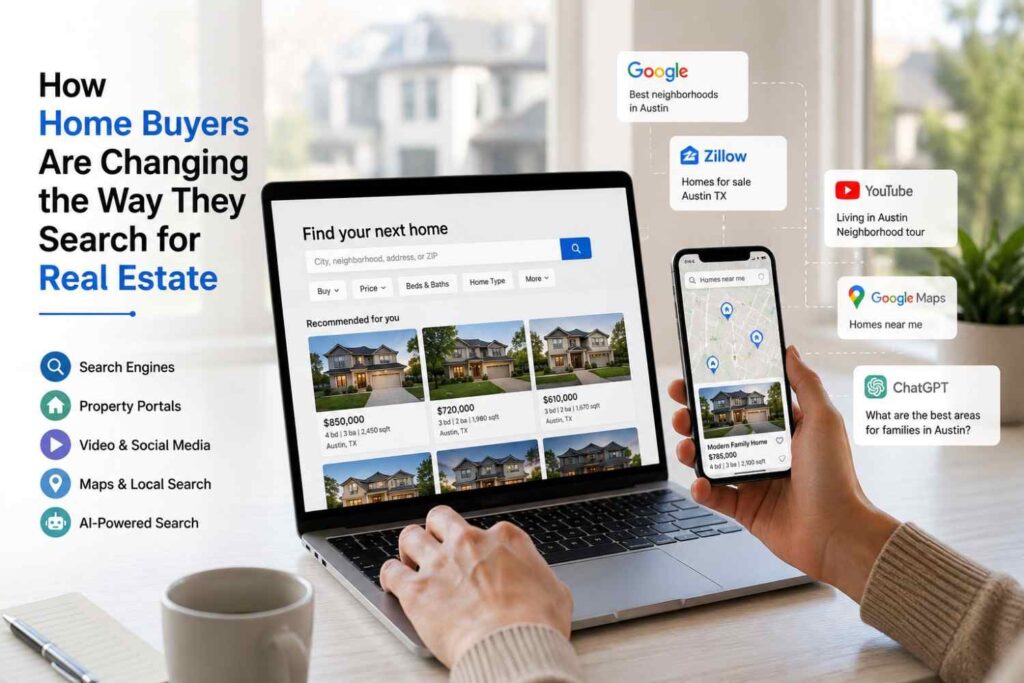
For years, the digital home search followed a fairly predictable pattern.
A buyer would visit a property portal, enter a location, set a price range, select a few filters and start scrolling through listings. Eventually, they might contact an agent, schedule a viewing and move deeper into the buying process.
That journey still exists. However, it no longer tells the whole story.
Today’s buyers move between real estate websites, mobile apps, Google, Maps, social media, video, neighborhood research and, increasingly, AI-powered search tools. They may research schools before looking at homes, watch a dozen neighborhood videos before speaking to an agent, or ask an AI assistant to compare areas based on commute time, lifestyle and affordability.
The search for a home is becoming less like filling out a form and more like an ongoing research process.
That shift matters for real estate professionals.
A brokerage or agent can no longer assume that visibility on one property portal—or even a strong position in traditional Google search—is enough to reach a modern buyer. The buyer may encounter your brand, listings and expertise across several different environments before deciding whether to contact you.
The important question is no longer simply:
“Where do buyers search for homes?”
It is becoming:
“Where do buyers go to understand their options, and are you visible when they get there?”
The Home Search Has Become a Multi-Channel Journey
Property portals and real estate apps remain an important part of the buying process. Zillow’s 2025 research found that 79% of buyers installed a real estate app during their homebuying journey, while prospective buyers also reported regularly viewing homes through major real estate websites. (Zillow)
However, buyers do not stay inside one platform.
A person considering a move to a new city may begin by searching for homes. Soon after, the questions become more complicated.
What are the best neighborhoods for families?
How long is the commute?
What is changing in the local market?
Are prices expected to rise?
Which areas offer better schools, restaurants or access to parks?
Could this neighborhood fit their lifestyle five years from now?
A property listing alone cannot answer all of those questions.
As a result, the modern home search often moves through several channels before the buyer is ready to speak with a real estate professional.
Property Search Is Only One Part of the Research
Finding available homes is relatively easy.
Understanding whether a location is the right place to live is much harder.
That distinction is important because buyers increasingly research the context around a property, not just the property itself. Neighborhood characteristics, schools, local amenities, commuting patterns, housing inventory and market conditions can all influence the decision.
For a real estate professional, this creates an opportunity.
The agent who only publishes listings is competing for attention at one stage of the journey. The agent or brokerage that helps buyers understand a market can become useful much earlier.
That usefulness can shape who the buyer remembers when it is finally time to make contact.
Buyers Are Often Researching Before They Raise Their Hand
A website form submission or a phone call doesn’t necessarily mark the beginning of the buyer journey.
In many cases, it marks the point at which the buyer has already done substantial research.
Zillow’s 2025 data shows that online resources play a meaningful role in how buyers find the agents they eventually hire, while a significant share of buyers discover agents through websites, apps, search engines and social platforms. (Zillow)
This creates a visibility challenge for real estate businesses.
If your digital strategy only focuses on capturing buyers who are already ready to schedule a viewing, you may be entering the conversation late.
Buyers Are Searching for Answers, Not Just Listings
The language of real estate search is changing.
Traditional search was largely filter-based:
Homes under $800,000.
Three bedrooms.
Brooklyn.
For sale.
Those searches still matter. Yet buyers are increasingly describing what they want in more human terms.
They may search for:
A quiet neighborhood near Manhattan with good schools and more space.
Or:
Areas in Austin where I can buy a family home and still have a reasonable commute.
Or:
Should I buy in this neighborhood now or wait another year?
These are not simply property searches.
They are decision-making questions.
Realtor.com has also introduced AI-powered conversational property search built around the idea that consumers want to describe what they are looking for naturally rather than relying only on rigid filters. In a related survey, 62% of current and potential buyers said they wanted to describe what mattered to them and receive meaningful results. (National Association of Realtors)
The Search Query Is Becoming More Specific
As search becomes more conversational, the information a buyer provides can become richer.
Instead of searching:
“Homes in Miami”
a buyer might describe:
“I want a home near Miami with access to good schools, outdoor space and a commute under 40 minutes.”
The second query reveals considerably more about intent.
It also means that real estate businesses need to think beyond isolated keywords.
A buyer is not necessarily looking for a page that repeats “Miami homes for sale” twenty times. They are trying to solve a more complicated problem.
The businesses that provide useful information around those decisions have more opportunities to become part of the research process.
AI Is Becoming Another Layer of Real Estate Research
AI has not replaced real estate professionals. Nor has it replaced property websites.
Instead, it is becoming another place where buyers can ask questions, compare options and make sense of complicated information.
A 2025 Realtor.com survey found that 82% of surveyed Americans interested in buying or selling—or who had recently done so—reported using AI for real estate insights. ChatGPT and Gemini were among the most commonly used platforms in that survey. At the same time, respondents continued to rate real estate agents as their most trusted and accurate source of market information. (Realtor)
That combination is worth paying attention to.
AI may help buyers organize information, generate questions and compare options. Yet when the decision becomes personal, local and financially significant, professional expertise remains highly valuable.
Buyers Can Ask Better Questions Before Contacting an Agent
Consider the difference between these two questions:
“Best neighborhoods in Dallas.”
and:
“Which Dallas neighborhoods are best for a young family moving from New York, with a budget of $900,000 and a preference for walkability?”
The second question is closer to the kind of conversation a buyer might eventually have with an agent.
AI tools make it easier to ask these longer, more detailed questions early in the research process.
For real estate professionals, this changes what digital visibility can mean.
It is no longer enough to consider whether you rank for a short list of property-related keywords. You should also consider whether your expertise, market knowledge and business are visible when buyers research broader questions around locations, property types and lifestyle decisions.
This Doesn’t Mean Agents Should Chase Every AI Trend
There is already plenty of noise around AI search.
Real estate professionals do not need to rebuild their entire marketing strategy around trying to “rank in ChatGPT.”
The stronger approach is more fundamental.
Build a digital presence that clearly explains:
- who you help;
- which markets you understand;
- what types of properties or clients you specialize in;
- what questions you can answer;
- and what evidence supports your expertise.
The same qualities that help a prospective client understand your value can also make your business easier for modern search systems to interpret.
Social Media Has Become Part of the Research Process
Real estate has always been visual.
Social media has expanded that advantage.
A buyer can now explore a neighborhood through short-form video, watch a walkthrough of a property, follow an agent’s local market updates or get a sense of an area’s lifestyle without visiting it in person.
Realtor.com’s 2025 survey found that nearly 90% of respondents relied on some form of social media for housing-related content. YouTube and Facebook were particularly widely used, while TikTok had stronger adoption among younger respondents. (Realtor)
Zillow also found that an agent’s social media presence can influence prospective buyers. Overall, 41% said they were more likely to hire an agent with a social media presence, with the effect stronger among younger groups. (Zillow)
Buyers Are Looking Beyond Perfect Property Photos
A polished listing photo is useful.
But buyers increasingly want a better sense of reality.
They want to know what the street feels like. They want to see the neighborhood, nearby restaurants, schools, parks and commuting options. They may be interested in local events, development plans or even the practical details that rarely appear in a property listing.
This creates room for a different type of real estate content.
An agent doesn’t need to become a full-time influencer.
However, consistently sharing useful local insight can help a prospective buyer see the agent as someone who genuinely understands the market.
A video titled:
“What $1 Million Buys You in Three Different Chicago Neighborhoods”
may answer a much more useful question than another generic post announcing that a property is available.
The Agent Is Still Important—But the Moment of Contact Is Changing
The growth of digital research or strong SEO does not mean buyers no longer need agents.
Quite the opposite.
According to Zillow’s 2025 Consumer Housing Trends Report, 84% of buyers used a real estate agent, broker or REALTOR® during some part of their search, shopping or purchase process. NAR’s 2025 research similarly found that 88% of buyers purchased their home through an agent or broker. (Zillow)
What is changing is how buyers arrive at the relationship.
They may know more before the first conversation.
They may have already compared neighborhoods, studied listings, researched mortgage rates and read market reports. Some may have already formed opinions about which agents or brokerages appear to understand the area best.
The role of the agent therefore remains important, but digital research increasingly influences who gets considered.
Visibility Creates the Opportunity to Be Chosen
A buyer cannot evaluate an agent they never encounter.
That sounds obvious, yet it has major implications for real estate marketing.
Referrals remain important, but online research has become another significant path into the agent relationship. Zillow’s 2025 data found that websites and apps, search engines and social networks all contribute to agent discovery, while its research also points to a growing importance of online research in the broader agent-selection process. (Zillow)
For a real estate business, this means the digital presence should answer a simple question:
If a potential buyer discovers us today, will they quickly understand why we are relevant to their situation?
Local Expertise Is Becoming a Digital Asset
For decades, “local knowledge” has been one of the strongest selling points for real estate agents.
The difference today is that this knowledge needs to exist somewhere buyers can find it.
A brokerage may have twenty years of experience in a market. Its agents may understand every neighborhood, development and pricing pattern.
But if that knowledge only exists in private conversations, it has limited value during the research stage.
Turn Local Knowledge Into Useful Resources
Consider the questions buyers routinely ask.
Which neighborhoods are good for families?
Where are first-time buyers finding value?
What areas are changing?
Where can buyers find larger homes within a particular budget?
Which neighborhoods work well for commuters?
What should an out-of-state buyer know before moving?
Each of these questions represents an opportunity to create something genuinely useful.
The answer could take the form of a detailed guide, a video, a market comparison or a well-designed neighborhood page.
The format matters less than the usefulness.
A real estate business should not publish content simply because “SEO requires blogging.” The better objective is to document the expertise buyers are already looking for.
The Real Estate Website Has a Bigger Job to Do
Many real estate websites are built around listings.
That makes sense, but a modern buyer often needs more than a search interface.
By the time someone arrives on an agent’s or brokerage’s website, they may be trying to answer questions such as:
Do these people understand the market I’m considering?
Have they worked with buyers like me?
Can they help me understand the differences between these neighborhoods?
What happens after I contact them?
Why should I trust them with such a significant decision?
A website should help answer those questions.
Property Pages Are Not the Entire Experience
Listings are important, but they are also widely available.
What distinguishes one real estate business from another is often the interpretation around the listings.
Market expertise.
Local insight.
Negotiation experience.
A clear understanding of specific buyer types.
Evidence from previous transactions.
Those elements can help turn a website from a searchable property database into a useful decision-making resource.
The Path to Contact Should Feel Natural
A buyer who has just started researching may not be ready to schedule a consultation.
That doesn’t mean they are not valuable.
Someone comparing neighborhoods could benefit from a local guide. A first-time buyer may want a simple explanation of the purchasing process. An out-of-state family might be interested in a relocation resource.
Different stages of research call for different next steps.
The goal is not to force every visitor into the same “Contact Us” form.
It is to give them a reasonable way to continue the relationship.
What This Means for Real Estate Marketing
The home search is becoming more fragmented, but the underlying principle is straightforward.
Buyers are gathering information wherever it is easiest, most useful and most relevant to the question they have at that moment.
Sometimes that will be Google.
Sometimes it will be Zillow or Realtor.com.
Sometimes it will be YouTube.
Sometimes it will be an AI assistant.
Sometimes it will be a recommendation from a friend.
A real estate business cannot control every platform. Nor should it try to dominate all of them.
The more useful strategy is to build a strong foundation and extend it into the places that matter most to the business.
Start With a Clear Digital Identity
Your website, business profiles and content should consistently communicate:
Who do you help?
Where do you work?
What markets do you understand?
What type of buyer or seller are you particularly well positioned to serve?
These answers should be clear to both prospective clients and search systems.
Create Content Around Real Buyer Questions
Avoid producing generic content simply to increase the number of pages on the website.
Instead, identify recurring questions that arise during the actual buying process.
The strongest content often sits where a buyer needs help making a decision.
That might mean comparing neighborhoods, explaining market changes or helping someone understand the trade-offs between different locations.
Think Beyond Rankings
Ranking number one for a keyword can be valuable.
However, a buyer’s journey rarely follows one straight line.
They may search, watch, compare, leave, return, ask another question and eventually contact an agent weeks later.
Visibility should therefore be considered across the wider customer journey.
The important question is not only:
“Where do we rank?”
It is also:
“Where are potential buyers encountering us before they are ready to choose?”
The Future Home Search Will Feel More Like a Conversation
The direction of travel is clear.
Property search is becoming more flexible, more personalized and more conversational.
Buyers increasingly expect to describe what they want rather than translate their needs into a rigid set of filters. AI-powered real estate search tools are already being developed around this expectation, while survey data suggests that consumers are experimenting with AI alongside search engines, property platforms, social media and professional advice. (Realtor)
At the same time, the value of real estate expertise has not disappeared.
The modern buyer simply has more ways to research before deciding who deserves their trust.
That presents both a challenge and an opportunity.
A real estate professional with limited digital visibility may find it increasingly difficult to enter the buyer’s consideration set. On the other hand, an agent or brokerage that consistently shares useful expertise can build familiarity long before a prospect becomes a lead.
Final Thoughts
Home buyers are not abandoning traditional property search.
They are expanding it.
A modern buyer may begin with listings, move to Google, watch neighborhood videos, check local information, compare options through AI, read reviews and only then decide which real estate professional to contact.
For real estate businesses, that changes the role of digital marketing.
The objective is no longer simply to generate a website visit or rank for “homes for sale.”
It is to become visible and useful throughout a longer research journey.
The brokerages and agents that adapt will not necessarily be the ones publishing the most content or appearing on every possible platform.
They will be the ones who understand how their buyers search, what questions they ask and where they go for answers.
Because before a buyer chooses an agent, a brokerage or even a neighborhood, they spend time trying to understand their options.
The question for every real estate business is whether its expertise is part of that process—or whether buyers are finding someone else first.
Frequently Asked Questions
How are home buyers searching for real estate today?
Home buyers use a combination of property websites and apps, search engines, social media, video, local research and professional guidance. Zillow’s 2025 research found that real estate apps remain widely used, while online channels also play an important role in how buyers discover agents. (Zillow)
Are home buyers using AI to research real estate?
Yes. A 2025 Realtor.com survey of U.S. adults who were interested in buying or selling, or had recently done so, found that 82% had used AI for real estate insights. However, respondents still viewed real estate agents as the most trusted and accurate source of housing-market information. (Realtor)
Does social media influence how buyers choose a real estate agent?
It can. Zillow found that 41% of prospective buyers said they were more likely to hire an agent with a social media presence, with the influence stronger among younger buyers. (Zillow)
Do home buyers still use real estate agents?
Yes. Zillow reported that 84% of buyers used an agent, broker or REALTOR® during some part of the buying process, while NAR reported that 88% of buyers purchased their home through an agent or broker in its 2025 research. (Zillow)
What should real estate businesses do to adapt to changing search behavior?
They should build a strong digital foundation around clear positioning, accurate local information, useful market and neighborhood content, an effective website and visibility across the channels their ideal clients actually use. The goal is not to chase every new platform, but to make the business easier to discover and easier to understand throughout the buyer’s research journey.
Are Home Buyers Finding Your Real Estate Business?
The way people research property is changing. A strong digital presence can help your brokerage or real estate business become visible across search, local discovery, content and emerging AI-powered search experiences.
[Explore Real Estate Digital Marketing →]
[Explore AI Search & GEO Optimization →]
[Explore Local SEO Services →]