
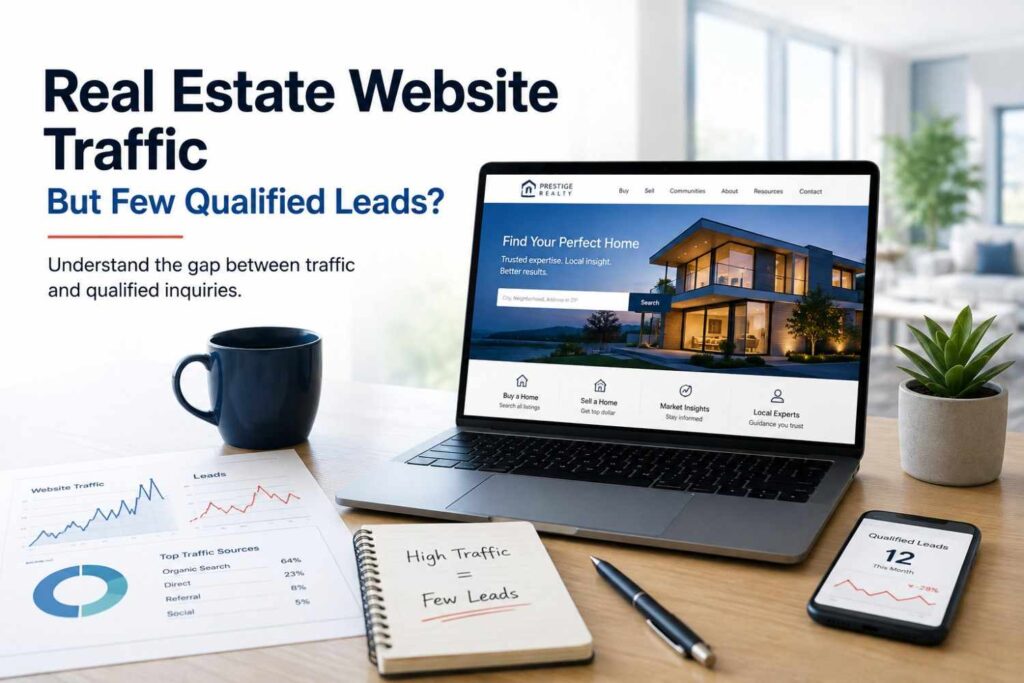
A real estate website can look successful in a monthly report.
Organic traffic is growing. Property pages are receiving visits. Blog content is attracting readers. Google Search Console shows more impressions, and analytics reports hundreds or even thousands of visitors.
Yet the phone is not ringing enough.
The inquiry forms are inconsistent.
And many of the leads that do arrive are not the people the business actually wants to work with.
This is a common problem because traffic and demand are not the same thing.
A visitor can find your website without needing your services. Someone may be researching a neighborhood, checking property prices, reading a market update or casually browsing listings. Another visitor may be seriously preparing to buy, sell or relocate.
Both count as a website visit.
Only one may represent a meaningful business opportunity.
That distinction is becoming increasingly important as more of the real estate journey happens online. Zillow’s recent research found that online research plays a meaningful role in agent selection, while buyers often narrow their options before making direct contact.
For a real estate business, the challenge is therefore not simply getting more people to the website.
It is understanding whether the website is attracting the right people—and whether it gives those people enough reason to take the next step.
A High-Traffic Website Can Still Have a Lead Problem
Website traffic is an activity metric.
Qualified leads are a business outcome.
Those two things are connected, but they are not interchangeable.
Imagine a real estate website receiving 10,000 visits per month.
A large share of those visitors may be arriving through searches such as:
- Things to do in a neighborhood
- Average home prices
- Famous houses
- General market information
- Property-related questions with no immediate buying or selling intent
That traffic may be useful for building visibility. It can also help establish topical authority.
However, it should not automatically be treated as evidence that the website is generating demand.
At the same time, a page receiving only 300 visits per month could be far more commercially valuable if those visitors are searching for:
Luxury real estate agent in Miami
or:
Relocation specialist for families moving to Austin
The difference is intent.
This is why the question should not simply be:
“How much traffic are we getting?”
A more useful question is:
“What type of people are arriving, and what were they hoping to accomplish when they got here?”
The Wrong Traffic Can Make a Website Look Healthier Than It Is
SEO can produce impressive-looking numbers.
A well-performing article might attract thousands of visitors. A neighborhood guide could rank for dozens of searches. Property pages may receive regular impressions.
However, visibility only becomes commercially valuable when it connects with the business the company wants to build.
Informational Interest and Buying Intent Are Different
Consider these two searches:
“Average home price in Brooklyn”
and:
“Brooklyn buyer’s agent for a $2 million home.”
Both are related to real estate.
The first search may come from a student, journalist, homeowner, investor or someone casually researching the market. The second search communicates a much clearer commercial need.
Neither type of content is automatically better.
The problem appears when a business invests heavily in attracting broad informational traffic while assuming those visitors will naturally turn into qualified clients.
They often won’t.
A strong real estate SEO strategy should create a balance between:
- broad market visibility;
- local authority;
- buyer and seller education;
- commercial service pages;
- high-intent location pages;
- and content for specific client needs.
The goal is not to eliminate informational traffic.
It is to make sure the website also has clear paths for visitors whose research is moving closer to a transaction.
Visitors Often Need More Than a Property Listing
Real estate websites frequently make one assumption:
If people find the right property, they will contact us.
Sometimes they will.
But purchasing property is rarely that simple.
Buyers may be comparing locations, evaluating affordability, researching schools, understanding market conditions or trying to decide whether a particular area fits their lifestyle.
NAR’s home buyer research continues to show that buyers use multiple information sources throughout the process, while agents remain highly important in helping buyers navigate complex decisions.
This creates an important opportunity for the website.
A property listing can show what is available.
Your website should also help explain what the buyer needs to understand before making a decision.
Context Can Create the Difference Between Browsing and Trust
Suppose a family is considering moving to a new city.
They may find a suitable home on your website.
But before contacting an agent, they still want answers.
What is the neighborhood like?
What should they know about the local market?
How long is the commute?
Are there similar areas worth considering?
What does the buying process look like for an out-of-state family?
A website that provides useful answers reduces uncertainty.
A website that only displays listings leaves the visitor to continue researching somewhere else.
That does not mean every page needs to become a 3,000-word guide.
It means the website should recognize that the property is often only one part of the decision.
Your Website May Not Explain Why Someone Should Choose You
This is one of the most overlooked conversion problems in real estate.
Many websites tell visitors:
We are a leading real estate agency.
We provide exceptional service.
Our experienced agents are here to help.
The problem is that almost every competitor says something similar.
None of those statements immediately answers the visitor’s more important question:
“Why are you the right choice for my situation?”
General Positioning Creates a General Impression
A real estate business does not necessarily need to serve one narrow audience.
However, its expertise should still be easy to understand.
For example:
We help families relocating to Austin understand neighborhoods, schools and the local buying process before they make a move.
This immediately communicates:
- who the business helps;
- where it operates;
- and what type of value it provides.
Compare that with:
Your trusted real estate partner.
The second statement sounds professional.
The first gives the visitor something specific to remember.
Zillow’s research has also highlighted the importance of online information in how buyers evaluate agents, including reviews, agent or brokerage websites, past performance and evidence of local market knowledge.
Your website is therefore doing more than presenting listings.
It is helping a potential client decide whether you understand their needs.
Trust Often Breaks Down Before the Contact Form
A visitor may like a property.
They may even like your website.
That still does not mean they are ready to provide their phone number.
Real estate decisions involve significant financial and personal commitments. Before contacting an agent or brokerage, buyers often want evidence that they are dealing with someone credible.
A modern real estate website should therefore make trust easy to find.
Not hidden on an isolated About page.
Not buried in a footer.
Visible where the visitor is making decisions.
Trust Signals Should Support the Decision
Depending on the business, useful signals may include:
- client reviews;
- transaction experience;
- market expertise;
- local knowledge;
- recognizable media features;
- relevant certifications;
- case studies or client stories;
- clear agent profiles;
- neighborhood specialization.
The purpose is not to fill the page with badges.
It is to answer a natural concern:
“Can these people actually help someone like me?”
The closer your proof is to the visitor’s specific situation, the stronger it becomes.
A relocation client may care about different evidence than a luxury buyer.
A first-time buyer may need a different level of reassurance than an experienced investor.
One Generic CTA Cannot Serve Every Visitor
This is where many otherwise attractive real estate websites lose opportunities.
Every page ends with:
Contact Us
or:
Book a Consultation
Those calls to action are useful for visitors who are ready.
But many visitors are still researching.
Forcing every person into the same conversion path creates unnecessary friction.
Different Stages Require Different Next Steps
Someone ready to buy may want to:
Schedule a consultation.
Someone moving from another state may prefer:
Download the relocation guide.
A visitor comparing neighborhoods might want:
Explore neighborhood guides.
A seller considering a move may be interested in:
Request a home valuation.
These actions do not replace the primary contact form.
They create additional entry points.
A website should help visitors move forward from wherever they currently are instead of demanding that everyone immediately become a lead.
The Website Experience May Be Working Against the Lead
A traffic problem and a conversion problem can look similar in a report.
Both can result in fewer inquiries.
However, the underlying issue may be completely different.
Sometimes the website is attracting the right visitors, but the experience makes it difficult for them to continue.
Friction Is Often Small but Expensive
The problem does not always involve a broken website.
It may be something simpler.
The main message is unclear.
Important information takes too long to find.
The mobile experience is frustrating.
The inquiry form asks for too much information.
Property pages are difficult to compare.
The website feels outdated compared with the platforms buyers use every day.
Individually, these issues may appear minor.
Together, they can create a simple outcome:
The visitor leaves and continues the search elsewhere.
Realtor.com, Zillow and other major platforms continue to invest heavily in improving the search experience, personalization and engagement. Realtor.com’s recent work on conversational AI search, for example, reflects a broader shift toward making property discovery feel easier and more natural.
Independent brokerages do not need to replicate those platforms.
They do, however, need to consider the experience visitors have come to expect.
Traffic From Search Is Not Always the Same Quality
Where a visitor comes from can influence what they expect from the website.
Someone arriving from a broad Google search may still be learning.
A visitor clicking from a specific local search may have a stronger need.
Someone returning directly to the website after researching your business elsewhere may already have a higher level of familiarity.
The source matters.
So does the page they land on.
Look Beyond the Total Traffic Number
Instead of evaluating the website only through sessions, consider:
- Which pages generate inquiries?
- Which traffic sources produce qualified leads?
- What searches bring commercially relevant visitors?
- Which locations create meaningful demand?
- Where do qualified visitors leave the website?
- Which pages assist conversions before someone contacts the business?
This can reveal something important.
The pages receiving the most traffic are not always the pages creating the most value.
A smaller number of high-intent visitors can often be more important than a large audience with no immediate reason to act.
A Strong Real Estate Website Connects Search Intent With Action
The most effective websites do not treat SEO and conversion as separate projects.
They work together.
A page should consider:
Why did this visitor arrive?
Then:
What information do they need now?
And finally:
What is the most appropriate next step?
This creates a more useful structure.
A visitor searching for neighborhood information may arrive on a detailed local guide.
From there, the website could naturally introduce:
- available properties;
- related neighborhoods;
- local market insights;
- the relevant agent or team;
- and an appropriate way to ask a question.
That journey feels more natural than immediately placing a large:
CONTACT US NOW
button in the middle of the page.
The visitor has already received value.
The next action now has context.
Real Estate Websites Need to Compete Beyond Listings
Listings are important.
But listings are also widely available.
The same property can often be found across multiple portals, brokerage websites and property platforms.
That makes the broader experience increasingly important.
Why should someone continue their journey on your website?
What can they understand here that they cannot easily find somewhere else?
Why should they remember your business after leaving?
The answer is usually not more listings.
It is better context, clearer expertise and a more useful path through the buying or selling journey.
This could include:
- market-specific resources;
- neighborhood comparisons;
- relocation information;
- buyer or seller guides;
- specialist landing pages;
- clear explanations of your process;
- and evidence that supports your expertise.
A website should not simply display inventory.
It should help a potential client make progress.
More Traffic Is Not Always the Right Solution
When lead volume is low, the immediate reaction is often:
We need more traffic.
Sometimes that is true.
However, increasing traffic to a weak conversion experience can simply increase the number of people who leave without contacting you.
Before investing more into SEO, paid advertising or content production, it is worth understanding where the gap actually exists.
A simple framework can help:
| Stage | Question |
| Visibility | Are the right people finding the website? |
| Relevance | Does the landing page match what they were searching for? |
| Understanding | Can visitors quickly understand what you offer? |
| Trust | Is there enough evidence to support the decision? |
| Experience | Is it easy to find information and continue? |
| Action | Is the next step appropriate for the visitor’s stage? |
| Qualification | Are the resulting inquiries aligned with your ideal client? |
A problem at any stage can reduce qualified leads.
The solution should match the actual problem.
What Should Real Estate Businesses Measure Instead?
Traffic still matters.
Search rankings still matter.
But they should be connected to stronger business metrics.
Consider tracking:
Qualified inquiries
How many leads actually match your target market or service?
Conversion paths
Which pages did qualified leads visit before contacting you?
High-intent landing pages
Which service, location or specialist pages generate the strongest results?
Lead source quality
Which channels consistently produce prospects rather than casual visitors?
Assisted conversions
Which content helps build familiarity before a visitor eventually becomes a lead?
These metrics provide a more useful picture of whether the website is contributing to business growth.
A page with 500 monthly visitors and five qualified inquiries may be considerably more valuable than one with 20,000 visitors and no meaningful outcomes.
The Goal Is Not More Leads at Any Cost
A real estate business does not necessarily need hundreds of inquiries.
It needs the right conversations.
For a luxury brokerage, a small number of highly qualified prospects may be more valuable than thousands of casual visitors.
For a relocation specialist, success may mean attracting families who are genuinely preparing to move into a specific market.
For a local agency, it may mean improving visibility among homeowners who are actively considering selling.
That is why website strategy should begin with the desired client rather than the desired traffic number.
Once you know who the business is trying to attract, you can build the search, content and website experience around that audience.
Final Thoughts
A real estate website can receive plenty of visitors and still struggle to generate qualified leads.
The problem is not always a lack of traffic.
Sometimes the website is attracting the wrong intent.
Sometimes it fails to explain why the business is relevant.
Sometimes visitors need more information before they are ready to inquire.
And sometimes the path from research to action simply creates too much friction.
As online research continues to shape how buyers discover and evaluate real estate professionals, the website has become more than a digital brochure. It often contributes to the first impression and, increasingly, the decision about whether a prospect wants to continue the conversation.
The strongest real estate websites understand this.
They do not measure success only by how many people arrive.
They consider what happens next.
Because traffic is only the beginning.
The real value comes when the right visitor finds enough relevance, confidence and clarity to become the right conversation.
Frequently Asked Questions
Why does my real estate website get traffic but no leads?
Your website may be attracting visitors with low commercial intent, or it may not provide enough relevance, trust or clarity for qualified visitors to take the next step. Reviewing traffic sources, landing pages and conversion paths can help identify where the gap exists.
How can a real estate website generate more qualified leads?
Focus on attracting the right search intent, clearly communicating your specialization, providing useful local or market-specific information, building trust and creating appropriate calls to action for visitors at different stages of the buying or selling journey.
Is more website traffic always better for a real estate business?
No. A smaller number of highly relevant visitors can be more valuable than a large volume of broad informational traffic. Traffic quality and conversion potential should be evaluated alongside total visitor numbers.
What should a real estate website include to build trust?
Useful trust signals can include authentic client reviews, clear agent expertise, transaction experience, local market knowledge, relevant case studies and a transparent explanation of how the business helps clients.
Should every real estate website visitor be pushed to contact an agent?
Not necessarily. Some visitors are still researching and may respond better to useful next steps such as a neighborhood guide, market resource, property alert or relocation information. The contact option should remain accessible, but the journey should reflect different levels of readiness.
Is Your Website Attracting Visitors but Missing the Right Opportunities?
A strong real estate website should do more than generate traffic. It should help the right visitors understand your expertise, build confidence and take a meaningful next step.
[Explore Web Design & Development →]
[Explore Local SEO Services →]
[Explore AI Search & GEO Optimization →]