
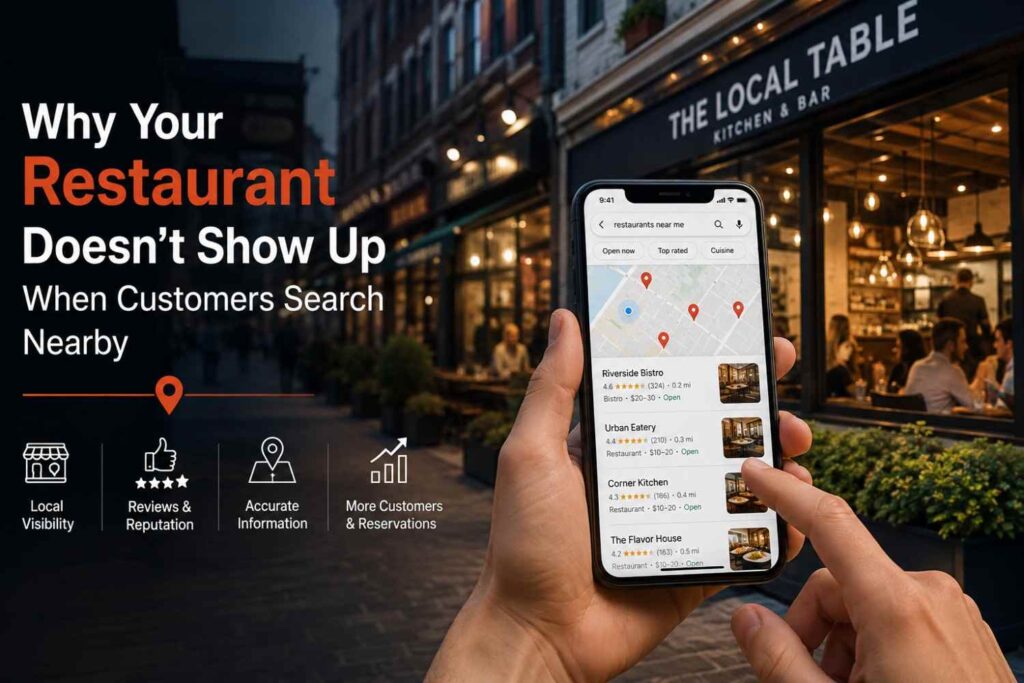
Imagine a customer is standing a few blocks from your restaurant and searching Google for somewhere to eat.
They type “Italian restaurant near me,” “best brunch near me,” or perhaps something more specific such as “family-friendly restaurant near [neighborhood].”
Your restaurant is right there. You serve exactly what they are looking for. Yet the businesses appearing in the local results are your competitors.
For a restaurant owner, this can be difficult to understand. You may have a good location, a strong menu, loyal customers and plenty of positive reviews. You may even have a website that looks better than some of the restaurants appearing ahead of you.
The problem is that being physically close to a customer doesn’t automatically make your restaurant the strongest local search result.
Google says local results are primarily influenced by relevance, distance and prominence. It also uses information from your Business Profile and other sources across the web to understand and evaluate local businesses.
So if your restaurant isn’t showing when nearby customers search, the answer usually isn’t as simple as “you need more SEO.”
There may be a gap between what your restaurant offers, what Google understands about the business, and what customers are actually searching for.
What Google Looks At When Someone Searches for a Restaurant Nearby
When someone searches for a restaurant on Google Maps or Search, the results aren’t simply a list of businesses sorted by physical distance.
Google’s own guidance identifies three primary factors: relevance, distance and prominence. These work together to determine which businesses are the best match for a particular search.
Understanding those three factors helps explain why a restaurant that’s two blocks away can sometimes appear below one that’s farther away.
Relevance to the Search
Relevance is about how well your business matches what the customer is looking for.
Someone searching for “Japanese restaurant” is giving Google a different signal from someone searching for “steakhouse,” “vegan restaurant,” or “late-night restaurant.”
Your Business Profile therefore needs to communicate what your restaurant actually is and what it offers. Google specifically recommends providing complete and detailed business information so it can better understand the business and match it with relevant searches.
This doesn’t mean adding every possible keyword to your profile. In fact, that can make the information less useful.
The better approach is to make the restaurant’s real positioning clear: its primary cuisine, dining format, services, location, hours, menu and other legitimate characteristics.
Distance and Location
Distance still matters.
If two restaurants are similarly relevant for a search, the one closer to the customer may have an advantage. Google calculates distance based on the searcher’s location and, when a location is specified in the query, the location included in that search.
However, distance isn’t a guarantee.
A restaurant that is farther away can still appear prominently if Google considers it a better match for what the customer is looking for.
That’s why simply saying “we’re closer” isn’t enough to explain local visibility.
Prominence and Reputation
The third factor is prominence—essentially, how well known or established Google understands a business to be.
Google says prominence can be influenced by information across the web, including links, articles and directories, as well as review count and ratings. It also notes that a business’s position in regular web search can play a role.
For restaurants, this is particularly important because customers have many alternatives.
A restaurant with a well-established local presence, substantial review history and strong online references may have a stronger overall prominence signal than a newer or less established competitor.
Why Your Restaurant May Be Missing From Local Search
The three factors above explain the broad picture. The more useful question for a restaurant owner is what might be weakening those signals in practice.
Usually, the problem isn’t one dramatic technical mistake. Instead, several smaller weaknesses can combine to make another restaurant look like the safer or more relevant result.
Your Google Business Profile Isn’t Sending Clear Signals
Your Google Business Profile is effectively your restaurant’s storefront on Google Maps and Search. Customers can see information such as your location, hours, website, photos, reviews and, for restaurants, menu information.
That means the profile shouldn’t be treated as something you set up once and forget.
The business category needs to accurately represent the restaurant. Your description should explain the business naturally. Hours should remain current, especially around holidays. Menu information should be accurate, and your photos should give customers a realistic sense of the dining experience.
Google’s restaurant-specific guidance also supports adding menu content, menu URLs, photos and videos, while giving restaurants tools for posts and review responses.
If the profile contains incomplete, outdated or conflicting information, you’re making it harder for both Google and customers to understand the business.
Your Website Doesn’t Reinforce Your Local Relevance
A restaurant’s Google Business Profile doesn’t exist in isolation.
Google says it can use publicly available information, including content from a business’s official website, alongside information from other sources when building local listings and search results.
Your website should therefore reinforce the same basic story.
If your Google profile says you’re an Italian restaurant in a particular neighborhood, but your website barely mentions the location or cuisine, the two properties aren’t working together as effectively as they could.
The website should make practical information easy to understand: where you’re located, what you serve, what type of dining experience you offer, your menu, opening hours, reservation options and the neighborhoods or communities you genuinely serve.
You’re Not Optimized Around the Searches Customers Actually Make
Restaurant owners often think about their business using the name they use internally.
Customers don’t necessarily search that way.
They may search for:
“Italian restaurant near me”
“best pizza near [neighborhood]”
“romantic dinner near me”
“family restaurant open now”
“brunch near [landmark]”
“vegan restaurant in [city]”
The right strategy isn’t to turn your website into a collection of awkward keyword phrases. Instead, understand the different ways customers describe the type of restaurant or dining experience they’re looking for.
That distinction matters because local search is ultimately about matching a business to a customer’s intent.
Your Reviews Aren’t Helping You Compete
Reviews influence how customers perceive a restaurant, but they also form part of the wider prominence picture Google considers in local search. Google specifically states that review count and review score can affect local ranking.
That doesn’t mean a restaurant should chase reviews purely as an SEO tactic.
A better approach is to build a consistent process for encouraging genuine customers to share their experience, responding appropriately to reviews and paying attention to recurring feedback.
Reviews can also reveal what customers value most.
If customers repeatedly mention your outdoor seating, seafood menu, service, atmosphere or Sunday brunch, that feedback can help you understand what differentiates the restaurant in the real world.
Your Local Information Is Inconsistent
Google gathers business information from several sources, not just the information a business owner enters directly. Its documentation notes that local information can come from the official website, third-party data, user contributions, reviews, photos and other sources.
That makes consistency important.
If your address, phone number, hours, restaurant name or other core information differs significantly between important platforms, customers may encounter conflicting information.
This is particularly frustrating for restaurants because opening hours and location are often part of the decision itself.
Someone searching for “restaurant open now” doesn’t have much patience for an outdated listing that sends them somewhere at the wrong time.
Your Competitors Have Built Stronger Local Authority
Sometimes your restaurant is doing many things correctly and still isn’t winning the local results.
The reason may simply be that competitors have stronger signals.
Perhaps they’ve been established longer. Maybe they have substantially more genuine reviews. Their website may have earned relevant mentions and links. Local publications may have covered them. Customers may regularly discuss them online.
Google describes prominence partly in terms of how well known a business is and considers information from across the web when evaluating it.
In that situation, changing one field in your Business Profile won’t suddenly close the gap.
You need to build a stronger local presence over time.
Being Visible on Google Maps Is Only Part of the Job
Getting into the local results is important, but it isn’t the final objective.
The customer still has to decide whether to visit, call, make a reservation or place an order.
That means restaurant Local SEO should be connected to the experience that follows the search.
What Happens After Someone Finds You?
A customer may discover your restaurant through Google Maps and immediately look at your photos, reviews, menu, hours and website.
Google’s restaurant Business Profile guidance specifically highlights metrics such as searches, menu interactions and bookings as useful performance indicators.
Those actions are much more meaningful to a restaurant than simply knowing that the profile appeared in search.
If customers are finding you but rarely clicking through to your menu, requesting directions, calling or booking, there may be another problem further down the journey.
Your Google Profile and Website Need to Work Together
Your Business Profile can get the customer to the door, metaphorically speaking.
Your website can provide the additional information that helps them decide.
A customer might want to see the full menu, understand the atmosphere, check private dining options, view a reservation system or learn whether the restaurant is suitable for a particular occasion.
If the profile promises one experience and the website communicates another, the customer has to work harder to make a decision.
A consistent journey makes that decision easier.
Don’t Optimize for Rankings Alone
A restaurant can celebrate appearing in the local pack while missing a more important question:
Are those searches turning into customers?
Track the actions that matter to the business.
Calls, website clicks, direction requests, menu interactions, reservations and orders tell you considerably more about the commercial value of local visibility than a ranking screenshot alone.
What a Strong Local Search Strategy Looks Like for a Restaurant
A restaurant’s local search presence should be treated as an ecosystem rather than a single Google profile.
The profile, website, reviews, local references, content and customer experience all contribute to how the business is discovered and evaluated.
Build a Strong Google Business Profile
Start with accuracy.
Use the most appropriate business category, maintain correct hours, provide complete business information, keep menu details current and add high-quality photos that represent the actual restaurant.
Google recommends keeping Business Profile information complete and accurate because this helps businesses appear in relevant local searches.
Strengthen the Restaurant Website
Your website should clearly communicate the restaurant’s identity and location.
Make the menu easy to find. Make reservations obvious. Include accurate contact and location information. Explain the dining experience rather than relying entirely on generic marketing language.
Most importantly, make the mobile experience easy to use. A large portion of restaurant discovery happens while people are already out, commuting or deciding where to eat.
Build Genuine Local Authority
Local authority isn’t something you can manufacture overnight.
It develops through legitimate mentions, relationships and customer experiences.
Local publications, neighborhood organizations, relevant directories, community events, partnerships and genuinely useful content can all contribute to the restaurant’s wider presence.
The focus should be on being genuinely present in the local community, not collecting hundreds of meaningless listings.
Develop a Review Strategy
Don’t wait for reviews to happen randomly.
Create a consistent process for asking satisfied customers to share honest feedback, then respond appropriately to the reviews you receive.
The goal isn’t to script what customers say. It is to make it easy for genuine customers to tell others about their experience.
Create Content Around Local Customer Intent
A restaurant doesn’t need a huge blog.
In many cases, a small amount of useful, well-targeted content can be more valuable than dozens of generic posts.
Consider questions customers actually ask:
Where can I host a private dinner in [city]?
What are the best restaurants near [landmark]?
Where can I take a family for dinner in [neighborhood]?
Which restaurants offer a good brunch for groups?
The content should only cover subjects that genuinely relate to the restaurant’s offerings and audience.
Measure Calls, Directions, Visits and Conversions
Local SEO should eventually connect to business outcomes.
Look at how many people discover the profile, but also monitor what they do next.
Google provides restaurant businesses with performance information that can include searches, menu interactions and completed bookings.
Combine that information with website analytics and your own reservation or ordering data to understand which parts of your local presence are actually generating business.
Why Restaurants Should Look Beyond Traditional Local Search
Google Maps remains central to local restaurant discovery, but the broader search environment is changing.
People increasingly ask more detailed questions instead of searching only for a category and location. A customer might want a quiet restaurant for a business dinner, a family-friendly place near a particular attraction, or a specific cuisine that accommodates dietary requirements.
These searches can contain considerably more context than “restaurant near me.”
Search Is Becoming More Conversational
The important point isn’t that restaurants should suddenly abandon local SEO and start chasing AI mentions.
Instead, think about what conversational search demands from a business.
If someone asks for a restaurant recommendation, the system needs enough reliable information to understand what each restaurant offers, where it is, what type of experience it provides and whether it is relevant to the request.
That reinforces many of the same fundamentals that already matter in local search: clear business information, useful website content, accurate profiles and a strong reputation.
Your Business Information Needs to Be Consistent and Understandable
When information about a restaurant is scattered across different platforms, inconsistencies can create confusion.
Google says it compiles local business information from multiple sources, including websites, third parties, users and business owners.
For restaurants, this makes it especially important to keep the basics aligned: business name, location, hours, phone number, website, menu and the description of what the restaurant actually offers.
A clearer digital footprint helps both customers and search systems make sense of the business.
A Better Way to Think About Restaurant Visibility
The restaurant’s objective isn’t simply to appear when someone searches.
The real journey looks more like this:
Search → Discovery → Evaluation → Action
A customer searches for something relevant.
Your restaurant appears.
They look at your rating, photos, menu and location.
Then they decide whether to call, visit, reserve a table or order.
Every stage matters.
A restaurant that ranks well but has outdated photos, confusing hours and a poor mobile website can still lose the customer.
Likewise, a restaurant with an excellent website won’t benefit fully if almost nobody discovers it in local search.
Visibility and conversion have to work together.
Read how a performance marketing approach for restaurant does wonders to it’s overall revenue.
What Should You Check First?
If you’re wondering why your restaurant isn’t appearing for relevant nearby searches, don’t start by changing everything at once.
Start with a simple comparison against the restaurants that consistently appear ahead of you.
Search Your Restaurant’s Main Categories
Search from the areas you actually serve using realistic customer phrases.
Don’t test only your restaurant name. Search for the categories, cuisines and experiences customers might use when they don’t know your business yet.
Compare Your Google Business Profile With the Top Competitors
Look at the completeness of their profiles, categories, photos, menus, reviews, hours and other information.
The objective isn’t to copy them. It’s to understand what Google and customers can see about businesses that are currently winning visibility.
Check Your Website’s Local Signals
Can someone immediately understand where you are, what you serve and what makes the restaurant worth visiting?
Can they find the menu and reservation options easily?
Does the website work well on a phone?
Look at Your Reviews
Consider both quantity and quality, but also read what customers actually say.
What do they praise? What do they complain about? Are there recurring themes that could strengthen your positioning?
Check What Happens After Someone Finds You
A local search result is only valuable if it leads somewhere useful.
Test the journey yourself:
Google → Business Profile → Website → Menu → Reservation/Order
If you encounter friction, your customers probably do too.
Final Takeaway
When a restaurant doesn’t show up for relevant nearby searches, it is tempting to blame Google or assume that a competitor simply has better SEO.
The reality is usually more nuanced.
Google is trying to determine which businesses are the best match for a particular search, using factors that include relevance, distance and prominence. A restaurant therefore needs more than a physical location to compete effectively. Its digital presence needs to clearly communicate what it offers, where it operates and why customers should trust it.
That starts with a well-maintained Google Business Profile, but it doesn’t end there. The website, reviews, local reputation, content and customer experience all contribute to the bigger picture.
Most importantly, restaurant owners should stop measuring local visibility purely by where they appear on a map.
The more useful question is whether nearby customers can discover the restaurant, understand the experience, trust the business and take action without unnecessary friction.
That’s what turns local search visibility into actual foot traffic, reservations and orders.
Restaurant Local SEO Frequently Asked Questions
Why doesn’t my restaurant show up on Google Maps?
Your restaurant may be missing from relevant local searches because Google does not consider the profile sufficiently relevant or prominent for that particular query, or because distance and other local factors favor competing businesses. Google identifies relevance, distance and prominence as the primary factors in local ranking.
How can I make my restaurant more visible in local search?
Start by claiming and verifying your Google Business Profile, keeping your information accurate, using an appropriate category, maintaining your menu and photos, encouraging genuine reviews, and making sure your website clearly supports the same information. Google recommends complete and accurate Business Profile information for improving local visibility.
Does my restaurant website affect Google Maps visibility?
Your website is part of the wider information Google can use to understand a local business. Google says it may use publicly available website content alongside other sources when compiling information for local search.
How important are Google reviews for restaurant SEO?
Reviews are important for both customers and local visibility. Google says review count and review score can contribute to local ranking through the prominence factor.
How long does restaurant Local SEO take to work?
There isn’t a universal timeline. Results depend on the restaurant’s current visibility, competition, location, website, reputation and the condition of its existing local presence. Local SEO is generally a process of strengthening multiple signals rather than making one change and expecting an immediate ranking jump.
Your Restaurant Should Be Easy to Find When Customers Are Ready to Eat
Gadget Majesty helps restaurants strengthen their Local SEO, Google visibility, website experience and digital customer journey so local searches have a better chance of turning into real visits, reservations and orders.