
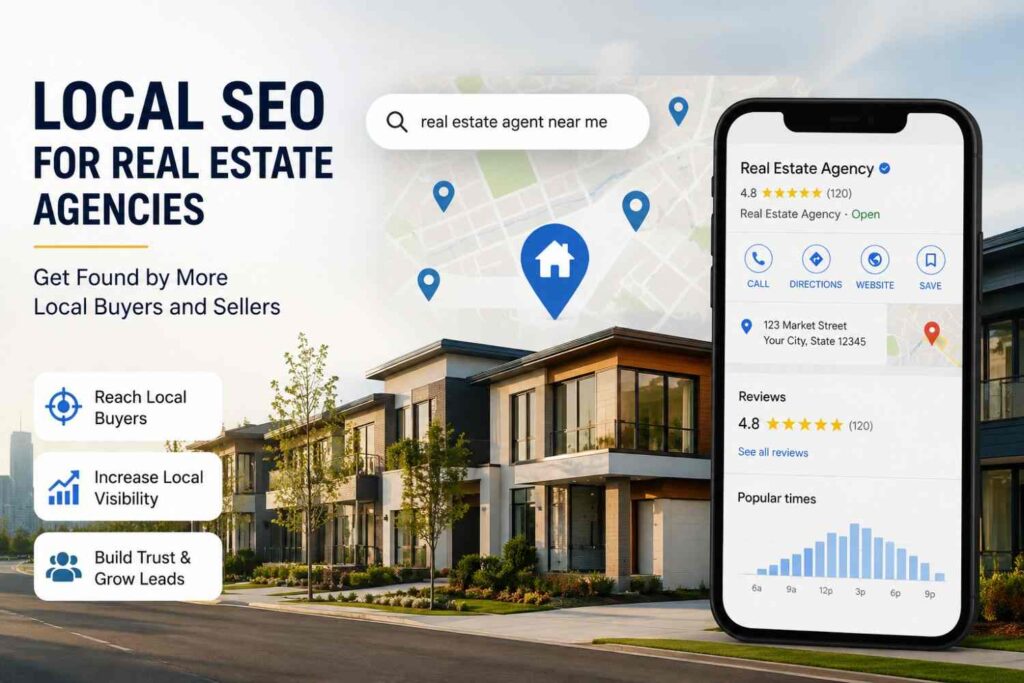
A real estate agency can have experienced agents, strong local knowledge, and an attractive website yet still remain difficult to find when potential clients search online.
That gap matters because many real estate decisions begin long before someone is ready to make contact. Buyers explore neighborhoods, compare areas, research property types, and look for professionals who understand the market. Sellers often follow a similar path, searching for local expertise before deciding which agency or agent deserves a conversation.
The challenge is not simply appearing in Google.
It is appearing in the right places, for the right searches, with enough relevance and credibility for a potential client to consider your business.
That is where Local SEO for real estate agencies becomes important.
A strong local presence can help connect your agency with people searching for real estate expertise in the markets you actually serve. However, effective Local SEO involves more than optimizing a business profile or adding city names throughout a website.
It requires a clearer connection between your business, locations, services, expertise, website, and the people searching for them.
Why Local Visibility Matters in Real Estate
Real estate is inherently local.
A buyer may be searching for:
- a real estate agent in a specific city;
- an agency that understands a particular neighborhood;
- homes in a certain area;
- advice about relocating;
- a specialist in luxury, commercial, or investment property.
A seller may search for an agency with experience in their local market or begin by researching property values and selling opportunities.
These searches do not all happen at the same stage of the journey. Some people are ready to contact an agent, while others are still gathering information.
For that reason, local visibility should not be viewed as a single ranking opportunity.
It is part of a broader process of helping potential clients discover and understand your business.
The local search journey can look like this:
Local Search
↓
Business or Content Discovery
↓
Website or Business Profile Visit
↓
Evaluation of Experience and Relevance
↓
Contact or Further Research
If your agency is missing from the first stages, you may never have the opportunity to compete for the client later.
The Real Local SEO Problem: Google Needs to Understand Your Relevance
Many agencies approach Local SEO with one simple goal:
“We want to rank for real estate agent + city.”
That can be a valuable search opportunity. However, a sustainable strategy needs to go further.
Your digital presence should help search engines and potential clients understand:
- who your business is;
- what services you provide;
- where you operate;
- which locations you know well;
- what type of clients you serve;
- what areas or property categories you specialize in.
The stronger and more consistent this information becomes across your digital presence, the easier it is to build a clearer picture of your business.
A Local SEO Strategy Should Connect Three Areas
Your Business Presence
This includes the information people encounter when searching directly for your agency or discovering it through local search.
Your business name, services, location information, reviews, website, and other signals should present a consistent and accurate picture.
Your Website
Your website provides the space to demonstrate expertise in greater depth.
A potential client should be able to understand where you operate, what you specialize in, and how you can help them.
Your Local Authority
Local authority develops when your business demonstrates genuine knowledge and relevance within the markets it serves.
This can come through useful location content, market knowledge, community involvement, relevant expertise, and a website that provides more value than a collection of generic location pages.
Together, these areas create a stronger foundation than relying on one Local SEO tactic alone.
Where Real Estate Agencies Commonly Lose Local Visibility
Local SEO problems are often more complicated than a missing keyword.
In many cases, an agency already has a Google Business Profile and a website but still struggles to gain meaningful visibility.
The issue may exist elsewhere.
Your Google Business Profile Doesn’t Clearly Reflect Your Business
Your business profile may be one of the first things a potential client sees.
Incomplete information, weak service descriptions, outdated details, or limited activity can make it harder to communicate what your agency actually does.
The goal should not be to fill every available field with keywords.
Instead, focus on creating an accurate and useful representation of the business.
That includes making sure the core business information, relevant services, website, contact details, and other available information are properly maintained.
Your Website Doesn’t Clearly Show Where You Operate
A common mistake is assuming that mentioning a city name in the footer is enough to establish local relevance.
For an agency serving multiple areas, that rarely communicates much about the depth of your market knowledge.
Your website should help visitors understand the relationship between your business and the locations you serve.
Depending on the agency, this may involve dedicated resources around:
- cities;
- neighborhoods;
- communities;
- property markets;
- relocation;
- specialized locations.
The important distinction is between creating useful local resources and simply producing dozens of nearly identical pages with different place names.
The first approach can build value.
The second can create a weak experience for both users and search engines.
Your Competitors Have Stronger Local Signals
A competing agency may not necessarily have a better-looking website.
However, it may have spent years building a stronger connection with its local market online.
That could include:
- more established reviews;
- useful neighborhood resources;
- stronger local recognition;
- clearer service information;
- relevant mentions from other organizations;
- better location-focused content.
This is why Local SEO should not become an obsession with copying a competitor’s page structure.
Instead, study where they are visible and identify opportunities where your agency can demonstrate something more useful or distinctive.
Building a Local SEO Strategy Around Real Search Behavior
The strongest real estate Local SEO strategies are built around how people actually research property and real estate professionals.
Someone searching for an agent is not necessarily searching for the same thing as someone exploring neighborhoods.
Likewise, a person relocating to a new city may need very different information from a homeowner considering selling.
This creates multiple types of local search opportunities.
Service-Based Searches
These are searches from people looking directly for professional help.
Examples may include searches related to:
- real estate agents;
- real estate agencies;
- property specialists;
- buyer representation;
- selling services.
These pages should make it easy for a visitor to understand what your agency offers and why your expertise is relevant.
Location-Based Searches
Location matters throughout the real estate journey.
Potential clients may search for information related to cities, neighborhoods, communities, or specific markets.
This creates an opportunity to build useful local resources around areas your business genuinely understands.
A strong location page should answer more than:
“We provide real estate services in this city.”
It should provide context that helps someone researching the area make progress.
Research and Decision Searches
Not every future client is ready to search for an agency.
Some are asking broader questions.
They may be researching:
- the best neighborhoods for a particular lifestyle;
- relocation considerations;
- property market trends;
- buying or selling processes;
- local property characteristics.
This content can introduce your business earlier in the decision journey while demonstrating genuine market expertise.
Over time, these resources can support both organic visibility and trust.
Turn Local Knowledge Into Useful Digital Assets
One of the biggest advantages a real estate agency has is local knowledge.
The problem is that much of that knowledge never reaches the website.
It remains in conversations between agents and clients.
That creates a missed opportunity.
Your team already knows which questions buyers ask. You understand the differences between neighborhoods. You know what relocating families are concerned about and what sellers want to understand before choosing an agency.
That knowledge can become useful content.
Start With the Questions Clients Already Ask
Instead of beginning with:
“What keywords should we write about?”
Try asking:
“What do potential clients repeatedly need help understanding?”
The answers may lead to topics around neighborhoods, relocation, selling, investment, schools, transportation, property types, or local lifestyle considerations.
Keyword research can then help refine the opportunity.
This creates a healthier process:
Client Questions
+
Search Demand
+
Local Expertise
Useful Search-Focused Content
The result is more likely to feel valuable than content created purely to target a phrase.
Local SEO Doesn’t End When Someone Finds Your Website
Getting discovered is only one part of the process.
Suppose a potential seller searches for a local agency, finds your website, and clicks through.
What happens next?
If the website feels generic, slow, confusing, or disconnected from the search that brought them there, the opportunity can disappear.
That is why Local SEO and website experience should work together.
Match the Landing Experience to the Search Intent
A person researching a specific neighborhood should not necessarily land on a broad homepage with no relevant information.
Similarly, someone looking for a local real estate agency should quickly understand:
- who you are;
- where you operate;
- what you specialize in;
- how you can help;
- what the next step looks like.
The path between discovery and contact should feel natural.
A website does not need aggressive pop-ups or excessive calls to action to encourage conversion.
Often, clarity does more work.
Reviews and Reputation Are Part of the Local Decision Process
Real estate decisions involve trust.
People are often choosing someone who may guide a major financial or personal decision.
As a result, reviews and reputation can influence what happens after your agency becomes visible.
A potential client may discover you through search and then immediately look for evidence of other people’s experiences.
That makes reputation part of the wider local visibility ecosystem.
The objective should not simply be to collect as many reviews as possible.
Instead, agencies should develop a sustainable process for encouraging genuine feedback from clients and maintaining an active, trustworthy public presence.
A strong reputation cannot compensate for poor visibility.
However, visibility without trust can also limit conversion.
Both matter.
Avoid the “One Page for Every City” Approach
Scaling Local SEO can be tempting.
An agency serving 30 cities might assume it needs 30 nearly identical pages.
In practice, that can create a weak website.
Changing only the city name while keeping the rest of the content largely identical does little to demonstrate genuine local expertise.
A better approach is to prioritize the locations that matter most to your business.
For each important market, consider:
- Is there enough unique information to create a useful resource?
- Do we have genuine experience in this area?
- What questions do clients have about this location?
- How is this market different from others?
- Can we provide insight that a generic competitor page cannot?
Quality should guide expansion.
A smaller group of genuinely useful local resources can be more valuable than a large collection of repetitive pages.
Measuring Local SEO Beyond Rankings
Ranking reports can be useful, but they should not become the entire measure of progress.
A broader view can help you understand whether your local visibility is creating meaningful opportunities.
Consider monitoring:
Search Visibility
Are impressions and clicks increasing for relevant local searches?
Website Engagement
Are visitors exploring relevant service or location pages?
Business Profile Activity
Are more people visiting your profile, calling, requesting directions, or clicking through to the website?
Lead Quality
Are the inquiries becoming more relevant to the markets and services you want to grow?
Conversion Paths
Which pages are helping visitors move toward a conversation?
These signals provide more context than a single keyword position.
After all, ranking first for an irrelevant search may do less for the business than appearing consistently for searches connected to genuine client needs.
Local SEO for Real Estate Is About Becoming Easier to Discover and Easier to Choose
The best Local SEO strategy does not treat Google Maps, your website, content, reviews, and conversion as completely separate activities.
They are connected parts of the same client journey.
A potential buyer or seller may discover your agency through one search, visit your website through another, and only decide to contact you after researching your reputation.
Your digital presence should support that process.
That means focusing on more than:
“How do we rank higher?”
A more useful question is:
“How can we make our local expertise easier to discover, understand, and trust?”
That shift creates a stronger foundation for sustainable local visibility.
How Gadget Majesty Approaches Real Estate SEO
Local visibility is only one part of the broader real estate search opportunity.
Your agency may need stronger organic visibility, better location relevance, more useful content, or a website experience that does a better job of turning relevant traffic into meaningful inquiries.
At Gadget Majesty, we look at how these areas connect.
Our Real Estate SEO approach can bring together:
- SEO strategy
- Local SEO
- Website optimization
- Content strategy
- Digital authority
- AI Search & GEO Optimization
The objective is not to apply the same package to every real estate business.
It is to identify where visibility and conversion opportunities are being lost and build a strategy around the areas that matter most.
Want to understand where your real estate business could improve its search visibility?
Explore our Real Estate SEO Services to see how SEO, Local SEO, content, website optimization, and AI search strategies can work together.
Frequently Asked Questions
1. What is Local SEO for real estate agencies?
Local SEO for real estate agencies is the process of improving how easily an agency can be discovered when people search for real estate services, agents, or property-related information in specific locations. It can involve your Google Business Profile, website, location-focused content, business information, reputation, and other signals that help establish local relevance.
2. How can a real estate agency improve its local search visibility?
The starting point is to make sure your business information is accurate and consistent, your website clearly explains where and how you operate, and your Google Business Profile is properly maintained. Beyond that, agencies can strengthen their presence by creating genuinely useful local content, building relevant authority, and improving the experience visitors have after discovering the business.
3. Does a real estate agency need a separate page for every location it serves?
Not necessarily. Creating a large number of nearly identical pages with only the location name changed can create a poor user experience. It is usually more effective to prioritize important markets and create location pages that offer genuinely useful, unique information about the area and your agency’s relevance to it.
4. Is Google Business Profile enough for Real Estate Local SEO?
A Google Business Profile can be an important part of local visibility, but it should not be the entire strategy. Potential clients may discover your agency through Google Maps, organic search, local content, reviews, or other search journeys. Your website and overall digital presence should support what people discover through your business profile.
5. How long does Local SEO take for a real estate agency?
The timeline depends on factors such as your current visibility, competition, locations you serve, website quality, and the strength of your existing digital presence. Some improvements may be visible relatively quickly, while building stronger local authority and sustainable search visibility typically requires consistent work over time.
6. How is Local SEO connected to generating real estate leads?
Local SEO can help your agency become visible to people searching for relevant services or information in your market. However, visibility alone does not guarantee leads. Your website, messaging, trust signals, and conversion experience also influence whether a visitor decides to contact you. The strongest strategy connects local discovery with a clear path toward meaningful action.
Final Thoughts
Local search can create valuable opportunities for real estate agencies, but visibility alone is not the finish line.
The businesses most likely to benefit from Local SEO are those that connect search optimization with genuine local expertise and a clear digital experience.
When potential clients can find your agency, understand what you know, and quickly see why your expertise is relevant to their needs, search visibility becomes more than a traffic source.
It becomes part of how new business opportunities begin.