
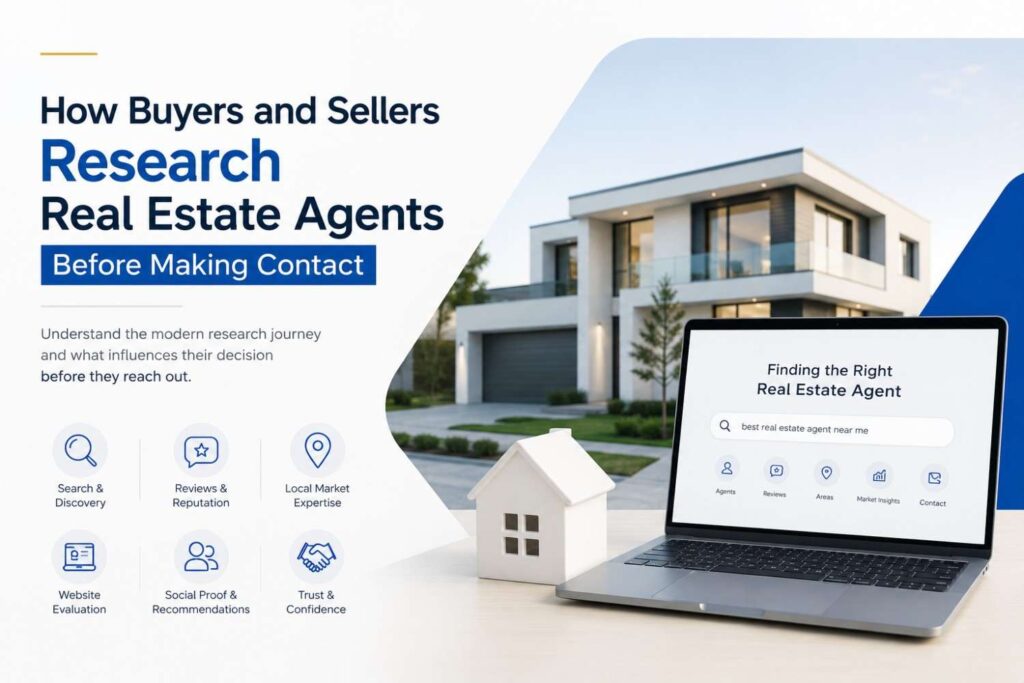
Choosing a real estate agent is rarely an impulsive decision.
Before a buyer or seller makes a call, fills out a form, or schedules a consultation, they often spend time researching their options. They search for agents in their area, compare websites, read reviews, explore local expertise, and look for signals that help them decide who understands their needs.
That research process has become increasingly fragmented.
Someone might first discover an agency through Google, visit its website later, check reviews on another platform, and return days afterward to search for a specific agent or service. In other cases, the journey begins with a broader question about a neighborhood or local market before the person starts comparing professionals.
For real estate businesses, this creates an important challenge.
Being found is only the first step. What potential clients discover after finding you can influence whether they move closer to making contact.
The Real Estate Decision Journey Starts Before the First Inquiry
Buyers and sellers do not all arrive at the same point with the same level of intent.
A seller may already know they want to list a property but still need to decide which agency to trust. A buyer might begin by researching neighborhoods and local market conditions months before contacting an agent.
As a result, real estate businesses need to consider more than searches such as:
“real estate agent near me”
Potential clients may also search for:
- agents who specialize in a particular area;
- agencies with experience in a specific property type;
- information about buying or selling in a local market;
- reviews and reputation;
- neighborhood expertise;
- relocation guidance;
- property market insights.
These searches may happen at different stages, yet they can all contribute to the same eventual decision.
Discovery Is Often Non-Linear
The path may look more like this:
Search → Discover → Research → Compare → Revisit → Contact
A potential client may leave your website without contacting you and return later after comparing several options.
That does not necessarily mean the first visit failed.
Real estate decisions often involve multiple research sessions, especially when the financial and personal stakes are high. The objective is to make sure that every meaningful interaction helps the person understand your expertise a little more clearly.
What Buyers and Sellers Look for When Comparing Real Estate Professionals
Once someone begins evaluating agents or agencies, visibility alone becomes less important.
The focus shifts toward relevance, credibility, and confidence.
Local Knowledge
For many clients, real estate is about more than buying or selling a property.
They want someone who understands the market around that property.
A buyer relocating to a new city may want insight into different neighborhoods. A seller may look for evidence that an agent understands current conditions in their area. Investors, luxury buyers, and commercial clients may have even more specialized requirements.
Your digital presence should make that expertise visible.
This does not mean every agent needs hundreds of pages of content. Instead, the website should provide clear evidence of the markets, locations, and client needs the business genuinely understands.
Reputation and Social Proof
People often look for reassurance before choosing a real estate professional.
Reviews, testimonials, client experiences, and other forms of social proof can help answer an important question:
“Have other people trusted this business with a similar decision?”
A strong reputation does not replace expertise. However, it can reinforce the confidence created by your website, search visibility, and messaging.
Consistency matters here as well.
If a potential client discovers a polished website but finds outdated business information or unresolved concerns elsewhere, that inconsistency can create uncertainty.
The goal is to create a more coherent picture of the business across the places where people are likely to research it.
A Website That Makes the Next Step Clear
A real estate website can receive substantial traffic and still struggle to generate meaningful inquiries.
One reason is that visitors may not immediately understand what distinguishes the agency or what they should do next.
The website should help answer practical questions:
- What markets do you serve?
- Who do you typically work with?
- What type of expertise do you offer?
- Why might someone choose your agency?
- What is the next step if they want to speak with you?
Those answers do not need to appear as a long list on every page. Instead, they should be woven naturally into the structure and messaging of the site.
Clarity often has a greater impact than simply adding more calls to action.
Search Visibility Influences Who Makes the Consideration Set
Before a client compares agencies, they first need to discover them.
This is where search visibility plays a larger role in the real estate decision journey.
If your agency consistently appears when people research relevant locations, services, and property-related questions, you have more opportunities to enter their consideration set.
That visibility can come from several connected areas.
Organic Search
Your website can appear when potential clients search for services, locations, property information, or questions related to the real estate process.
Local Search
Google’s local results can help people discover businesses operating in their area, particularly when they are actively looking for professional assistance.
Helpful Content
Useful articles and local resources can introduce your agency before someone is ready to choose an agent.
This is particularly valuable because many future clients begin with a problem or question rather than a direct search for a real estate agency.
The important point is that these channels should not operate independently.
A person who discovers your agency through an article should be able to understand your services. Someone who finds your business through local search should encounter a website that reinforces the relevance of that discovery.
Content Can Build Familiarity Before a Client Is Ready to Act
Not every visitor is ready to contact an agent.
Some are still learning.
They may be comparing neighborhoods, considering whether to sell, researching market conditions, or trying to understand the buying process.
Useful content gives a real estate business an opportunity to become part of that research.
However, the goal should not be to publish content simply because a keyword has search volume.
A stronger approach begins with the questions your potential clients actually ask.
Turn Real Client Questions Into Useful Resources
Your agents already have access to valuable insight.
Every week, they may answer questions about:
- local neighborhoods;
- property values;
- relocation;
- the selling process;
- investment opportunities;
- market changes.
Some of those questions may also be searched online.
When genuine client concerns are combined with search demand and local expertise, they can become valuable digital resources.
This approach creates a more natural relationship between SEO and content.
Instead of asking:
“What can we publish to rank?”
The better question is:
“What information would help the right potential client make a more informed decision?”
Search visibility can then become a result of creating content that genuinely serves the audience.
Buyers and Sellers Compare More Than One Business
A potential client may discover three or four agencies before deciding which one deserves a conversation.
That means your business is often being evaluated alongside competitors.
The comparison may happen consciously or subconsciously.
A visitor may notice:
- which website feels more relevant;
- who demonstrates stronger local knowledge;
- which agency has more convincing reviews;
- whether the business clearly explains its services;
- how easy it is to find useful information;
- whether the brand feels current and trustworthy.
You cannot control every comparison.
What you can control is how clearly your business communicates its value.
Make Your Expertise Easier to Understand
Many real estate businesses have genuine strengths that remain invisible online.
An agency may have decades of local experience, specialist knowledge, a strong referral network, or expertise with a particular type of client.
If those strengths are difficult to find, potential clients cannot easily factor them into their decision.
Your website and content should help bring that expertise forward.
Not through exaggerated claims.
Through useful evidence, clear positioning, relevant information, and a stronger overall digital experience.
The Role of AI Search in the Research Process
Search behavior is continuing to evolve.
People are increasingly comfortable asking broader questions rather than entering short keyword phrases. They may ask for recommendations, compare options, explore follow-up questions, or use AI-powered search experiences to understand a topic before visiting individual websites.
For real estate businesses, this creates another layer of discovery.
A potential client might ask an AI-powered search experience to compare neighborhoods, explain relocation considerations, identify what to look for when choosing an agent, or summarize options in a local market.
The fundamental challenge remains similar:
Can search systems clearly understand what your business knows, where you are relevant, and why your information deserves to be surfaced?
That is why strong SEO foundations, clear content, entity signals, structured information, and genuine authority continue to matter.
AI search does not replace the need for a well-structured digital presence. In many ways, it makes clarity even more important.
A Strong Real Estate Presence Supports the Entire Research Journey
It is tempting to treat SEO, website design, Local SEO, reviews, and content as separate marketing activities.
From the client’s perspective, they are often part of one experience.
Someone may discover you through search.
Then they visit your website.
Later, they read reviews.
A few days afterward, they return to explore a neighborhood guide or service page.
Eventually, they decide whether to contact you.
Each interaction contributes to the overall impression.
This Is Why Visibility and Conversion Need to Work Together
More traffic does not automatically create more qualified opportunities.
Likewise, an excellent website cannot help if the right people never discover it.
A stronger strategy connects:
Search Visibility → Relevant Discovery → Trust and Understanding → Meaningful Action
The goal is not to optimize every possible metric.
It is to reduce the gaps that prevent the right potential clients from moving through the research process.
How Real Estate Businesses Can Improve Their Digital Research Experience
There is no universal checklist that will work for every agency.
A local brokerage, luxury real estate firm, property developer, and relocation specialist may all have different audiences and search opportunities.
However, most businesses can start by examining a few connected areas.
Understand How Potential Clients Currently Find You
Look beyond direct website traffic.
Which searches are creating visibility? Which pages attract potential clients? Are people discovering your business through local search, informational content, or branded searches?
This can reveal where your strongest opportunities already exist.
Identify the Gaps Between Discovery and Contact
A visitor may arrive on the website and leave without taking action.
That does not automatically mean the traffic is poor.
The page may not match the search intent. Important information may be difficult to find. Alternatively, the visitor may simply need more time and information before making a decision.
Understanding these gaps can help prioritize improvements.
Strengthen the Evidence of Your Expertise
Consider whether your website clearly communicates what makes your agency relevant.
Can a visitor quickly understand your locations, specializations, services, and market knowledge?
If not, improving that clarity may be more valuable than simply publishing another generic blog post.
Build Content Around Genuine Decision Needs
Content should support real stages of the buyer or seller journey.
A useful neighborhood guide, market resource, or decision-focused article can help build familiarity before someone is ready to contact an agency.
Over time, those resources can strengthen both visibility and trust.
From Being Found to Being Considered
Real estate SEO is often discussed as a ranking exercise.
Rank higher.
Get more traffic.
Increase visibility.
Those metrics matter, but they only describe the beginning of the journey.
A stronger question is:
Once the right person finds your business, what helps them decide that you are worth considering?
The answer may involve your local expertise, website experience, content, reputation, service positioning, and the consistency of your overall digital presence.
When these elements support one another, search visibility can become more valuable.
Instead of simply attracting another website visit, it can create the beginning of a meaningful business relationship.
How Gadget Majesty Approaches Real Estate Search Visibility
Real estate businesses often face more than one visibility challenge.
An agency may need to improve its organic search presence, strengthen local relevance, turn underperforming website traffic into better opportunities, or create clearer content around the markets it serves.
These challenges are connected, which is why a broader view can be more useful than applying isolated tactics.
At Gadget Majesty, our approach can combine:
- SEO strategy
- Local SEO
- Website optimization
- Content strategy
- Digital authority
- AI Search & GEO Optimization
The objective is not simply to generate more impressions.
It is to understand how your potential clients discover, research, and evaluate your business—and then identify where opportunities are being lost.
Explore Our Real Estate SEO Services
Discover how we help real estate businesses strengthen visibility, improve digital experiences, and create a clearer path from search to meaningful opportunities.
[Explore Real Estate SEO Services →]
Final Thoughts
The decision to choose a real estate agent often begins long before the first conversation.
Buyers and sellers research. They compare. They revisit information. Over time, they form an impression of which businesses understand their needs and which ones feel relevant to their situation.
For that reason, real estate marketing should not focus only on getting found.
It should also focus on what people discover once they find you.
A strong digital presence makes your expertise easier to see, your services easier to understand, and the next step easier to take.