
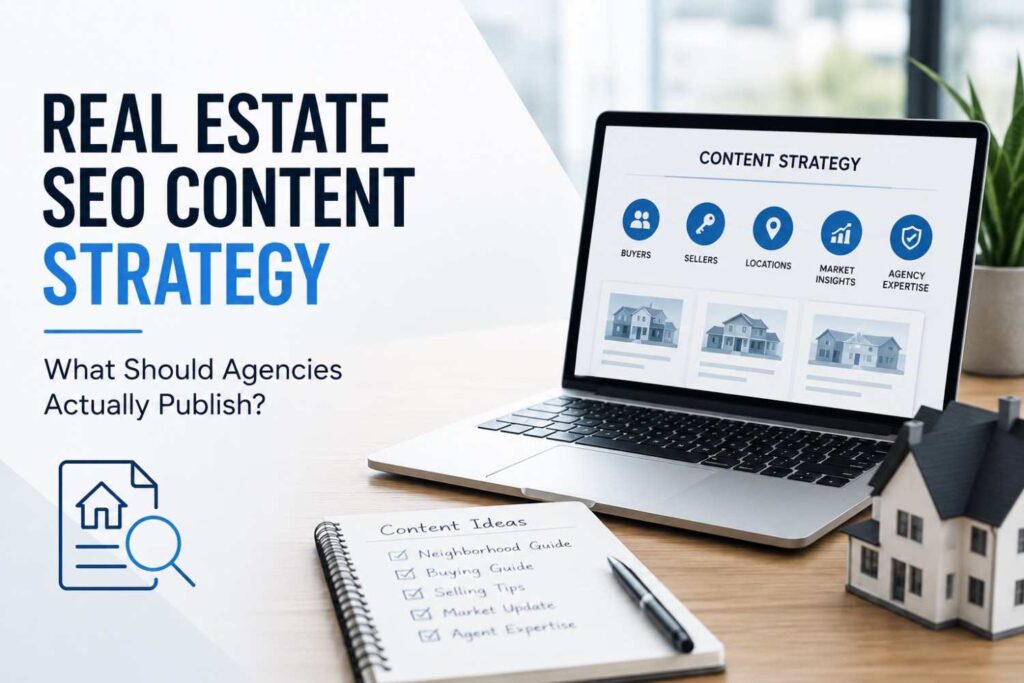
Most real estate agencies do not have a content problem.
They have a content direction problem.
A website may already contain property listings, service pages, a few neighborhood guides, and a blog that has been updated occasionally over the years. New articles are often published when someone finds a keyword idea or decides the website “needs more content.”
The result is usually a collection of pages rather than a strategy.
Some articles attract traffic but have little connection to the agency’s services. Others target topics that dozens of competitors have already covered without offering anything new. Meanwhile, important questions that buyers, sellers, and local clients actually have may never appear on the website at all.
A stronger Real Estate SEO Content Strategy begins with a different question:
What role should each piece of content play in helping the right person discover, understand, and eventually consider your business?
That shift changes how content is planned.
Instead of publishing because a keyword has search volume, agencies can build a content system around search behavior, client needs, local expertise, and commercial goals.
Content Should Have a Job, Not Just a Keyword
A keyword can tell you that people are searching for something.
It does not automatically tell you what your agency should publish.
For example, a high-volume search may attract visitors who have no interest in buying, selling, relocating, or working with a real estate professional. On the other hand, a lower-volume topic could attract people at an important stage of the decision process.
That is why content planning needs context.
Before creating a page, it helps to understand:
- Who is searching for this information?
- What are they trying to accomplish?
- Where are they in the property or decision journey?
- What expertise can your agency genuinely add?
- Where could this content naturally lead next?
When those questions are clear, keyword research becomes more useful.
It helps refine the opportunity rather than becoming the entire strategy.
A practical content framework looks like this:
Search Demand
- Client Need
- Agency Expertise
- Business Relevance
= Content Worth Creating
Not every topic needs to satisfy all four equally. However, the strongest long-term content usually sits where these areas overlap.
Build Around the Different Ways People Search
Buyers, sellers, investors, and relocating clients do not search for the same information.
Someone considering selling a home may want to understand property values or the selling process. A buyer might spend weeks researching neighborhoods before looking for an agent. An investor could be comparing markets, while someone relocating may have questions that extend far beyond property listings.
A useful content strategy recognizes these differences.
Rather than placing every topic into one generic blog, agencies can organize content around the major types of needs their audience has.
Service Content: Help People Who Are Already Looking for Professional Support
Some visitors are actively looking for help.
They may be searching for:
- a real estate agency in a particular market;
- a buyer’s agent;
- property selling services;
- relocation support;
- investment expertise;
- a specialist for a particular property type.
These searches often deserve dedicated service pages rather than blog articles.
A service page should clearly explain what the agency offers, who it helps, where the service is relevant, and why someone should consider taking the next step.
Content should support commercial pages, not compete with them
A common mistake is publishing several articles that all target nearly the same commercial keyword.
For example, an agency may create:
- “Best Real Estate Agency in [City]”
- “Top Real Estate Agency in [City]”
- “Leading Real Estate Agents in [City]”
Those pages can easily overlap in purpose.
A stronger approach is to create one clear commercial page and build supporting content around related questions, decisions, locations, or problems.
That creates a more understandable structure for both users and search engines.
Location and Neighborhood Content: Turn Local Knowledge Into a Search Asset
Local expertise is one of the most valuable advantages a real estate business can have.
The challenge is that much of this knowledge often stays inside conversations with clients.
Agents know which neighborhoods appeal to different lifestyles. They understand commuting challenges, local amenities, market differences, property types, and the questions people ask before moving to an area.
That knowledge can become genuinely useful content.
The goal is not to create a page for every location
A location strategy should focus on places where your agency has genuine relevance and something useful to contribute.
A strong neighborhood or location resource might explore:
- who the area may suit;
- local lifestyle considerations;
- housing characteristics;
- accessibility and commuting;
- market context;
- nearby amenities;
- common questions from buyers or relocating clients.
The exact structure will depend on the market.
What matters is that the page gives someone a reason to stay and explore.
Simply changing the name of the city or neighborhood inside a template rarely creates that value.
Think beyond “Where do we operate?”
A stronger question is:
“What does someone need to understand before making a decision about this place?”
That question can lead to far more useful content.
Buyer-Focused Content: Support Research Before Someone Is Ready to Contact You
Many potential clients begin their journey with research rather than a direct search for an agency.
They may be asking:
- Which neighborhoods should I consider?
- What should I know before moving to this area?
- How does the buying process work?
- What should I look for when comparing properties?
- What costs should I prepare for?
These searches may happen weeks or months before the person is ready to contact an agent.
That does not make them unimportant.
Useful buyer-focused content can introduce your agency early in the journey and create familiarity before a direct service need appears.
Build content around genuine decisions
Generic articles such as “10 Tips for Buying a Home” can be easy to publish but difficult to differentiate.
A more useful approach connects the topic to a real decision.
For example, instead of creating another broad article about buying property, an agency could explore the specific considerations that affect buyers in its market.
That gives the content a clearer purpose and allows the agency’s expertise to become part of the resource.
Seller-Focused Content: Answer Questions Before the Listing Conversation
Sellers have a different set of concerns.
They may be researching property values, preparing a home for sale, comparing agencies, or trying to understand what happens before a listing goes live.
This creates opportunities for content that supports the seller’s decision process.
Useful seller content can focus on:
- preparing a property for sale;
- understanding the local selling process;
- evaluating offers;
- choosing the right agent;
- understanding local market conditions;
- deciding when to sell.
The goal is not to create a separate article for every possible question.
Instead, look for recurring themes that matter to your ideal clients.
Sales conversations can be a valuable source of insight here. The questions people repeatedly ask your team may reveal opportunities that keyword tools alone would not immediately uncover.
Market Content: Demonstrate Expertise Without Publishing Commentary for Its Own Sake
Market updates are common across real estate websites.
The problem is that many of them are created because the agency believes it should publish a monthly update—not because the content has a clear purpose.
A report filled with numbers may be useful to an industry professional while offering little context to an ordinary buyer or seller.
A stronger approach interprets information.
Instead of simply presenting what changed, explain:
- what the change may mean;
- who may be affected;
- what local factors are worth watching;
- which assumptions clients should avoid;
- what questions a buyer or seller may want to consider next.
This is where professional judgment becomes valuable.
The data itself may be widely available. Your interpretation, local knowledge, and ability to explain its relevance can make the resource more useful.
Decision-Stage Content: Help Potential Clients Compare Their Options
Some of the most valuable content opportunities exist close to the point where someone is evaluating professional help.
A buyer or seller may be asking:
- How do I choose a real estate agent?
- What should I ask before hiring an agent?
- How do I compare real estate agencies?
- What experience should matter for my situation?
- What should I expect from a buyer’s or seller’s agent?
This type of content serves an important purpose.
It helps potential clients make a decision while giving your business an opportunity to demonstrate what you believe good professional service looks like.
The key is to keep the content genuinely useful.
If every answer immediately becomes:
“Choose us.”
the resource loses credibility.
A stronger approach provides an honest framework and allows your own expertise and positioning to become visible naturally.
Map Content to the Client Journey
A real estate website should not assume every visitor is ready to contact an agent.
Some people are discovering a market. Others are comparing options. A smaller group may be ready to take action.
Content can support these different stages.
Discovery
At this stage, people are often researching a question, location, lifestyle, or market.
Useful content may include:
- neighborhood guides;
- relocation resources;
- market explainers;
- buyer and seller education.
Consideration
Here, the person is narrowing options and looking for more specific information.
Content may focus on:
- property types;
- local market expertise;
- buying or selling decisions;
- agency specializations;
- comparisons and decision guides.
Decision
At this stage, the visitor may be actively looking for professional support.
Service pages, specialist pages, relevant case studies, testimonials, and clear contact pathways become increasingly important.
The stages are not always linear.
Someone can move from research to action quickly, while another person may return to the website several times over a few months.
The purpose of content is to provide useful next steps regardless of where the visitor currently sits.
Avoid Publishing Isolated Articles
One of the easiest ways to weaken an SEO content strategy is to treat every article as an independent project.
A stronger approach creates connections.
For example, a neighborhood guide can link to:
- related location resources;
- buyer guidance;
- relevant property services;
- relocation support.
A seller-focused article can lead toward:
- local market information;
- a selling service page;
- content about choosing an agent.
These connections help visitors continue their research.
They also give the website a clearer internal structure.
Think in content clusters, not individual posts
A useful cluster may look like this:
Core Commercial Page
↓
Supporting Service or Expertise Pages
↓
Decision-Focused Content
↓
Informational and Research Content
Each page should have a different job.
The goal is not to create as many links as possible. It is to create logical pathways between related information.
Start With Existing Knowledge Before Looking for More Topics
Before searching for another list of “100 Real Estate Blog Ideas,” look at what your business already knows.
Your team may have years of answers, observations, and local experience that have never been documented.
Start by collecting:
- frequently asked questions;
- recurring client concerns;
- common misconceptions;
- questions that delay decisions;
- locations people repeatedly ask about;
- problems that create confusion;
- insights your agents explain every week.
This becomes a valuable source of content ideas.
Keyword research can then help determine how those topics connect with existing search demand.
This creates a more sustainable editorial process
Instead of chasing random topics, your agency develops a repeatable system:
Listen to Clients
→ Identify the Underlying Question
→ Check Search Demand and Intent
→ Determine the Best Content Format
→ Connect It to a Relevant Next Step
Over time, this produces a website that reflects genuine expertise rather than a collection of disconnected SEO articles.
Know When Not to Create a New Page
More content is not always the answer.
Before publishing something new, ask:
- Do we already have a page serving this search intent?
- Would updating an existing resource be more useful?
- Is the new topic genuinely different?
- Can we add a perspective competitors are missing?
- Does this content support an important audience or business goal?
This is particularly important for larger websites.
Publishing several pages around the same topic can create confusion about which page should be the primary resource.
A focused content strategy is often as much about what not to publish as what to create.
Create Content That Reflects How Search Is Changing
Search behavior is becoming more conversational.
People increasingly ask complete questions, explore follow-up topics, compare options, and use AI-powered search experiences to summarize information before visiting websites.
That makes clarity more important.
Content should make it easy to understand:
- what the page is about;
- who it is for;
- what question it answers;
- where the information comes from;
- how the topic connects to your broader expertise.
This does not mean writing for an algorithmic system instead of people.
The same characteristics that make content easier for a person to understand—clear structure, useful explanations, specific expertise, and logical context—can also help search systems interpret the information.
For real estate agencies, this creates an opportunity to turn existing market knowledge into a more structured digital presence.
A Practical Real Estate Content Framework
Rather than maintaining an endless editorial calendar, organize content around a few clear areas.
1. What helps people find us?
Content around services, locations, and relevant search opportunities.
2. What helps people understand the market?
Neighborhood resources, market explainers, relocation guidance, and local expertise.
3. What helps people make a decision?
Buyer guides, seller resources, comparisons, and decision-stage content.
4. What helps people trust us?
Evidence of expertise, useful analysis, case studies, testimonials, and content that demonstrates genuine market understanding.
These areas should work together.
A useful neighborhood guide may improve discovery. At the same time, it can demonstrate local knowledge and introduce a visitor to the agency behind the resource.
That is more valuable than treating every page as a separate attempt to rank.
How Gadget Majesty Approaches Real Estate SEO Content
A content strategy should not begin with a requirement to publish a certain number of articles every month.
For some real estate businesses, the biggest opportunity may be improving existing location pages. For others, it may involve creating buyer and seller resources that address important gaps in the research journey.
The starting point is understanding the current website, audience, market, and search opportunity.
At Gadget Majesty, our Real Estate SEO approach can connect:
- keyword and search intent research;
- content opportunity analysis;
- local market relevance;
- service and location page strategy;
- internal content structure;
- website optimization;
- AI Search & GEO Optimization.
The objective is to create content with a purpose.
Some pages may support discovery. Others may demonstrate expertise or help a potential client make a decision. Together, they can create a more useful and connected search presence.
Explore Our Real Estate SEO Services
See how we help real estate businesses identify search opportunities, strengthen their digital presence, and create clearer pathways from discovery to meaningful business opportunities.
[Explore Real Estate SEO Services →]
Final Thoughts
A strong real estate content strategy is not built by publishing more articles than your competitors.
It is built by understanding what potential clients need at different stages of their journey and deciding where your agency can provide genuinely useful expertise.
The best question is not:
“What should we publish this month?”
It is:
“What information should the right potential client be able to find from us—and why?”
When that question guides the strategy, content becomes more than an SEO activity.
It becomes part of how your agency is discovered, understood, trusted, and eventually chosen.