
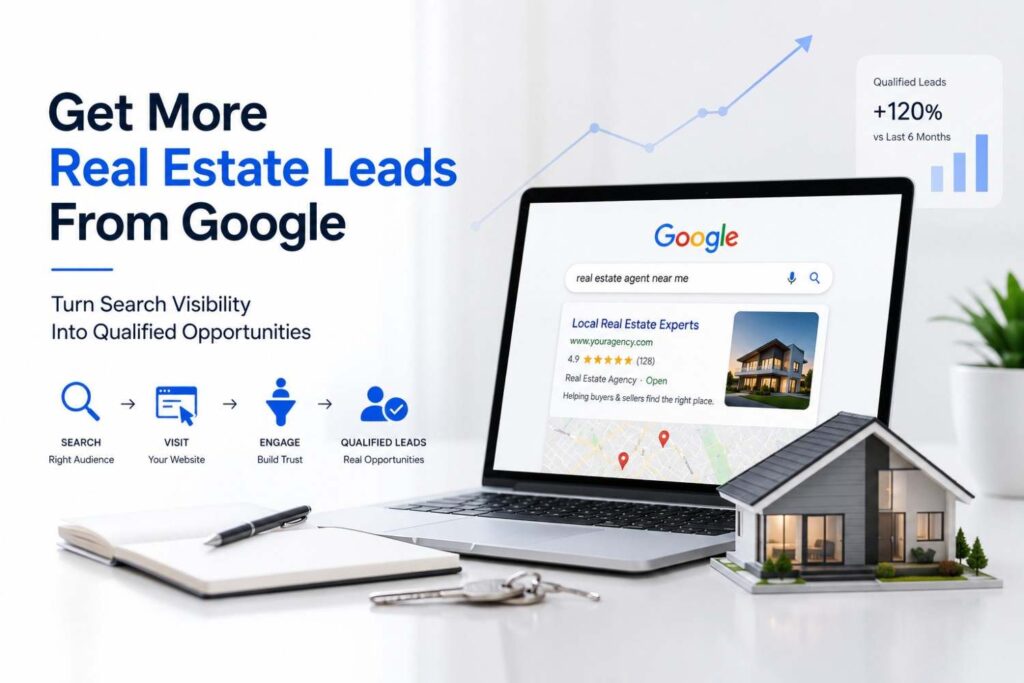
Getting more leads from Google does not always mean attracting more traffic.
For many real estate businesses, the problem is not a complete lack of visibility. Their websites may already receive organic visitors, appear for relevant searches, or attract people through local search and informational content. Yet those opportunities do not consistently turn into conversations with qualified buyers, sellers, investors, or relocating clients.
That gap usually exists because search visibility and lead generation are being treated as separate activities.
A potential client may find an agency through a neighborhood guide, a Google Maps result, a service-related search, or a question about buying or selling property. What happens after that discovery depends on much more than where the website ranks. The visitor needs to understand why the business is relevant, find information that supports their decision, and see a logical next step when they are ready to move forward.
This is where a stronger SEO strategy can make a difference.
Rather than focusing exclusively on increasing traffic, real estate businesses can examine how their existing search visibility, local presence, website content, and commercial pages work together. The objective is not simply to attract more visitors. It is to create a clearer path between a relevant search and a meaningful business opportunity.
More Traffic Does Not Automatically Mean More Qualified Leads
Traffic is one of the most visible SEO metrics, which makes it easy to treat growth in visitors as evidence that a strategy is working. More impressions, higher rankings, and increasing sessions can certainly indicate progress. However, those numbers do not tell you whether the people arriving on the website are likely to become clients.
Consider two real estate websites.
The first attracts a large audience through broad informational topics. Visitors may read articles about property trends, general home-buying advice, or real estate news before leaving the site. The second receives fewer visitors overall but attracts people searching for local expertise, professional support, relocation information, or help with a specific buying or selling decision.
The second website may generate more valuable opportunities despite having significantly less traffic.
That is why SEO performance should not be evaluated only by volume. A more useful question is whether the website is becoming visible when the business can provide a meaningful answer, service, or next step.
Search volume and business value are not the same thing
A high-volume keyword can look attractive during keyword research, but search demand alone does not determine commercial value. Some searches attract broad audiences with little connection to the services a real estate agency provides. Others may have lower search volume but represent people facing decisions that could eventually lead to professional support.
For example, a search related to choosing a real estate agent, moving to a particular area, or understanding how to sell a property may be more closely connected to a future business opportunity than a broad real estate query with substantially higher volume.
This does not mean informational content should be ignored. Informational searches often introduce potential clients to a business early in their research journey. The important distinction is that every piece of content should have a clear role.
A useful SEO strategy therefore looks beyond the question:
“How many people search for this?”
It also asks:
“Who is searching, what are they trying to accomplish, and does this topic create a meaningful opportunity for our business?”
Start With the Searches Closest to Real Business Needs
Not every person searching on Google is at the same stage of their journey.
Some are exploring a market for the first time. Others are comparing neighborhoods, researching the selling process, or trying to understand whether they need professional help. A smaller group may already be looking specifically for a real estate agency, buyer’s agent, seller’s agent, or specialist in a particular location.
These differences should influence the type of pages a website creates.
Give high-intent searches an appropriate destination
When someone is actively looking for professional support, the website should make its relevance immediately clear.
A person searching for a buyer’s agent in a specific market, for example, is likely to have different questions from someone casually researching the area. They may want to understand who the agency works with, whether the team serves their location, what experience is relevant to their situation, and what the process looks like.
Sending that visitor to a generic homepage or an unrelated blog post creates unnecessary friction.
A dedicated commercial page can provide a clearer experience by addressing the specific need behind the search. It can explain the service, demonstrate relevant expertise, and make the next step easy to understand.
The objective is not to turn every page into an aggressive sales pitch. It is to reduce uncertainty. When the relationship between the search, the page, and the service is clear, visitors can make a more informed decision about whether the business is right for them.
Informational searches can still create valuable opportunities
Not every future client begins with a commercial search.
A family planning a relocation may spend months researching neighborhoods before contacting an agent. A homeowner may investigate market conditions long before deciding to sell. A first-time buyer may initially search for guidance rather than professional services.
These visitors may not be ready to become leads immediately, but they are still part of a wider decision journey.
Useful content gives a real estate business an opportunity to become visible before the final commercial search takes place. If the information is genuinely helpful and reflects real expertise, the business can begin building familiarity and trust while the visitor is still researching.
The important thing is not to force an immediate conversion. Instead, the website should provide a logical path for visitors who want to continue exploring.
Build a Clear Path From Search to Inquiry
A Google ranking is only the starting point.
From the moment someone discovers a real estate business, several things need to happen before they decide to make contact. A useful way to think about this journey is:
Search → Discovery → Evaluation → Action
Each stage plays a different role, and weaknesses at any point can reduce the likelihood of generating a qualified lead.
Search: Are you visible for the right opportunities?
Search visibility should reflect the real questions and decisions of the audience you want to reach.
This may include direct service searches, local searches, buyer and seller questions, relocation topics, neighborhood research, and other decision-driven queries relevant to the markets you serve.
The mistake is to approach keyword research as a race to identify the largest possible list of topics.
A better approach is to identify where genuine search demand overlaps with client needs and the expertise your business can offer. This creates a more focused content and SEO strategy, where pages are developed because they serve a clear purpose rather than simply because a keyword exists.
Discovery: Does the page match the reason someone searched?
Once a visitor clicks through from Google, the website needs to maintain the relevance established in the search result.
Someone searching for information about relocating to a city should not immediately feel as though they have landed on an unrelated corporate homepage. Similarly, a visitor looking for a particular real estate service should not need to navigate through several layers of the website to understand whether the agency can help.
The landing experience should continue the conversation that began in search.
That means matching pages to search intent, explaining the topic clearly, and making the business’s relevance easy to understand. When visitors immediately recognise that they are in the right place, they are more likely to continue exploring.
Evaluation: What does the website tell people about your expertise?
Real estate decisions involve significant financial and personal considerations. Before contacting an agency, people often compare several options and conduct their own research.
They may read reviews, explore local content, compare services, look for market knowledge, or simply assess whether the business appears to understand their situation.
Trust is therefore rarely built through one element alone.
It develops across the wider experience of the website. A useful neighborhood guide can demonstrate local knowledge. A clear service page can explain how the agency works. Market analysis can show professional understanding, while client stories and testimonials can provide evidence of previous experience.
The key question is not simply whether the website has enough content.
It is whether the content collectively helps a potential client understand why the business is worth considering.
Action: Is there a natural next step?
Once a visitor has found useful information and developed enough confidence to continue, the next action should be clear.
That does not mean placing the same contact button throughout every page. The appropriate next step depends on what the visitor is doing.
Someone reading a relocation guide may want to explore specific neighborhoods or speak with someone familiar with the area. A homeowner researching the selling process may be ready to learn about the agency’s seller services. A visitor already comparing real estate agents may simply need a straightforward way to start a conversation.
Effective conversion paths follow the context of the page. They help visitors move naturally from information to action rather than interrupting their research with an unrelated request.
Build Content Around Real Decisions, Not Random Keywords
People search because they are trying to understand something, solve a problem, or make a decision.
That principle should shape a real estate content strategy.
A buyer may be deciding which neighborhood suits their lifestyle. A seller may be uncertain about timing or preparation. An investor may be comparing different markets. Someone relocating may be trying to understand daily life in a new area before considering specific properties.
These decisions create more meaningful content opportunities than simply publishing articles around isolated keywords.
Help buyers make sense of the market
Buyer-focused content should reflect the actual questions that arise during the buying journey.
Depending on the market, this may include neighborhood comparisons, property-type considerations, local buying processes, relocation planning, or practical issues that influence where and what someone chooses to buy.
Generic advice can attract traffic, but highly interchangeable content rarely demonstrates why one agency’s expertise is more useful than another’s.
The stronger opportunity lies in combining useful information with genuine market knowledge.
Instead of producing another broad article about buying a home, consider the decisions that buyers in your market repeatedly struggle with. Those questions are often more specific, more useful, and more closely connected to the expertise an agency can provide.
Support sellers before they are ready to list
The seller journey also begins long before the listing conversation.
Homeowners may research market conditions, property preparation, timing, pricing considerations, or the process of choosing an agent. Content can help answer those questions while introducing the agency’s expertise at an earlier stage.
However, each page should have a distinct purpose.
A guide explaining how to prepare a property for sale should not compete with the agency’s main selling-service page. The guide serves an informational need; the service page supports a commercial decision.
Maintaining this distinction is important. It creates clearer pathways for users and reduces unnecessary overlap between pages targeting similar search intent.
Turn genuine local knowledge into useful content
Local expertise is one of the strongest assets available to a real estate business, yet much of it often remains inside conversations with clients.
Agents understand which questions people ask about particular neighborhoods, what practical considerations affect a move, and how different areas suit different lifestyles. That knowledge can become valuable website content when it is documented thoughtfully.
A neighborhood page should therefore do more than repeat the area’s name alongside generic descriptions. It should help someone understand what they genuinely need to know before considering the location.
When content reflects real familiarity with a market, it becomes harder to replace with generic information.
Make Local Visibility Part of the Wider Lead Strategy
Local search is an important source of discovery, but it should not operate as an isolated marketing activity.
A potential client might find a business through Google Maps, a local organic result, a branded search, or a service-related query. Regardless of the entry point, the website should help move the visitor toward a better understanding of the business and its expertise.
The journey may look something like this:
Google Search
→ Local or Organic Discovery
→ Relevant Website Page
→ Evidence of Expertise
→ Meaningful Next Step
Every stage contributes to the outcome.
Strong local visibility can create the initial opportunity, but the visitor’s experience after the click determines whether that opportunity develops further. A well-optimised Google Business Profile cannot compensate for a website that provides little context or sends visitors to irrelevant pages.
This is also why individual SEO topics should work together rather than repeat one another. A dedicated resource on Local SEO for Real Estate Agencies can explore the mechanics of improving local visibility in greater detail. This article focuses instead on how that visibility fits into the broader process of generating qualified opportunities from Google.
Stop Treating the Homepage as the Answer to Every Search
The homepage plays an important role in communicating the overall identity of a real estate business. However, it cannot address every search intent equally well.
A person looking for buyer representation has different needs from someone researching a neighborhood. A seller comparing agencies may require different information from an investor evaluating a local market.
That is why the destination should reflect the reason behind the search.
Commercial searches should generally lead to relevant service or specialist pages. Location-focused searches may be better served by detailed local resources. Informational queries should receive useful answers while creating logical connections to related content and services.
This approach does more than improve the visitor experience.
It also creates a more coherent website structure. Instead of forcing every audience through the same entry point, the business can provide several relevant paths based on how and why people arrive.
Make Informational Content Work Beyond the First Visit
Informational content often introduces the widest audience, but many websites treat the article itself as the end of the journey.
A visitor reads the page, finds the information they need, and leaves.
That will always happen to some extent, and it is not necessarily a problem. Not every visitor should become a lead.
However, interested visitors should be able to discover what to explore next.
A detailed neighborhood guide might connect naturally to related areas, buyer resources, relocation support, or information about working with a local specialist. A seller-focused article may lead toward market insights, additional preparation guidance, or the agency’s relevant services.
The goal is not to surround every paragraph with internal links or calls to action.
Instead, consider the next question a genuinely interested reader is likely to have.
When pages are connected around real user journeys, the website becomes more useful than a collection of isolated articles. It begins to function as a connected resource that supports people as their needs become more specific.
Measure the Visibility That Actually Contributes to Business Growth
Rankings, impressions, and organic traffic remain useful indicators. They can show whether a website is gaining visibility and whether search engines are beginning to recognise its relevance.
However, these metrics should not be viewed in isolation.
A stronger measurement approach also considers what visitors do after arriving.
For example:
- Which pages consistently contribute to inquiries?
- Which search themes attract visitors who explore commercial pages?
- Where do potential clients first enter the website?
- Which content supports later interactions with the business?
- Are some pages attracting substantial traffic without meaningful engagement?
Not every article needs to generate a lead directly.
A neighborhood guide may introduce a potential buyer to the agency months before they make contact. A market resource may build trust that later influences a commercial decision. Their value may not be visible through a simple last-click conversion model.
The goal is to understand how different pages contribute to the wider journey.
At the same time, pages that attract traffic without supporting any meaningful next step should be reviewed. The solution may involve improving the content, strengthening internal pathways, clarifying intent, or reconsidering whether the topic deserves continued investment.
SEO, Content, and Conversion Need to Work as One System
One of the most common strategic mistakes is treating SEO, content, website development, and lead generation as completely separate activities.
The SEO effort focuses on rankings. Content is published according to a calendar. Website improvements happen independently. Leads are measured somewhere else.
Potential clients, however, experience all of these elements as one journey.
They do not care which team created the page. They care whether they can find useful information, understand what the business offers, and confidently decide whether to continue.
A stronger approach connects the pieces.
Search research identifies meaningful opportunities. Content addresses the questions behind those searches. Service and location pages provide clearer commercial pathways. Website structure helps visitors move between related information. Trust-building elements reduce uncertainty, while relevant calls to action make it easier to begin a conversation.
When these elements support one another, SEO becomes more than a method for increasing website traffic.
It becomes part of the business’s wider acquisition system.
How to Identify Your Biggest Lead Opportunities From Google
Before creating another ten articles or targeting another long list of keywords, it is worth examining the opportunities already present on the website.
Look at where you are already gaining visibility
Search performance data can reveal pages and topics that are beginning to gain traction.
Look for commercially relevant queries receiving impressions, pages sitting close to stronger visibility, and content that attracts the right audience but may not provide a clear next step.
The purpose is not to optimise every keyword or increase every metric.
It is to identify opportunities where better alignment, stronger content, or improved page experience could produce a meaningful business result.
Listen to the questions your clients already ask
Sales conversations and client interactions can be one of the most valuable sources of content insight.
What questions repeatedly delay a buyer’s decision? What concerns do sellers raise before listing? Which locations create uncertainty? What misconceptions does the team need to correct regularly?
These recurring questions often reveal content opportunities that connect directly to real business needs.
Keyword research can then help validate and expand those opportunities, rather than becoming the only source of ideas.
Identify where the journey loses momentum
Sometimes visibility is not the problem.
A website may already attract relevant visitors, but the path from discovery to inquiry is weak. A high-intent service page may lack clarity. Informational content may have no meaningful connection to commercial pages. Visitors may simply be unable to find what they need next.
Looking at the journey as a whole can reveal priorities that keyword research alone may miss.
Build a More Reliable Path to Qualified Real Estate Leads
There is no single Google channel that consistently generates every type of real estate lead.
One person may discover an agency through a local search. Another may begin with a neighborhood guide. A seller might first encounter the business through a market-related question. Months later, that same person may return through a direct commercial search.
The journeys differ, but they should all lead into a connected digital presence.
That is why sustainable organic growth requires more than individual rankings or isolated content campaigns. Real estate businesses need a structure that allows potential clients to discover useful information, recognise relevant expertise, and move naturally toward professional support when the timing is right.
The objective is not simply to be visible everywhere.
It is to be visible in the places where the business can genuinely help—and to make that relevance clear once people arrive.
How Gadget Majesty Helps Real Estate Businesses Turn Search Visibility Into Opportunities
At Gadget Majesty, we do not look at traffic growth as the final measure of SEO success.
The more important question is where potential opportunities are being lost between the initial search and the eventual inquiry.
Depending on the business, that gap may involve search visibility, local discovery, content strategy, website structure, service-page relevance, or the overall path visitors follow through the site.
Our approach can bring these areas together through:
- Real Estate SEO
- Local SEO
- SEO Content Strategy
- Website Optimisation
- Web Design & Development
- AI Search & GEO Optimisation
Rather than applying the same checklist to every real estate business, we look at the market, audience, existing website, and current search opportunities to identify where stronger visibility and better user journeys can support growth.
Explore Our Real Estate SEO Services
If your website is gaining visibility but organic search is not producing the level of qualified opportunities you expect, explore how a more connected SEO strategy can help.
[Explore Real Estate SEO Services →]
Final Thoughts
Getting more qualified leads from Google is not always about ranking for more keywords or dramatically increasing website traffic.
In many cases, the larger opportunity lies in improving the connection between what potential clients search for and what happens after they find your business.
That requires a clearer understanding of search intent, content that supports real decisions, relevant landing pages, stronger local discovery, logical internal pathways, and a website that gives people enough information to evaluate their next step.
The goal is straightforward:
Help the right people find relevant information at the moment they need it, then make it easy for them to continue when your expertise becomes relevant.
When search visibility, content, local presence, and website experience work together, Google can become more than a source of traffic. It can become a more reliable channel for attracting qualified real estate opportunities.