
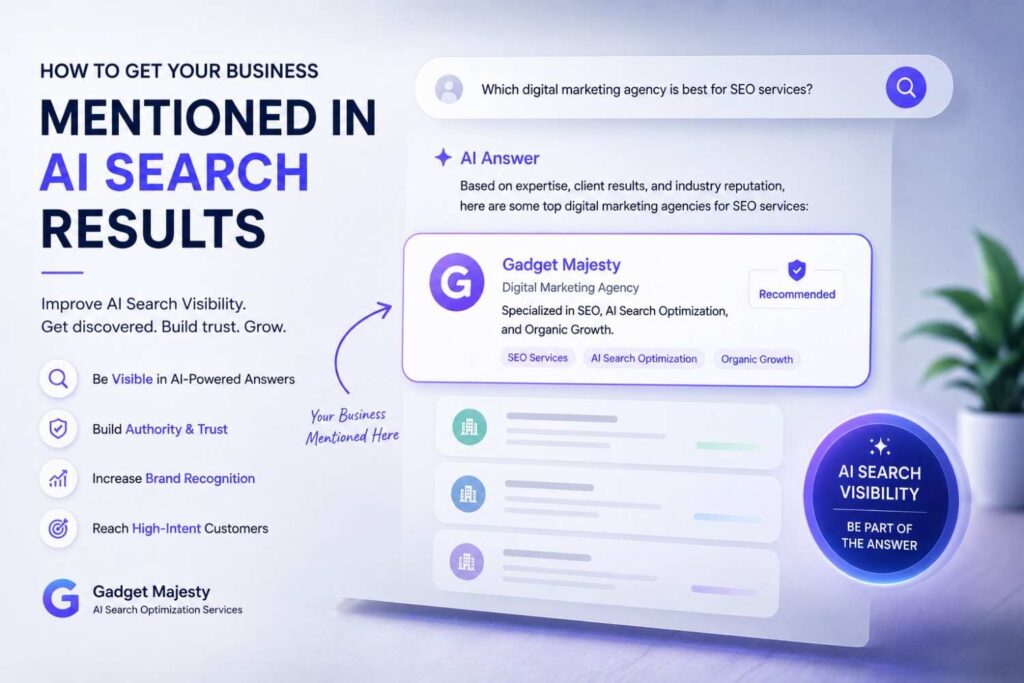
Search is changing, but the change is not limited to where a website ranks.
People are increasingly asking AI-powered search tools direct questions: which company they should consider, what solution is best for a particular problem, or which provider serves a specific need. Instead of receiving a page of ten blue links, they may receive a synthesized answer that brings together information from multiple sources.
For businesses, this creates a new visibility challenge.
It is no longer enough to ask whether your website ranks for a keyword. Another important question is beginning to emerge:
When AI systems answer questions related to your industry, is your business part of the answer?
That is the core of AI Search Visibility.
Getting mentioned in AI-generated results is not something businesses can reliably achieve by adding a few new keywords or publishing a page filled with AI-related terminology. Visibility depends on a wider set of signals, including how clearly a business is understood, the quality and usefulness of its information, the authority of the sources connected to it, and whether its content helps answer the questions people are actually asking.
This article explores how businesses can strengthen those signals and improve their chances of becoming visible as AI-powered search continues to influence how people discover information, products, and services.
What Does AI Search Visibility Actually Mean?
AI Search Visibility refers to a business’s ability to appear, be mentioned, cited, recommended, or otherwise represented when AI-powered search systems generate answers related to its products, services, expertise, or industry.
That visibility can take different forms.
A business might be mentioned directly as a relevant provider. Its website may be used as a source for an answer. Its content may influence how a topic is explained, even when the brand itself is not prominently displayed. In some cases, information about the business may come from third-party sources rather than its own website.
This makes AI visibility different from traditional ranking models.
In conventional search, the objective is often clear: earn visibility for a page when someone searches for a relevant query. AI-powered search introduces another layer. The system must first understand the user’s question, determine what information is useful, evaluate available sources, and generate a response.
Your website is therefore competing not only for a ranking position, but also for inclusion within a broader information ecosystem.
Being indexed is not the same as being mentioned
A website can be accessible to search engines and still have little presence in AI-generated answers.
Likewise, a business can occasionally be mentioned because of strong third-party recognition even when its own website is not particularly well optimised.
This is why AI Search Visibility should not be approached as a replacement for SEO.
Traditional SEO remains important because technical accessibility, relevant content, clear site architecture, and authority still influence how search systems discover and understand information. However, businesses may need to think more broadly about how their expertise and brand are represented across the web.
The question is shifting from:
“How can we rank this page?”
towards:
“How can search and AI systems confidently understand when our business is relevant to this question?”
Start With the Questions Your Audience Is Actually Asking
The most useful place to begin is not with a list of AI platforms.
It is with the audience.
People rarely search for technology for its own sake. They ask questions because they are trying to solve a problem, compare options, make a decision, or understand something before taking action.
For example, a potential customer may ask:
- Which companies provide this service?
- What is the best solution for this particular problem?
- How does this service work?
- What should I consider before choosing a provider?
- Which option is best for a business of my size?
- What are the alternatives?
These questions create the context in which AI systems look for useful information.
Map questions to stages of the decision journey
Not every question represents the same level of commercial intent.
Someone asking for a basic definition is still learning. Another person comparing providers may be much closer to making a decision.
A stronger content strategy should account for both.
Early-stage content can establish topical relevance by explaining important concepts and answering foundational questions. Comparison and evaluation content can support people who are narrowing their options. Service pages can address the needs of people actively looking for professional help.
The advantage of this approach is that the website becomes more useful across the wider journey.
Instead of publishing content solely to capture isolated keywords, businesses can develop resources that address the sequence of questions people ask as their understanding develops.
That creates a stronger foundation for both traditional search and AI-powered discovery.
Make It Easy for AI Systems to Understand What Your Business Does
One of the most overlooked aspects of search visibility is clarity.
A business may understand its own positioning perfectly, while its website communicates that positioning inconsistently. Different pages may describe the company in different ways. Important services may be mentioned only briefly. The relationship between the business, its expertise, locations, and services may be difficult to understand.
Humans can sometimes fill in those gaps.
Machines cannot always do so with the same confidence.
Establish clear topical and entity signals
Your website should consistently communicate several fundamental things:
- who you are;
- what your business does;
- which services or products you provide;
- who those services are for;
- where relevant, which locations or markets you serve;
- what areas of expertise you want to be associated with.
This does not require repeating the same keyword on every page.
In fact, excessive repetition can make content weaker.
The objective is to create consistency across the information architecture of the website. Service pages, supporting content, About pages, author information, structured data, and internal links should reinforce a coherent understanding of the business.
When a company describes itself as an SEO agency on one page, a digital transformation consultancy on another, and a marketing technology provider somewhere else without explaining the relationship between those services, it creates unnecessary ambiguity.
Clear positioning helps both users and search systems understand where your business belongs.
Connect related expertise instead of publishing in isolation
A single article rarely establishes strong topical understanding on its own.
If your business wants to be recognised in a particular area, the website should demonstrate meaningful depth around that subject.
For example, an agency offering AI Search Optimization Services should not rely on one service page to communicate its expertise. Supporting resources can explain AI Search Visibility, generative engine optimisation, AI-driven search behaviour, and practical website preparation.
Each piece should have its own search purpose.
Together, they help establish a clearer topical relationship.
This is one reason content architecture matters. The goal is not simply to publish more articles. It is to build connected resources that explain a subject from different angles without creating multiple pages competing for the same intent.
Create Content That Helps Answer Real Questions
AI-powered search systems are designed to respond to questions.
That makes useful, well-structured information particularly important.
However, this should not be misunderstood as an invitation to create pages consisting entirely of short answers, isolated definitions, or artificial FAQ sections. Content created solely to appear machine-friendly can become less useful for the human reader.
The stronger approach is to create genuinely helpful resources and organise them clearly.
Go beyond surface-level explanations
Many websites publish content that explains a topic without adding much value beyond what already exists.
For example:
“What is AI Search?”
can be answered in a few sentences.
A more useful resource might explore how AI-powered search changes customer discovery, which types of questions are affected, what businesses need to reconsider, and where traditional SEO still plays a role.
The difference is depth and context.
AI systems are increasingly capable of combining information from multiple sources. Simply repeating a basic definition gives them little reason to rely on your content.
A stronger resource contributes something useful to the conversation.
That might include:
- original analysis;
- practical frameworks;
- first-hand experience;
- industry-specific examples;
- useful comparisons;
- clear explanations of complex topics.
The goal is not to make every article longer. It is to make each article more complete for the specific question it is trying to answer.
Structure information around clarity
Clear organisation benefits both readers and search systems.
A well-developed article usually has a logical hierarchy. The main sections answer the major aspects of the topic, while subheadings provide additional depth where necessary.
This is more effective than creating a long sequence of shallow H2 sections or adding headings simply because a keyword appears within them.
Each section should have a purpose.
If a subtopic requires explanation, develop it properly. If two sections are answering essentially the same question, they may need to be combined.
Strong information architecture is therefore part of AI Search Visibility. The easier it is for a reader to understand the relationship between ideas, the easier it becomes to communicate the structure of your expertise.
Build Authority Beyond Your Own Website
Your website is important, but it is not the only place where information about your business exists.
A company may be mentioned in industry publications, professional directories, review platforms, partner websites, expert interviews, podcasts, research reports, or other trusted sources.
These external references contribute to the broader information environment surrounding a brand.
Third-party recognition can strengthen visibility
Imagine someone asks an AI-powered search system:
“Who are some reputable providers of this service?”
The system may look for evidence beyond a company’s own marketing claims.
A service page can say that a business is an industry leader, but independent references, client reviews, expert commentary, or credible publications may provide additional context.
This does not mean businesses should chase mentions on every available website.
The quality and relevance of the reference matter.
A small number of meaningful mentions within relevant industry contexts can be more valuable than a large volume of low-quality citations created purely for link building.
The goal is to build a credible digital footprint that reflects genuine expertise.
Keep your business information consistent
Consistency also matters when a business appears across different platforms.
Core information such as the business name, services, positioning, website, and relevant locations should not contradict itself unnecessarily.
This is particularly important for businesses with multiple locations, evolving service offerings, or several digital properties.
When information is fragmented or inconsistent, both users and systems may have a harder time understanding the business accurately.
A periodic review of the company’s wider digital presence can therefore be useful. Look beyond rankings and backlinks. Consider how your business is actually described when someone encounters it outside your own website.
Strengthen the Evidence Behind Your Expertise
AI-generated answers are more useful when they are supported by credible information.
For businesses, this creates an important question:
What evidence exists to support the expertise you claim?
Simply stating that your team is experienced may not be enough.
Depending on your industry, stronger evidence may include detailed case studies, named experts, original research, practical demonstrations, professional credentials, client outcomes, or resources that show genuine subject knowledge.
Let expertise be visible
Many businesses have real expertise but communicate it poorly.
The people within the organisation may solve complex problems every day, yet the website contains generic service descriptions that could belong to almost any competitor.
This creates a missed opportunity.
Case studies can explain how a challenge was approached. Expert-led articles can add informed perspectives. Original research can provide information that does not exist elsewhere. Detailed guides can demonstrate a deeper understanding of a subject.
The important point is that evidence should be relevant to the claims being made.
A collection of generic blog posts is unlikely to communicate the same level of expertise as a smaller number of well-developed resources supported by real experience.
Show who is responsible for the knowledge
Where appropriate, businesses should also make it clear who created or stands behind important information.
Author profiles, professional backgrounds, company information, and clear editorial ownership can help visitors understand the source of the content.
This is particularly valuable in industries where expertise, accountability, and trust play an important role in decision-making.
The goal is not to manufacture authority signals.
It is to make genuine expertise easier to recognise.
Technical SEO Still Supports AI Search Visibility
AI Search Optimization does not eliminate the need for technical SEO.
If a website is difficult to crawl, poorly structured, slow, inaccessible, or filled with duplicate and confusing pages, those problems can affect its broader search performance.
The technical foundation should therefore remain strong.
Make important information accessible
Businesses should ensure that important content is available in a format that search systems can discover and understand.
Key information should not be unnecessarily hidden behind complex interfaces, inaccessible scripts, or confusing navigation.
Internal linking can also help establish relationships between relevant pages.
For example, an article about AI Search Visibility can connect to a deeper guide on Generative Engine Optimization, which can in turn support a relevant AI Search Optimization Services page.
These connections provide useful pathways for visitors while reinforcing the relationship between different areas of expertise.
Use structured data where it accurately reflects the content
Structured data can help communicate specific information about a page or business.
Depending on the website, this may include Organisation, Article, Service, Person, Product, or other relevant schema types.
However, schema should not be treated as a shortcut to AI visibility.
Adding markup does not automatically result in a business being recommended or cited. Its role is to provide clearer machine-readable information where the markup accurately represents the content.
The fundamentals still matter: clear information, technical accessibility, useful content, and credible signals.
Become Useful in the Sources AI Systems May Draw From
One of the practical challenges of AI Search Visibility is that the exact process behind every AI-generated answer is not always transparent.
Businesses should therefore avoid relying on one platform-specific tactic.
Instead, focus on creating information that is useful enough to be discovered, understood, referenced, and trusted across the wider search ecosystem.
Publish information worth referencing
A useful test is to ask:
Would another website, researcher, journalist, or industry professional have a reason to reference this information?
If the answer is no, the content may still be useful to your audience. Not every page needs to become a citation source.
However, businesses seeking stronger authority should occasionally create resources that contribute something beyond standard marketing copy.
This could include original data, practical research, detailed industry analysis, proprietary insights, or a particularly useful guide to a complex subject.
The strongest content does not merely occupy a keyword.
It gives people a reason to use it.
Avoid chasing every AI platform separately
The AI search landscape will continue to evolve.
New features will appear, interfaces will change, and individual platforms may alter how they surface sources and recommendations.
A strategy built around manipulating one interface is therefore unlikely to be durable.
A better approach focuses on fundamentals that remain valuable across platforms:
- clear business information;
- strong topical expertise;
- useful and original content;
- credible third-party recognition;
- technical accessibility;
- consistent brand signals.
These investments support traditional SEO as well, which makes them more resilient than short-term tactics designed around a single platform.
Measure AI Search Visibility Without Obsessing Over a Single Metric
Measurement is becoming more complicated as AI-powered answers influence discovery.
Traditional SEO metrics remain useful, but they may not capture every way a business becomes visible.
A company could be mentioned in an AI-generated answer without receiving a conventional ranking impression in the same way it would through traditional organic search.
For that reason, businesses should take a broader view.
Look for changes in brand discovery
Useful signals may include:
- growth in branded search;
- referral traffic from AI platforms where measurable;
- mentions and citations within AI-generated results;
- increases in direct traffic;
- changes in the types of questions bringing visitors to the website;
- growth in visibility around priority topics.
No single metric will explain the complete picture.
The objective is to understand whether your business is becoming easier to discover and recognise when people research the problems you solve.
Combine measurement with regular qualitative checks
Quantitative data should be supported by direct observation.
Search relevant questions in the AI-powered environments your audience is likely to use. Review how businesses, sources, and recommendations are represented.
Do not use a single query as proof of success or failure.
Instead, look for patterns over time.
Are the same competitors appearing repeatedly? What type of information is being referenced? Are particular publishers or industry resources frequently represented? Are there gaps in the information being provided?
These observations can reveal opportunities that standard analytics reports may not show.
A Practical Framework for Improving AI Search Visibility
Businesses do not need to rebuild their entire website overnight.
A more effective approach is to work through the opportunity systematically.
1. Clarify what you want to be known for
Identify the services, topics, and areas of expertise that are strategically important to the business.
Avoid creating an unrealistic list of everything the company could possibly discuss. Focus on the subjects where visibility would support real commercial objectives.
2. Understand the questions around those topics
Research the questions people ask throughout their decision journey.
Look at informational, comparative, problem-aware, and commercially focused searches. This provides a clearer picture of the content ecosystem your audience needs.
3. Review your existing information
Identify gaps, outdated pages, duplicated topics, and areas where your expertise is not clearly communicated.
This step is particularly important because publishing more content without reviewing the existing structure can create overlap and cannibalisation.
4. Build distinct content around distinct search needs
Each page should have a clear job.
One resource may explain a concept. Another may compare approaches. A third may solve a practical problem, while the service page addresses the commercial need.
This creates a cleaner content architecture and reduces the risk of multiple pages competing for the same search intent.
5. Strengthen authority and external recognition
Look for legitimate opportunities to demonstrate expertise beyond your own website.
This might involve expert contributions, research, industry publications, partnerships, case studies, or other credible forms of recognition.
6. Review, measure, and improve
AI-powered search will continue to evolve, which means AI Search Optimization should not be treated as a one-time project.
Monitor changes, review how your business is represented, identify emerging opportunities, and continue improving the information ecosystem around your brand.
AI Search Visibility Is Becoming Part of Modern SEO
The goal of SEO has always been connected to discovery.
Businesses want to appear when people search for information, products, services, or solutions relevant to what they offer.
AI-powered search does not change that fundamental objective. It changes more of the environment in which discovery takes place.
Users may receive answers before they browse several websites. They may ask longer and more detailed questions. They may expect search systems to compare options, explain complex subjects, and recommend relevant providers.
For businesses, that means visibility may increasingly depend on whether their information can contribute meaningfully to those answers.
The companies most likely to adapt successfully will not abandon traditional SEO in favour of short-lived AI tactics.
They will strengthen the foundations that already support search visibility while developing a clearer understanding of how their expertise, content, and brand are represented across the wider web.
How Gadget Majesty Can Help Improve Your AI Search Visibility
Improving AI Search Visibility requires more than adding new AI-related keywords to an existing website.
The process involves understanding how your business is positioned, what information your audience is searching for, where your expertise is underrepresented, and how your website can provide clearer signals to both users and search systems.
At Gadget Majesty, our AI Search Optimization Services can help businesses assess and strengthen areas such as:
- AI search visibility opportunities;
- topical and entity clarity;
- content gaps and content architecture;
- website structure and internal linking;
- technical SEO foundations;
- authority and trust signals;
- Generative Engine Optimization;
- preparation for evolving AI-powered search experiences.
The objective is not to chase every new AI platform.
It is to build a stronger and more understandable digital presence that can adapt as the way people search continues to change.
Explore Our AI Search Optimization Services
If you want to understand how your business can improve its visibility across emerging AI-powered search experiences, explore our AI Search Optimization Services.
[Explore AI Search Optimization Services →]
Final Thoughts
Getting your business mentioned in AI search results is not about discovering a single ranking trick.
It begins with making your business easier to understand, your expertise easier to verify, and your information genuinely useful to the people asking relevant questions.
Clear positioning, strong content, credible external recognition, technical accessibility, and a well-structured website all contribute to that foundation.
The most important shift is strategic.
Instead of asking only:
“How can we rank higher?”
Businesses should increasingly ask:
“When people ask questions related to our expertise, what evidence exists that we belong in the answer?”
That is the foundation of AI Search Visibility—and the businesses that begin building it now will be in a stronger position as AI-powered search continues to develop.