
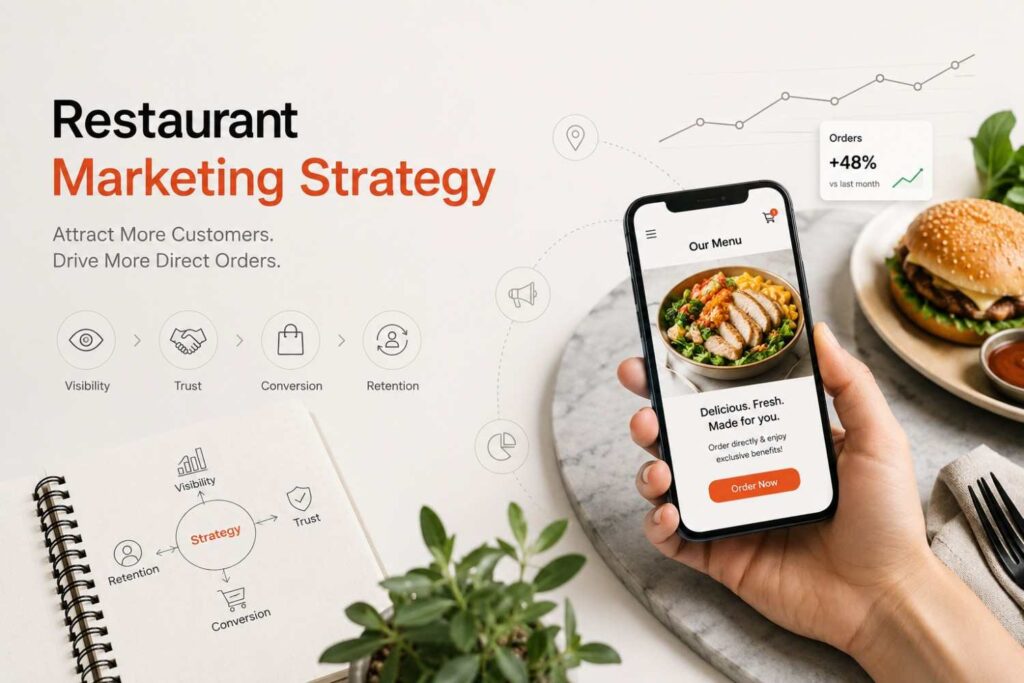
Restaurant marketing has become more complicated than simply creating a website, posting on social media, or running the occasional advertisement.
Customers can discover a restaurant through Google Search, Google Maps, social media, food delivery platforms, recommendations, and paid advertising. They may interact with several of these touchpoints before deciding where to order.
That creates a common problem. Many restaurants are active across multiple channels, but those activities do not always work together.
A Google Business Profile may generate discovery, while the website makes ordering difficult. Paid ads may generate clicks without proper conversion tracking. SEO may attract traffic that never reaches a relevant menu or ordering page.
A stronger restaurant marketing strategy connects these activities around the customer journey.
The objective is not simply to generate more visibility. It is to help the right local customers discover your restaurant, evaluate it, take action, order directly, and ideally return again.
The Restaurant Marketing Framework: Visibility, Trust, Conversion and Retention
Before choosing individual marketing channels, it helps to understand what each part of your strategy is supposed to achieve.
A practical restaurant marketing strategy can be built around four connected stages:
Visibility → Trust → Conversion → Retention
Visibility
This is where the customer first discovers your restaurant. Local SEO, Google Business Profile optimisation, Google Maps visibility, social media, local partnerships, and paid advertising can all contribute to this stage.
The goal is not to appear in front of everyone. It is to become visible when a relevant customer is actively looking for a restaurant—or when there is a realistic opportunity to introduce your business to someone within your market.
Trust
Discovery does not automatically lead to a customer.
Once someone finds your restaurant, they begin evaluating it. They may look at your reviews, food photography, menu, pricing, location, website, or overall presentation.
This stage answers a simple question:
Why should I choose this restaurant over the alternatives?
Your marketing should make that decision easier.
Conversion
Once the customer is interested, the next step should be obvious. Depending on your business model, that could mean ordering online, booking a table, calling the restaurant, or getting directions.
A strong strategy removes unnecessary friction between interest and action.
Retention
The first order should not necessarily be the end of the customer relationship.
Remarketing, loyalty programmes, direct-order incentives, email marketing, and customer communication can all help turn a one-time customer into a repeat customer.
Every marketing activity does not need to serve all four stages. However, a good strategy should make sure that no important stage is being ignored.
Start With the Customer Journey, Not the Marketing Channel
Restaurant customers rarely follow a perfectly straight path.
Someone might search Google for a nearby restaurant, compare several businesses on Google Maps, visit your website, check the menu, and leave without ordering. Later, they may see one of your ads on Facebook or Instagram. A few days later, they could search for your restaurant by name and finally place an order.
This is why the first marketing question should not be:
Should we invest in SEO or Meta Ads?
A better question is:
Where are potential customers dropping out of our journey?
A simplified journey may look like this:
Discovery → Evaluation → Website Visit → Decision → Order → Repeat Purchase
Once you understand that journey, it becomes easier to identify where your marketing investment can have the greatest impact.
1. Build a Strong Local Search Foundation
Local search is one of the most valuable opportunities available to restaurants because many potential customers are already looking for somewhere to eat.
The challenge is understanding which searches actually matter to your business.
A strong local SEO strategy should focus on customer intent rather than simply chasing the highest search volume.
Research How Local Customers Actually Search
Start with the core things your restaurant offers. That might be your cuisine, your service model, or the type of dining experience you provide.
A restaurant could begin by exploring terms around its main category, such as an Indian restaurant, halal restaurant, pizza delivery, or family dining. From there, local modifiers can help identify more commercially relevant opportunities.
For example, there is a meaningful difference between someone broadly researching Indian food and someone searching for an Indian restaurant in a specific location.
The second search is much closer to a potential customer.
Your research should therefore consider the search intent, the level of local competition, and whether the person searching is realistically within your target market.
The goal is not to create an enormous spreadsheet of keywords.
It is to understand the searches that can bring the right people to the right pages.
Map Search Intent to the Right Page
One of the easiest ways to create unnecessary SEO problems is to build separate pages for every keyword variation.
Instead, group similar searches around a shared intent and decide which page is best suited to satisfy that need.
| Keyword Theme | Search Intent | Recommended Page |
| Restaurant in [location] | Local discovery | Homepage or location page |
| [Cuisine] restaurant in [location] | Specific restaurant search | Cuisine or relevant service page |
| Food delivery in [location] | Ordering intent | Delivery or ordering page |
| Restaurant menu | Brand evaluation | Menu page |
| Best [cuisine] near me | Local comparison | Relevant local landing page |
This creates a cleaner site structure and helps prevent multiple pages from competing for essentially the same search intent.
The principle is simple:
Create pages around meaningful customer needs, not individual keyword variations.
Look for Gaps in the Local Market
Competitor research should help you understand the market rather than encourage you to copy what other restaurants are doing.
Look at the businesses already appearing for your important local searches. Pay attention to how they structure their websites, present their menus, manage their Google Business Profiles, and communicate their location or services.
Then look for the gaps.
A competitor may have strong local visibility but a weak website experience. Another may have excellent reviews but poor content around its main services. These weaknesses can reveal opportunities for your own restaurant.
Good competitor research should help answer:
Where can we become more useful, relevant, or easier to choose?
2. Turn Your Google Business Profile Into a Stronger Discovery Point
For many local restaurant searches, a potential customer may see your Google Business Profile before visiting your website.
That makes it an important part of the decision-making process.
Customers may use the profile to check your reviews, opening hours, location, photos, menu, and available ordering options. If important information is missing or outdated, you may lose the opportunity before the customer reaches your website.
Your profile should therefore be accurate, complete, and useful.
The basic information—including your business details, opening hours, category, location, website, and menu or ordering links—should always reflect the current state of the business.
Beyond that, think about the information a first-time customer needs in order to make a decision. High-quality food photography, clear service information, and updated business details can all make the evaluation process easier.
Regular activity can also support the wider strategy. Updates about new dishes, seasonal menus, special events, or relevant offers can give customers more information and reasons to engage.
The important point is that activity should serve a purpose.
Posting simply to keep the profile active is not a strategy. Each update should help the customer understand something, discover something, or take the next step.
3. Make Your Website a Direct Order Asset
A restaurant website should do more than look good.
It should help visitors move towards a meaningful action.
A useful question to ask is:
Can a first-time visitor understand what we offer and what to do next within a few seconds?
If the answer is unclear, the website may be creating friction.
Make the First Impression Work Harder
When someone lands on your homepage, they should quickly understand the type of restaurant, the location, and the primary action available to them.
If direct ordering is an important business objective, the option should not be hidden deep inside the navigation.
A visitor should be able to move naturally from discovering the restaurant to exploring the menu and taking action.
The rest of the page can then support the decision with relevant information. This might include popular dishes, food photography, customer reviews, delivery details, opening hours, or the story behind the restaurant.
The structure does not need to be complicated.
It simply needs to answer the questions a potential customer is likely to have before ordering.
Treat Speed as Part of the Customer Experience
Website speed is often discussed as a technical SEO issue. For restaurants, however, it is also a customer experience issue.
Someone deciding where to eat may compare several options within a few minutes. If your website takes too long to load or makes the menu difficult to access on mobile, that delay can become a reason to move elsewhere.
The goal is not to chase a perfect technical score for its own sake.
Focus on whether performance creates visible friction. Heavy images, slow pages, difficult mobile navigation, or delayed ordering buttons can all interrupt the path towards conversion.
A faster and clearer experience makes it easier for an interested visitor to become a customer.
4. Create a Clear Direct Order Strategy
Third-party delivery platforms can provide restaurants with visibility and access to customers. However, direct orders can give the business greater control over the customer relationship.
That makes direct ordering an important part of a broader marketing strategy.
The first step is visibility.
Customers should not have to search through several pages to find out that they can order directly. Clear calls to action such as Order Direct, Order Online, or View Menu and Order should appear naturally at the points where customers are most likely to make a decision.
The second step is value.
Depending on the restaurant’s business model, there may be opportunities to give customers an additional reason to order directly. This could be a loyalty benefit, an exclusive offer, a promotional code, or simply a smoother ordering experience.
The strategy does not need to rely on constant discounts.
The objective is to make the direct relationship visible and worth considering.
5. Use Paid Advertising to Support Customer Acquisition
Local SEO can help a restaurant capture existing demand.
Paid advertising can create additional opportunities by introducing the restaurant to relevant customers before they actively search for it.
For a restaurant, Meta Ads can support a range of commercial objectives, including direct orders, special promotions, seasonal campaigns, new menu launches, or local awareness.
The strategy should begin with the business outcome—not the advertising platform.
If the objective is direct orders, the campaign should be structured and measured around meaningful conversion activity. A campaign that generates thousands of impressions but produces no measurable business value is not necessarily successful.
Likes, comments, reach, and impressions can provide useful context, but they should not become the primary definition of performance when the real objective is revenue or customer acquisition.
Focus on Customers Who Can Actually Become Customers
For a local restaurant, geographic targeting deserves serious attention.
A limited advertising budget can disappear quickly when the campaign is trying to reach an unnecessarily broad audience. The targeting area should reflect your delivery radius, customer travel behaviour, local competition, and budget.
A restaurant with a small daily budget may need a tighter geographic focus than a larger brand with multiple locations and a substantial advertising budget.
The same principle applies to audience targeting.
A campaign can begin with useful signals related to food, dining, online ordering, or customer behaviour. As more data becomes available, customer lists, lookalike audiences, website visitors, and remarketing audiences may provide additional opportunities.
The objective is not to build the most complicated audience structure possible.
It is to provide useful signals while leaving enough flexibility for the advertising platform to optimise delivery.
6. Align Your Advertising Budget With Customer Demand
Restaurant demand is rarely distributed evenly throughout the week.
Some businesses experience stronger demand during weekends. Others may perform best during Friday and Saturday evenings or around specific lunch periods.
Instead of automatically spreading the budget equally across every day, look at the business itself.
Review your sales patterns and identify when customers are most likely to order, when average order values are strongest, and when additional demand could create the greatest value.
If Friday through Sunday consistently produce better commercial results, concentrating more of the advertising effort around those periods may make more sense than running the same budget every day.
The principle is straightforward:
Your advertising schedule should reflect how your customers actually behave.
That turns budget allocation into a business decision rather than simply another campaign setting.
7. Set Up Measurement Before Scaling
Marketing becomes difficult to improve when all you can see is traffic.
Before increasing investment, make sure you can measure meaningful customer actions.
The tools may include platforms such as Google Analytics, Google Tag Manager, or Meta Pixel, depending on how your website and ordering system are configured. What matters most is not the number of tools installed but whether they help you understand what happens after someone discovers your business.
Can you identify an online order?
Or measure a booking?
Can you see whether advertising contributes to meaningful customer actions?
Without that information, it becomes much harder to know what deserves more investment and what needs to change.
A Restaurant Marketing Measurement Scorecard
Different parts of your marketing system should be evaluated differently.
| Marketing Area | Useful Metrics |
| Local visibility | Search visibility, profile interactions, direction requests |
| Google Business Profile | Calls, website visits, direction requests, customer actions |
| Website performance | Engagement, conversion rate, ordering actions |
| Direct orders | Order volume, order value, direct revenue |
| Paid advertising | Cost per acquisition, conversion value, ROAS where measurable |
| Retention | Repeat orders, returning customers, loyalty activity |
You do not need to optimise every number at once.
Start with the metrics closest to your current business objective. If the immediate priority is direct orders, then order volume, conversion rate, acquisition cost, and revenue are likely to matter more than social media engagement.
8. Connect Organic and Paid Marketing
SEO and advertising are often discussed as though a restaurant must choose between them.
In reality, they can serve different parts of the same customer journey.
Local SEO helps you compete when someone is already searching for a restaurant, a particular cuisine, or a nearby delivery option.
Paid advertising can introduce your restaurant to relevant local audiences who may not be actively searching at that moment.
Remarketing creates another opportunity to reconnect with people who have already shown interest by visiting the website, exploring the menu, or reaching an ordering page.
These channels do not have to compete with one another.
A better approach is to understand what each one contributes.
The question is not:
Which channel is best?
It is:
Where does each channel create value in the journey towards a customer?
9. Build the Strategy in Phases
Trying to fix every part of your marketing at once can spread resources too thinly.
A phased approach helps establish priorities.
Days 1–30: Fix the Foundation
The first month should focus on understanding the local search environment, reviewing competitors, improving the Google Business Profile, addressing major website issues, and ensuring meaningful conversion tracking is in place.
The objective is to remove the weaknesses that could limit everything that follows.
Days 31–60: Improve Visibility and Test Acquisition
Once the foundation is stronger, attention can shift towards implementing local SEO opportunities, improving relevant website content, maintaining Google Business Profile activity, and testing paid campaigns.
At this stage, the goal is not aggressive scaling.
It is to begin generating useful performance data while strengthening visibility.
Days 61–90: Optimise What Demonstrates Value
By this point, you should have a clearer picture of which search opportunities are producing visibility, which pages are supporting customer actions, and which campaigns are contributing to meaningful results.
Use that information to improve the strategy.
Scale what demonstrates value.
Do not simply scale activity.
10. Review the Whole System Before Increasing Your Budget
Before spending more money on advertising or producing more content, step back and look at the complete customer journey.
Is your restaurant easy to find locally?
Does the Google Business Profile give customers enough information to evaluate the business?
Can visitors quickly understand what you offer?
Is the menu easy to access?
Or, is direct ordering obvious?
Can you measure what happens after someone clicks?
These questions are often more valuable than immediately asking which new marketing channel to add next.
Sometimes the biggest opportunity is not additional traffic.
It is fixing what happens after the traffic arrives.
Frequently Asked Questions About Restaurant Marketing Strategy
What is the most effective marketing strategy for a restaurant?
There is no single strategy that works for every restaurant. The right approach depends on the location, cuisine, competition, budget, and how customers typically discover and order from the business.
However, most effective strategies connect local visibility with a strong customer experience. That usually means making the restaurant easy to find, giving potential customers enough information to trust the business, creating a simple path towards ordering or booking, and measuring the results.
The individual channels may vary. The connected customer journey should not.
How can a restaurant get more direct orders?
The first step is to make direct ordering obvious and easy.
If customers have to search through the website to find an ordering option, some will leave before reaching it. A clear menu, visible calls to action, and a simple mobile experience can remove unnecessary friction.
Restaurants can then support direct orders through local SEO, Google Business Profile optimisation, paid advertising, remarketing, and customer retention strategies.
The most useful place to start is by identifying where customers currently abandon the journey.
Should a restaurant invest in SEO or paid advertising?
They solve different problems.
SEO and local optimisation can help capture existing demand when people are actively searching. Paid advertising can help create additional opportunities to introduce the restaurant to relevant audiences.
For many restaurants, the better decision is not choosing one permanently over the other. It is deciding which channel currently addresses the business’s biggest limitation.
If people are searching but cannot find you, local SEO may deserve attention first. If local visibility is established but you need additional demand, paid advertising may become more valuable.
How much should a restaurant spend on marketing?
There is no universal percentage or fixed amount that applies to every restaurant.
A new restaurant may need to invest differently from an established business with a loyal customer base. The size of the market, competition, margins, customer lifetime value, and business objectives all matter.
A practical approach is to start with a budget that you can properly measure. Use the data to understand what is producing meaningful results before increasing investment.
The goal should not be to spend more.
It should be to understand what additional spending can realistically produce.
Is Google Business Profile important for restaurant marketing?
Yes. For many local searches, the Google Business Profile is one of the first places where potential customers encounter a restaurant.
They may use it to check reviews, view photos, confirm opening hours, find directions, visit the website, or explore menu information.
That makes it part of the customer acquisition journey, not simply an online directory listing.
Keeping the profile accurate and useful should be an ongoing part of a local restaurant marketing strategy.
What should a restaurant track to measure marketing performance?
The answer depends on the business objective.
A restaurant focused on direct orders may prioritise order volume, order value, direct revenue, conversion rate, and acquisition cost.
A restaurant working on local visibility may pay closer attention to profile interactions, direction requests, calls, and relevant website activity.
The key is to avoid treating every available metric as equally important.
Start with the outcome you are trying to improve, then identify the measurements that help explain progress towards that outcome.
Final Thoughts
A restaurant can be active on social media, appear in local search results, maintain a Google Business Profile, and run paid advertising—yet still struggle to turn that attention into consistent revenue.
The problem is often not a lack of marketing.
It is what happens between one activity and the next.
A customer discovers the restaurant but finds an outdated profile. Another clicks an advertisement and lands on a slow website. Someone else explores the menu but cannot immediately see how to order directly.
Those gaps matter.
A stronger restaurant marketing strategy looks beyond individual channels and focuses on how they connect. Local search creates the opportunity to be discovered. Your Google Business Profile and website help customers evaluate the restaurant. The ordering journey gives them a path to act. Paid campaigns can create additional demand, while proper measurement helps identify what is actually contributing to business growth.
The goal is not to be present everywhere.
It is to make each important step easier for the customer—and easier for the business to understand, measure, and improve.