
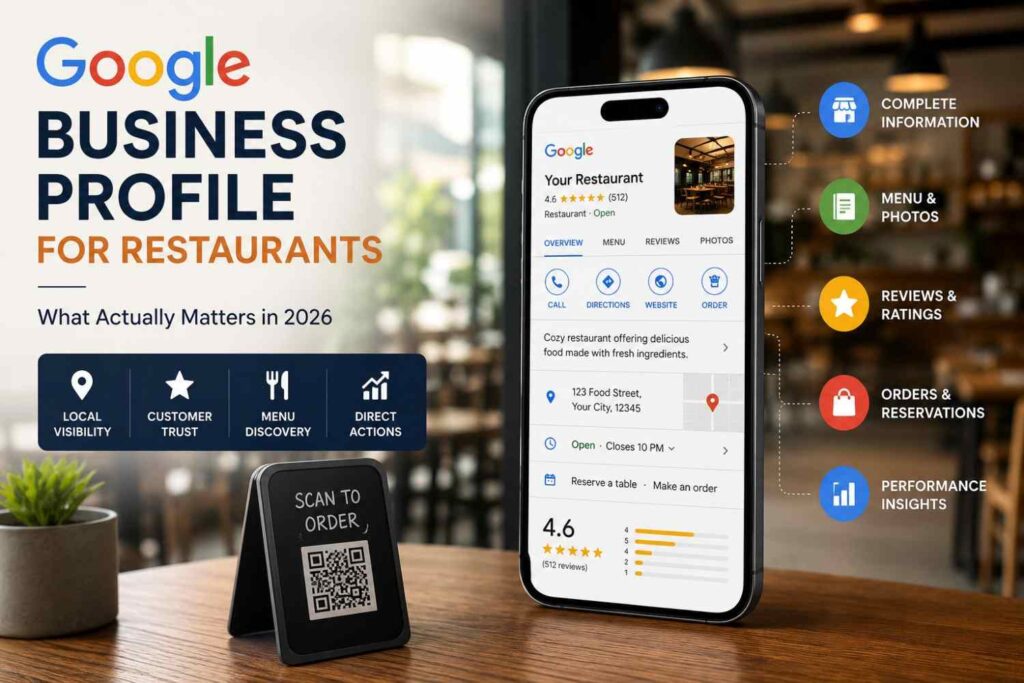
| A restaurant’s Google Business Profile is often treated like an online business card: add the address, phone number, opening hours and a few photos, then move on.
That approach misses the bigger opportunity. For restaurants, the profile sits remarkably close to the moment of decision. Someone searches for somewhere to eat, sees a restaurant on Google Maps or Search, checks the rating, looks at the food, opens the menu, checks the hours and may go straight to an order or reservation. The profile is not just helping people find the restaurant. It is helping them decide what to do next. And that changes how it should be managed. Your Google Business Profile Is Part of a Bigger Search EntityGoogle doesn’t understand a restaurant from the Business Profile alone. Its local search systems can use information from the business’s official website, third-party sources, user contributions, reviews, photos and other available information. That means your profile should not tell one story while your website tells another. If your profile identifies the business as an Italian restaurant in a particular neighbourhood, your website should reinforce that identity. Your menu should reflect what you actually serve. Your opening hours should agree across important sources. Your reviews, photos and local mentions should make sense within the same picture. Think of it as an entity rather than a listing: Restaurant → Cuisine → Location → Menu → Experience → Reputation → Ordering/Reservation The clearer those relationships are, the easier it is for customers—and search systems—to understand the business. This is where semantic SEO becomes practical. It isn’t about inserting more related keywords. It is about making the business itself unambiguous. What Google Actually Uses to Understand Local RelevanceThere is no setting inside your profile that guarantees a better position. Google says local results are primarily influenced by relevance, distance and prominence. RelevanceDoes the restaurant genuinely match what the customer is looking for? A restaurant serving Japanese cuisine should make that identity clear. So should a vegan restaurant, steakhouse, family restaurant or late-night venue. Complete, accurate business information helps Google understand those distinctions. DistanceWhere is the restaurant relative to the person searching? A restaurant cannot optimise its way into being physically closer to a customer. Location remains a fundamental part of local search. ProminenceHow established and well-known does the business appear? Google says prominence can be influenced by information across the web, including links and directories, as well as review count and ratings. That is why a Business Profile should not be treated as an isolated SEO project. The profile is one part of the restaurant’s wider digital footprint. The Parts of a Restaurant Profile That Deserve AttentionStart With the Business FundamentalsThe basics are not exciting, but they are foundational. The restaurant name, address, phone number, primary category, opening hours and other core information should accurately represent the real business. Special hours deserve particular attention. A restaurant that appears open when it is actually closed has created a customer-experience problem before the customer even arrives. Google specifically recommends keeping Business Profile information complete and accurate to improve the chances of appearing for relevant local searches. The goal isn’t to add information for the sake of completeness. It is to remove ambiguity. Treat the Menu as Searchable Business InformationFor restaurants, the menu is one of the most valuable parts of the profile. Google’s restaurant tools allow businesses to manage menu sections, dishes, descriptions and prices, as well as a menu URL and menu photos. That matters beyond presentation. A restaurant isn’t simply a generic “restaurant” entity. It may specialise in sushi, biryani, pizza, seafood, vegan dishes, Sunday roast or dozens of other specific offerings. Those details help describe what the business actually does. Keep the menu accurate, structured and aligned with the restaurant’s website. If the profile highlights dishes that no longer exist, or the website and profile present different menus, the customer has to resolve the inconsistency themselves. Don’t make them. Photos Should Show the Experience, Not Fill a GalleryRestaurants are visual businesses. Customers want to know what the food looks like, but food photography is only part of the decision. Interior, exterior, atmosphere and other representative images can help someone understand what visiting the restaurant will actually be like. Google recommends category-specific business photos and specifically highlights food and drink imagery for restaurants. So think beyond quantity. A useful photo set might help answer: What does the food look like? What does the restaurant feel like? Can I recognise the place when I arrive? Does this look appropriate for the occasion I’m considering? That is much more useful than uploading dozens of near-identical images. Reviews Are More Than a Star RatingReviews influence the customer’s decision and form part of the wider prominence picture Google considers for local results. But chasing reviews purely as an SEO tactic misses their greater value. Read what customers actually say. If people repeatedly mention the atmosphere, service, seafood, outdoor seating, Sunday brunch or family-friendly experience, those patterns tell you something about how customers perceive the restaurant. That information can influence positioning, website messaging and content—not just the Business Profile. And the review strategy should remain genuine. Encourage real customers to share honest experiences and respond professionally, rather than trying to manufacture a particular review profile. Make the Next Action ObviousA customer who discovers a restaurant on Google may already be close to making a decision. Don’t make them search for the next step. Google allows restaurant profiles to connect customers with actions such as food ordering and reservations, while Business Profiles can also include menu and other business links. That creates a simple opportunity: Discovery → Information → Action If someone wants to see the menu, let them. If they want to reserve a table, make that straightforward. If direct ordering is available, don’t hide it. The Business Profile should reduce the distance between “This looks good” and “I’ll go/order/book.” Your Website Should Complete the ProfileA Google Business Profile can create the first impression, but the website often handles the deeper evaluation. A potential customer may want to understand the menu in more detail, explore the restaurant’s atmosphere, check a booking option, learn about private dining, or confirm location information. The website should therefore reinforce the same entity Google is seeing. That means keeping the restaurant’s name, location, cuisine, services, menu, hours and other important details consistent. Google says publicly available information from a business’s official website can be one of the sources it uses when compiling local business information. This is why GBP optimisation and website optimisation should not be treated as two unrelated projects. Don’t Confuse Activity With VisibilityPosting regularly can be useful for communicating offers, updates and events, but activity itself shouldn’t become the goal. A restaurant shouldn’t publish something simply because it has been a few days since the last post. Ask what the customer needs to know. A new menu? A seasonal offer? An event? A relevant update? Then make the post useful and connect it to the appropriate next action. Google’s restaurant guidance specifically includes posts, review responses, menu management and performance monitoring as part of managing a restaurant Business Profile. The quality of the information matters more than creating noise. What About Search Beyond Google Maps?Local search is becoming more conversational. A customer may search for: “Where can I take my family for dinner near Soho?” rather than simply: “restaurant Soho” That doesn’t mean restaurants need a separate “AI SEO trick.” It makes clear business information even more important. If your restaurant has a distinctive cuisine, specific dining experience, particular opening hours, dietary options or other genuine characteristics, those details should be clearly represented across your digital presence. The better your business can be understood, the easier it becomes for modern search experiences to connect the right customer with the right business. AI visibility starts with business clarity—not a list of prompts or hacks. Measure What the Profile Is Actually DoingA profile view is useful, but it isn’t the business outcome. Google provides restaurant-specific performance information that can include searches, menu interactions and completed bookings. Those metrics become much more useful when combined with your website analytics, ordering system and reservation data. For example: More profile visibility + more menu interactions can indicate stronger customer interest. More profile visibility + no meaningful actions may point to a conversion problem. More menu interactions + more direct orders is a much stronger commercial signal. The question isn’t simply: “Did our visibility increase?” It’s: “What did customers do after they found us?” A Practical Restaurant GBP AuditBefore investing more heavily in advertising or publishing more content, review the profile as if you were a first-time customer. Search for the restaurant without relying only on its name. Look at the profile from a realistic customer location. Check whether the category, cuisine, hours, menu, photos and reviews make the business immediately understandable. Then follow the journey yourself: Google → Business Profile → Menu → Website → Reservation / Order If something feels confusing, outdated or unnecessarily difficult, fix that before adding more traffic. That’s where a Business Profile audit becomes more valuable than a generic optimisation checklist. Frequently Asked QuestionsIs Google Business Profile important for restaurants?Yes. Restaurants depend heavily on local discovery, and a Business Profile can give potential customers access to essential information such as location, hours, menu, photos, reviews, ordering and booking options directly through Google. Does adding keywords to a restaurant’s Business Profile improve rankings?Not by itself. Google says local relevance depends on how well the profile matches the search and recommends complete, detailed business information. The goal should be accurate information that describes the real business, not keyword stuffing. Should a restaurant add its full menu to Google?Where the menu editor is available, maintaining accurate menu sections, dishes, descriptions and prices can make it easier for customers to understand what the restaurant offers directly from Google. Do reviews improve restaurant Google Maps visibility?Reviews and ratings can contribute to the prominence factor used in local ranking, but they are not the only consideration. Relevance and distance also matter. Should restaurants post on Google Business Profile regularly?Posts can be useful for communicating relevant offers, updates and events, but posting frequency should serve the customer rather than become a vanity activity. The broader profile—its accuracy, relevance, reputation, content and conversion options—matters more than simply publishing frequently. The Bigger OpportunityA well-managed Google Business Profile doesn’t guarantee that a restaurant will dominate local search. It does something more useful: it gives Google and potential customers a clearer understanding of the business. What you serve. That information needs to make sense beyond the profile, too. When the Business Profile, website, menu, reviews, local presence and customer journey reinforce one another, the restaurant becomes easier to understand—and easier to choose. That is what restaurant Google Business Profile optimisation should be about in 2026. Ready to turn local visibility into real customer action?Gadget Majesty helps restaurants improve their Google Business Profile, Local SEO, website experience and digital customer journey—with the focus on what happens after someone finds you. |