
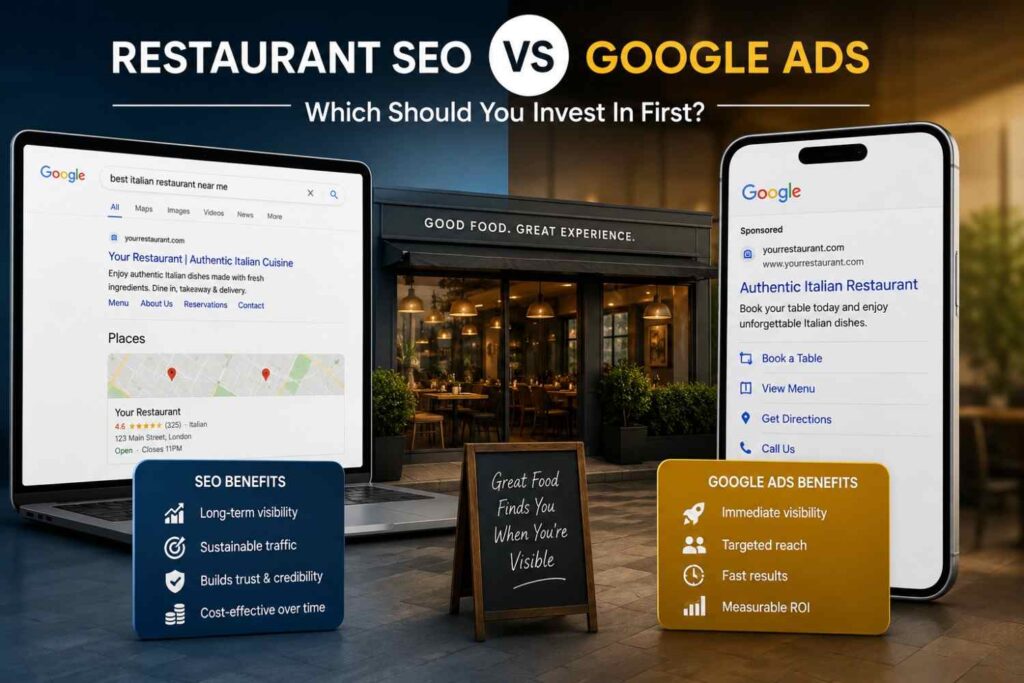
A restaurant looking to grow on Google has two obvious options.
Build organic visibility through SEO, or pay for visibility through Google Ads.
The problem is that this framing makes the decision sound simpler than it really is. SEO and Google Ads can both bring customers from search, but they work on different timelines and give a business different levels of control.
For a new restaurant, immediate visibility may matter more than long-term organic growth. An established restaurant with strong search demand may have more to gain from building an asset it can keep benefiting from. And in many cases, the strongest approach is to use both—provided each has a clear role.
So the better question isn’t “SEO or Google Ads?”
It’s “What kind of search demand are we trying to capture, and what is the best way to capture it?”
SEO and Google Ads Solve Different Problems
Google Search brings together several ways for a business to become visible.
Organic results are earned through search relevance, useful content, technical quality, authority and other signals. Google Ads gives advertisers a way to appear in paid placements when people are actively searching for relevant products or services.
For a restaurant, the distinction is important.
SEO takes time, but the work can strengthen the website and its organic presence over the long term. Google Ads can provide much faster access to searches that matter, with control over budget, targeting and campaign objectives.
Neither is automatically the better investment.
The right choice depends on what the restaurant needs now.
Start With What Customers Are Searching For
Before deciding where to spend money, understand the demand.
A customer might search for a cuisine, a particular dish, a restaurant in a neighbourhood, a takeaway option, a dietary requirement or somewhere suitable for a specific occasion. They might search for the restaurant by name when they are already familiar with it.
Those searches carry different levels of intent.
Someone looking for “Italian restaurant in Soho” is exploring options. Someone searching for “[restaurant name] menu” is much further along. A query such as “Italian restaurant Soho booking” contains an even clearer signal that the person may be ready to act.
That distinction matters for both SEO and paid search.
The job isn’t simply to collect keywords. It is to understand the relationship between the restaurant, its location, cuisine, offerings and the reason someone is searching.
That gives us a better basis for deciding which demand should be built organically and which demand is worth paying to capture immediately.
When SEO Deserves the Investment
SEO tends to make more sense when there is a foundation worth building on.
An established restaurant may already have a website, customer reviews, local recognition and consistent demand around its cuisine or location. In that situation, improving organic visibility can create a valuable long-term channel rather than making the business dependent on paid clicks.
Restaurant SEO also extends beyond publishing blog posts.
The important commercial signals may sit much closer to the business itself: the restaurant’s location, cuisine, menu, services, website, reviews and local presence all contribute to how clearly the business can be understood.
Google says local results are primarily influenced by relevance, distance and prominence, with complete and accurate business information helping Google understand which businesses are relevant to a search.
That is why good restaurant SEO is less about chasing a long list of keywords and more about building a strong, coherent digital presence around the actual business.
When Google Ads Makes More Sense
Paid search becomes particularly useful when timing matters.
A new restaurant opening next month doesn’t have the luxury of waiting for an organic strategy to mature. The same can apply to a new location, a seasonal promotion, a quieter trading period or a service the restaurant wants to push quickly.
Google Search campaigns can reach people actively searching for relevant products and services, while local advertising can also help businesses appear across Google Search and Maps and drive actions such as calls, directions and website visits.
That speed and control come at a cost, of course.
The restaurant is paying for access to that demand, so the campaign needs to make commercial sense. A good-looking click-through rate means very little if the resulting traffic rarely books, orders or visits.
The Decision Should Come Down to Economics
Traffic is only one part of the equation.
Suppose two campaigns each generate 100 visits. One produces two orders and the other produces ten. The traffic report may look similar, but the commercial value is clearly different.
That difference could come from search intent, the offer, the landing page, the ordering experience or the quality of the audience being reached.
For a restaurant, I would look at metrics such as:
- Average order value
- Conversion rate
- Customer acquisition cost
- Gross margin
- Repeat purchase rate
- Customer lifetime value
These numbers put the channel decision into context.
A restaurant with healthy margins and strong repeat business may be able to justify a higher acquisition cost than one with low order values and little repeat behaviour.
That is why there is no universal “ideal” SEO-to-Ads budget split.
The economics of the business should influence the marketing mix.
Search Visibility Doesn’t Happen in One Place
Another reason the SEO-versus-Ads debate can become misleading is that customers don’t experience search as a neat collection of marketing channels.
A restaurant may appear through its website, Google Business Profile, Maps, paid search, reviews, images or third-party platforms.
The customer simply sees the business.
Google also explains that information in local listings can come from multiple sources, including the business’s official website, third-party data, user contributions and Business Profile information.
That makes consistency important.
If the website says one thing about the restaurant’s cuisine, the profile says another and the ordering experience creates a third impression, no advertising strategy can completely solve that disconnect.
The business needs to make sense wherever the customer encounters it.
Where SEO and Google Ads Work Better Together
There is a strong case for using both channels when their roles are clearly defined.
SEO can build the restaurant’s organic presence around valuable search themes. Google Ads can provide immediate visibility for searches that are commercially important or particularly competitive.
Paid search can also provide useful market feedback. Campaign data can reveal which searches attract attention, which messages generate stronger engagement and which landing pages perform well. Those insights can help shape wider marketing decisions.
At the same time, stronger organic visibility can reduce the need to rely on paid traffic for every relevant search.
The goal isn’t to make SEO and Google Ads fight over the same space.
Give each channel a job.
Your Google Business Profile Still Matters
Neither SEO nor Google Ads replaces the restaurant’s Google Business Profile.
For organic local visibility, the profile contributes to the information Google uses to understand the business and match it with relevant searches. For paid local advertising, linking a Business Profile with Google Ads can provide location information and support local ad formats across Google surfaces.
That makes the profile part of the wider search ecosystem rather than a separate task sitting inside a marketing checklist.
The restaurant should be recognisable and accurately represented whether someone discovers it through an organic result, an advertisement or a local listing.
What Changes With AI Search?
Search is becoming more conversational, but that doesn’t mean restaurants need a separate collection of “AI SEO tricks.”
Google’s current guidance says there are no special technical requirements or separate AI optimisation techniques needed to appear in AI features. Its guidance continues to emphasise strong SEO fundamentals, useful original content and clear information, while also highlighting the value of local, visual and non-commodity content.
For a restaurant, that means the basics become even more valuable.
Can your digital presence clearly communicate what the restaurant is, where it is, what it serves, what makes it distinctive and what customers can do next?
A clear business entity is easier for people to understand—and useful information is easier for modern search experiences to work with.
AI visibility starts with clarity, not a shortcut.
So, Which One Should You Choose?
There isn’t a universal answer.
Choose SEO first when…
The restaurant has established demand, useful digital assets and enough time to build organic visibility. There is a genuine opportunity to create pages and information that can continue attracting relevant searches over time.
Prioritise Google Ads when…
The business needs immediate exposure, is launching something new, has a time-sensitive offer or wants greater control over the searches and locations it is targeting.
Use both when…
There is enough demand and budget to pursue immediate opportunities while also building a stronger organic presence for the future.
And sometimes the right answer is to fix something else first.
If the website is difficult to use, the menu is buried, conversion tracking is unreliable or the ordering process creates unnecessary friction, sending more traffic into the same experience won’t solve the underlying issue.
Find the constraint before increasing the volume.
A Practical Way to Make the Decision
Before committing to either channel, look at five things.
1. Is there enough relevant search demand?
If customers aren’t searching for what you offer, buying more search visibility won’t create demand that doesn’t exist.
2. How quickly do you need results?
A new restaurant with an opening date has a different problem from an established restaurant planning its next three years of growth.
3. What is a new customer worth?
Know your average order value, margins and repeat purchase behaviour before deciding what customer acquisition can reasonably cost.
4. Can the website convert the traffic?
Search visibility only gets the customer to the door. The website, menu, offer and ordering experience still have to do their part.
5. What are you trying to build?
If you need immediate demand, paid search may deserve more attention. If you’re building a durable organic presence, SEO needs consistent investment. If both objectives matter, don’t force one channel to do the other’s job.
The Better Strategy Isn’t Always More Traffic
A restaurant can increase its advertising budget, publish more content and target more search terms without seeing meaningful growth.
The problem may be elsewhere.
Perhaps the wrong customers are being reached. Perhaps the offer isn’t strong enough. Perhaps the website makes ordering harder than it should be. Or perhaps the restaurant has valuable search demand but isn’t visible for the right queries.
Good marketing starts by finding that gap.
Once you know where the opportunity is, the choice between SEO and Google Ads becomes much easier.
Build the visibility you want to own. Pay for the opportunities you need now.
Frequently Asked Questions
Is SEO better than Google Ads for restaurants?
Neither is universally better. SEO is a longer-term investment in organic visibility, while Google Ads can provide faster and more controllable access to relevant searches. The right choice depends on the restaurant’s goals, demand and economics.
How long does restaurant SEO take to work?
There is no reliable fixed timeframe. Competition, existing authority, technical quality, content, local relevance and the strength of the website all influence how quickly organic visibility develops.
Are Google Ads worth it for a new restaurant?
They can be useful when a new restaurant needs immediate visibility, particularly around an opening or specific offer. The decision should ultimately be based on the cost of acquiring customers and the value those customers generate.
Can SEO and Google Ads be used together?
Yes. In many cases, they complement each other well. Paid search can capture immediate opportunities while SEO builds organic visibility that can become increasingly valuable over time.
Should a restaurant run Google Ads if it already ranks organically?
Not necessarily. It depends on the search term, competition, incremental value of the paid placement and the economics of acquiring another customer. Organic visibility doesn’t automatically mean paid search is unnecessary, but it should make the decision more deliberate.
Final Thoughts
The SEO-versus-Google-Ads debate is often presented as a choice between two marketing channels.
For a restaurant, it is better understood as a question of timing, demand and economics.
SEO can help build an organic presence that becomes more valuable over time. Google Ads can put the business in front of relevant searches when speed and control matter. A strong local presence can support both.
The best strategy is rarely about choosing the channel with the loudest promise.
It is about understanding where the next customer is coming from—and deciding how much it makes sense to invest in reaching them.